


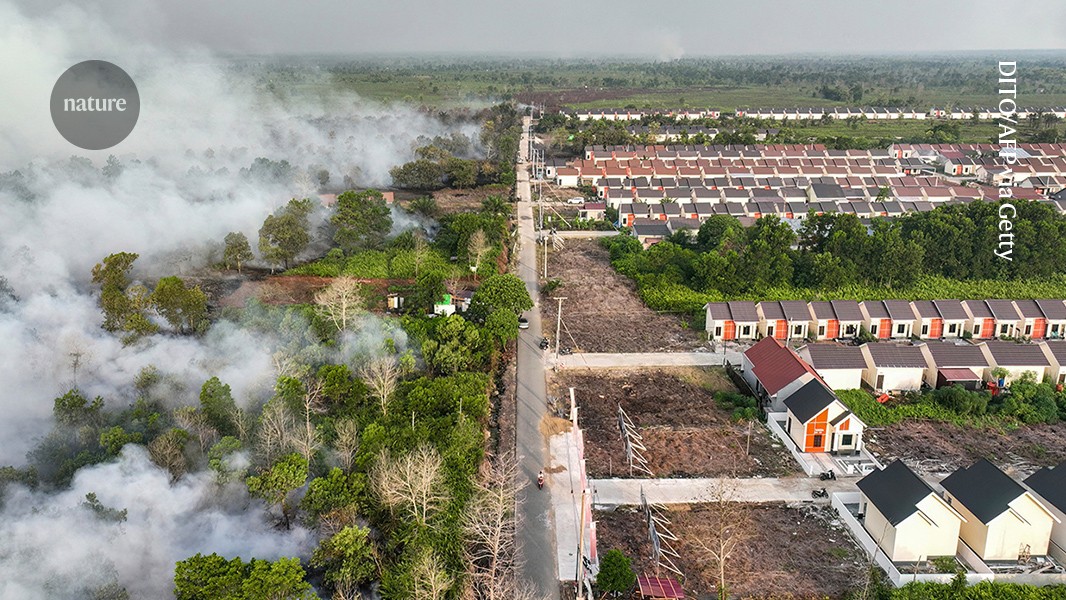
Wildfires in Indonesia this year, including a blaze that began beside an apartment complex in Kubu Raya, may have been intensified by a strong El Niño event.
Credit: DITO/AFP via Getty
For Julia Cole, a paleoclimatologist who studies Earth’s climate history using corals, the strong El Niño developing in the Pacific Ocean is no surprise. Her research suggests that the event may form part of a century-long pattern in which powerful El Niño episodes are becoming more frequent as human-caused global warming continues. “I don’t think it was a fluke,” she says.
Cole and her colleagues reached this conclusion by reconstructing eastern Pacific sea-surface temperatures during the pre-industrial millennium. Their study, published today in Science1, used coral skeletons from the Galápagos Islands to show that strong El Niño events have occurred more often during the past century than during the 1,000 years before anthropogenic greenhouse-gas emissions began driving global warming.
Many climate models indicate that the increase in strong El Niño events could continue throughout this century. These naturally occurring climate events can temporarily raise global average temperatures and alter weather patterns worldwide, creating serious risks for ecosystems, communities and economies. “We need to think about how to better prepare for these events so that they don’t become catastrophic for us,” says Cole, who is based at the University of Michigan in Ann Arbor.
However, the complex ocean–atmosphere interactions that produce El Niño make future projections uncertain. “Corals give us a time machine to look back into the past,” Cole says. “They don’t give us a time machine to see the future.”
Pacific climate cycle
El Niño is the warm phase of the El Niño–Southern Oscillation (ENSO), a natural cycle that alternates between unusually warm and cool conditions in the tropical Pacific Ocean. An El Niño event developed in the Pacific in June this year. Forecasts suggest it could become one of the strongest on record and the third major El Niño in just 11 years — a sequence that has not previously been observed.
The event has renewed a long-running debate over whether human-caused climate change is making El Niño episodes more frequent or more intense.
Researchers have struggled to resolve this question for several reasons. Climate models do not yet fully capture the complex feedbacks between winds, ocean temperatures and water movement that drive ENSO. In addition, reliable temperature records from remote parts of the tropical Pacific are scarce before the twentieth century, making it difficult to determine how the climate cycle behaved before human-driven warming.
Tracking the heart of El Niño
Paleoclimatologists are extending the historical ENSO record by studying natural climate proxies, including tree rings and marine fossils. Corals are especially valuable because their growth patterns can record monthly changes in ocean conditions, allowing researchers to identify short-lived events such as El Niño.
Coral records from the central Pacific indicate that strong El Niño events have become more frequent in recent decades. Until now, however, scientists have lacked sufficient records from the eastern Pacific, where El Niño reaches its greatest intensity. That has left the overall long-term trend uncertain. Julien-Emile Gay, a paleoclimatologist at the University of Southern California in Los Angeles, compares the challenge to a doctor trying to measure a patient’s heart rate with a stethoscope placed on the ankle.
The Galápagos Islands, located in the eastern Pacific, are ideally positioned to record the “center of El Niño,” Cole says. Yet the region’s extreme ocean conditions mean that very few corals are able to grow there.
Source: www.nature.com