


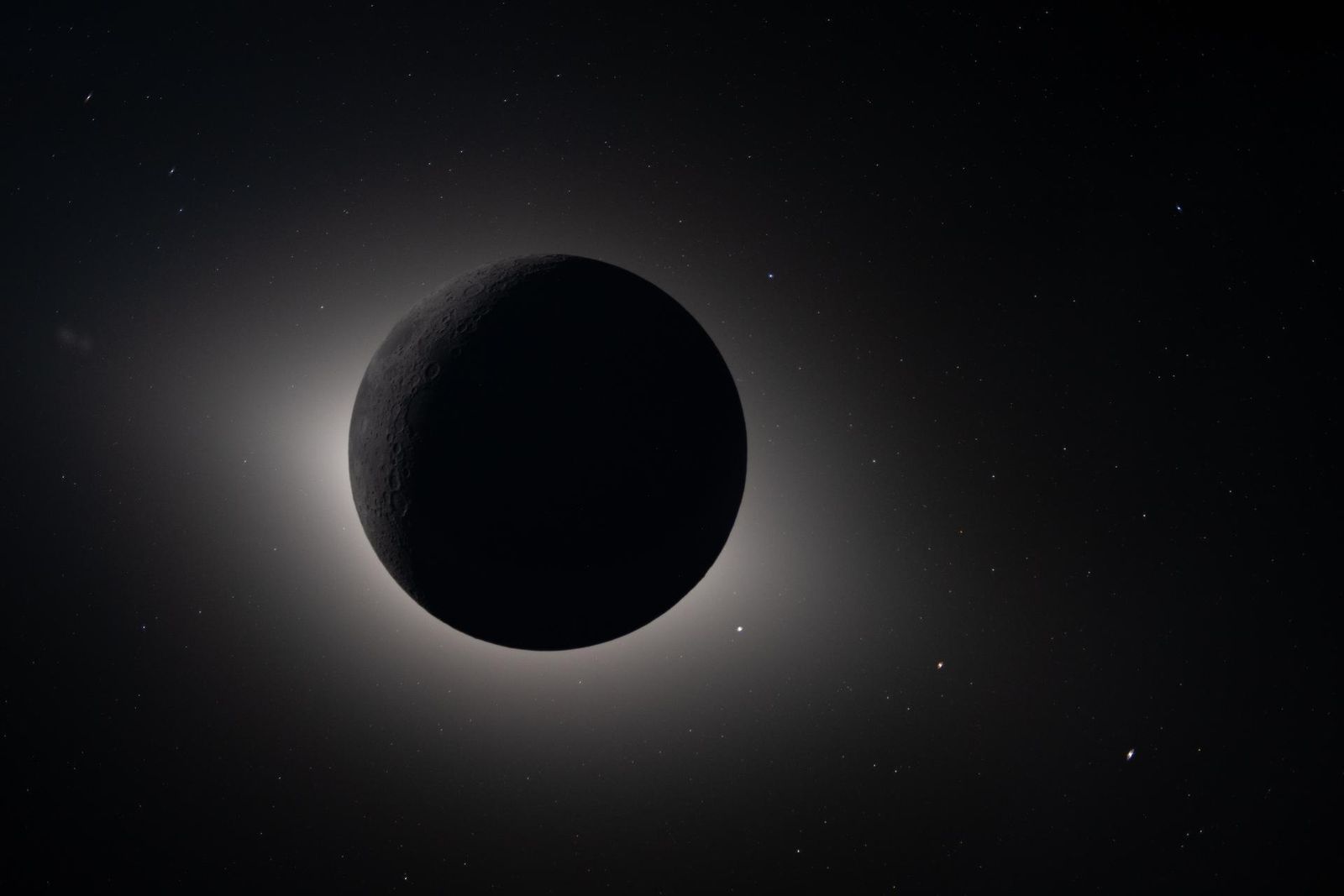
Artemis II astronauts captured a rare total solar eclipse from near the Moon, giving scientists an unusual view of the solar corona and the dusty environment surrounding the Sun.
:focal(960x640:961x641)/https://tf-cmsv2-smithsonianmag-media.s3.amazonaws.com/filer_public/25/62/2562045d-82e2-464d-8843-0e06165e4b09/art002e009301large.jpg)
NASA
On April 6, 2026, the sixth day of NASA’s Artemis II mission, four astronauts traveled around the far side of the Moon—farther from Earth than any humans had gone before. About 70 minutes after emerging from lunar orbit, the crew witnessed a rare celestial event: a total solar eclipse from close to the Moon.
As the Moon moved between the spacecraft and the Sun, the astronauts removed their eclipse glasses. “It was like there was a hole in the universe,” NASA astronaut and Artemis II pilot Victor Glover told Smithsonian magazine. “Where the Moon was, it had disappeared.”
For nearly 54 minutes, the astronauts watched the otherworldly eclipse through the windows of the Orion spacecraft. They photographed the event and recorded observations that scientists say could improve understanding of the Sun’s outer atmosphere and the dust that surrounds it.
“As my eyes adjust, the black hole begins to return to the Moon,” Glover recalled. “The western edge of the Moon begins to shine blue. … That’s it.” The faint blue glow was earthshine, sunlight reflected from Earth and cast onto the lunar surface.
The view was so surreal that Glover compared it to science fiction.
“If a big rocket engine came out of the back and it became the Death Star and flew away, it would only be about 1 percent more alien,” he said.
/https://tf-cmsv2-smithsonianmag-media.s3.amazonaws.com/filer_public/e3/2b/e32b4c61-d833-43d4-bd0c-bc88d3360274/art002e016204large.jpg)
NASA
A rare view of a total solar eclipse from space
The total solar eclipse was a fortunate coincidence. NASA’s Artemis program experienced repeated delays, and the mission’s launch date was not originally selected to observe an eclipse. However, after Artemis II launched on April 1, the spacecraft’s trajectory placed it in the right position to see the Moon block the Sun.
The view was dramatically different from a total solar eclipse seen from Earth. From our planet, the Sun and Moon appear nearly the same size in the sky. The Artemis II astronauts, however, were only about 5,400 miles from the Moon when totality began. At that distance, the Sun looked much smaller than the lunar disc.
“You can see a very small but very intense disk of light traveling behind this huge curved edge,” Glover said.
The astronauts used eclipse glasses similar to those worn by observers on Earth. During totality, they could see craters along the Moon’s dark surface, as well as stars shining through the faint light around the lunar disc.
“While the Sun was behind the Moon, it was—I don’t know a good word to describe it—creepy and spooky,” Glover said.
Their experience echoed that of the Apollo 11 astronauts. In 1969, while traveling to the Moon, Buzz Aldrin and his crewmates passed through the shadow of a total solar eclipse. Aldrin described it as “a truly eerie sight” in a radio transmission to mission control on July 19, 1969.
Both Apollo 11 and Artemis II astronauts also had an unobstructed view of the solar corona—the Sun’s wispy outer atmosphere, which is normally hidden by the star’s intense brightness.
“It’s that three-dimensional feel that you can’t really recreate in photos,” Glover said. “The depth of the corona was amazing, and because of our relative motion, it even seemed like it was moving.”
/https://tf-cmsv2-smithsonianmag-media.s3.amazonaws.com/filer_public/ca/b6/cab6f34d-bfc8-4534-84a2-7fd5186c462f/art002e010782large.jpg)
NASA
/https://tf-cmsv2-smithsonianmag-media.s3.amazonaws.com/filer_public/e3/0d/e30db2df-27fa-40a1-b4fa-5e0361e2ea17/art002e009299large.jpg)
NASA
Michael Kirk, a solar scientist at NASA’s Goddard Space Flight Center, says the dynamic view of the corona could provide valuable scientific data.
“Currently, almost all observations of the solar corona are from the Sun-Earth line,” Kirk said. “Artemis is a really exciting next step. We’re getting images of the Sun from a perspective just a few steps away from our typical viewpoint. That will be extremely valuable when trying to tease out complex structures.”
Total solar eclipses provide scientists with an opportunity to study the corona and powerful activity on the Sun. Researchers can observe features such as solar prominences, which are tendrils of plasma extending from the Sun’s surface, and coronal mass ejections, which send charged particles and magnetic fields into space.
A better understanding of these phenomena could reveal how solar activity affects Earth’s atmosphere, satellites and spacecraft. As NASA prepares for future crewed missions to the Moon, monitoring space weather will also be essential for protecting astronauts.
“How do small disturbances in the Sun come out? What changes when the solar wind reaches Earth? And how can we predict it?” Kirk asked. “All of those questions remain open.”
Scientists also study the solar atmosphere with coronagraphs, instruments that artificially block the Sun’s bright surface. But a total solar eclipse remains unmatched because the Moon can block more sunlight than even advanced instruments can remove.
“When a solar eclipse occurs, you have the opportunity to see the lower layers of the solar atmosphere that are normally invisible, even with current technology,” said Laura Hayes, a solar physicist at the Institute for Advanced Studies in Dublin.
Artemis II eclipse images reveal clues about solar dust
The Artemis II eclipse images were taken with a handheld camera, but the observations are already helping scientists study the environment around the Sun. In a recent study, researchers examined the F-corona, a faint glow produced when sunlight reflects off dust near the Sun.
“It is zodiacal light—the same cloud of interplanetary dust that produces the faint glow sometimes seen in the night sky after sunset and before sunrise,” said Koji Tsumura, a researcher at Tokyo City University and an author of the study.
The analysis found that the F-corona observed by Artemis II was rounder than expected. The dust surrounding the Sun appears to be less concentrated in the flat plane of the solar system than some models predict.
“One of the long-standing questions in planetary science is where the zodiacal light and the dust that causes the F-corona come from,” Tsumura said. “The leading idea is that it is produced either by collisions between asteroids or by material ejected from comets. Once produced, the dust gradually moves inward toward the Sun.”
/https://tf-cmsv2-smithsonianmag-media.s3.amazonaws.com/filer_public/fd/e3/fde34605-5185-462f-9511-b1cf34d7b394/art002e009298large.jpg)
NASA
Some parts of this process remain unexplained. Existing models of the F-corona do not fully account for the rounded structure seen in the Artemis II images. Tsumura suggested that another mechanism may lift or stir dust away from the central plane as particles move toward the Sun.
“By studying how dust moves, evolves and is ultimately removed near the Sun, we can learn more about the circulation of matter within the solar system and the physical processes that shape entire planetary systems,” he said.
The level of detail visible in the Artemis II photographs surprised researchers and demonstrated the scientific value of eclipse images taken from near the Moon—even when those images come from a simple handheld camera.
“The important thing about this study is that it shows you can do some really amazing science using a handheld camera from a window,” Hayes said.
Artemis II astronauts become ambassadors of wonder
/https://tf-cmsv2-smithsonianmag-media.s3.amazonaws.com/filer_public/18/e4/18e4a313-e90d-423d-a84c-6b9aa8b5bd8b/art002e009302large.jpg)
NASA
Beyond its scientific importance, the Artemis II solar eclipse gave researchers and the public a moving glimpse of human exploration. Solar scientists Kirk, Hayes and Tsumura said the astronauts’ experience offered an opportunity to study the Sun while sharing a powerful moment with people around the world.
“There’s an element of absolute beauty and awe,” Kirk said. “I’ve seen the Moon a thousand times, a hundred thousand times. I’ve seen solar eclipses a dozen times, including total and annular eclipses. But seeing this was completely different and truly breathtaking, because it’s rare to see something so familiar and so far away at the same time.”
“It made it feel real,” Hayes said. “It’s like, ‘Wow, this is what I see outside my window.’ That made it more human for me.”
“My first reaction was simply surprise,” Tsumura said.
For Glover, sharing the experience is central to the purpose of exploration.
“If there’s one thing this mission tells us, it’s that wonder and awe exist, whether we can see it or not,” Glover said. He hopes the Artemis II crew can serve as “ambassadors of that wonder.”
“The magic of seeing something so moving is not something that just the four of us can share,” he said. “Hopefully, we can give people a way to connect with that wonderful thing.”
Source: www.smithsonianmag.com