


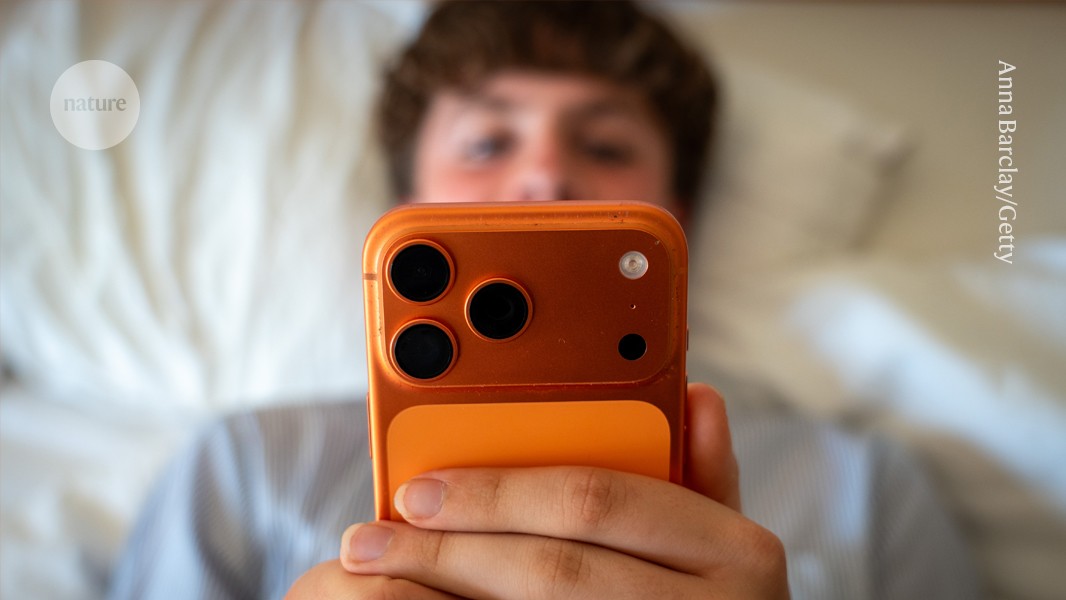
Under a legal settlement, teenagers in the United States will face time limits on their use of certain social media platforms.
Credit: Anna Barclay/Getty
Meta has agreed to pay up to $18 billion to U.S. states and introduce new safeguards on Facebook and Instagram, settling a lawsuit over whether its platforms contribute to poor mental health among children and teenagers. The agreement raises an important question: how effective will these changes be in protecting young people from the potential harms of social media?

Is social media addictive to teens? US court weighs in on scientific debate
The August 26 settlement is legally binding only in the United States. It is also the latest in a growing number of international efforts to limit children’s exposure to harmful social media use. In the coming months, U.S. Facebook and Instagram users under 18 are expected to receive new account restrictions, including a two-hour daily usage limit and a block on access between midnight and 6 a.m. Some of these restrictions can be disabled only with permission from a parent or guardian.
Scientists continue to debate how social media affects teenagers’ mental health and whether platform restrictions can be effectively implemented. Australia, for example, introduced a ban on social media use for children under 16. However, three months later, a survey of about 900 parents by the country’s internet-safety regulator found that nearly seven in ten respondents said their child still had an account on at least one major social media platform.
Kathryn Modeki, a psychologist at the University of Western Australia in Perth, is studying the effects of social media restrictions in Australia. Xiaoran Sun, a psychologist at the University of Minnesota in Minneapolis, researches how teenagers and parents use social media. Nature spoke with both researchers about the potential effects of the Meta settlement and the proposed changes to Facebook and Instagram.
What do you think about the Meta settlement and its proposed changes?
Sun: There is still significant work to do, and we should not become complacent. However, I see the settlement as an important step forward and I am encouraged by it.
Modeki: My concern is that people may assume young people are now safe. Many experts would disagree with that conclusion. It is important to recognize the effort involved in reaching this decision and the progress that has been made.
At the same time, the platform company continues to define what counts as harm and how the problem should be addressed. We are taking a selective approach to a complex issue. The outcome might look different if we stepped back and asked: “What would social media look like if the goal were to make it safer for everyone, including parents with limited digital literacy and children who are less engaged with online services?”
People often ask whether Australia’s social media ban is working. My response is that we should also ask a broader question: “How can we make social media safer and healthier for everyone, including children?”
Can social media screen-time limits improve children’s mental health?
Modeki: Recent research has generally not focused only on total screen time. If the aim is to improve online safety, simply imposing surface-level time limits is unlikely to be enough. Greater attention should be paid to the algorithms that determine which content teenagers see.
Meta has agreed to let users under 18 turn off algorithms that target them with content, but those algorithms will remain enabled by default. That means the setting is opt-out rather than opt-in.
Australia’s world’s first social media ban is a ‘natural experiment’ for scientists
The safer approach would be to make algorithmic personalization opt-in, rather than requiring teenagers to disable it themselves. If platforms were genuinely prioritizing child safety, the least protective setting would not be the default.
Sun: My colleagues and I published research in JAMA Pediatrics1. The study used data from teenagers’ smartphones to measure both their overall social media use and the time they spent on individual apps.
Instagram was the most-used social media platform by the median participant, but teenagers spent only about 13 minutes per day on it. Their median total social media use across all platforms was approximately 80 minutes per day. In that context, I question whether the two-hour daily limit proposed by Meta is the most effective way to reduce potential harm.
Restricting access to social media apps, particularly overnight, could nevertheless be a positive step. Research indicates that social media use can interfere with teenagers’ sleep. Poor sleep is associated with worse mental health, reduced concentration and lower academic performance.
Source: www.nature.com