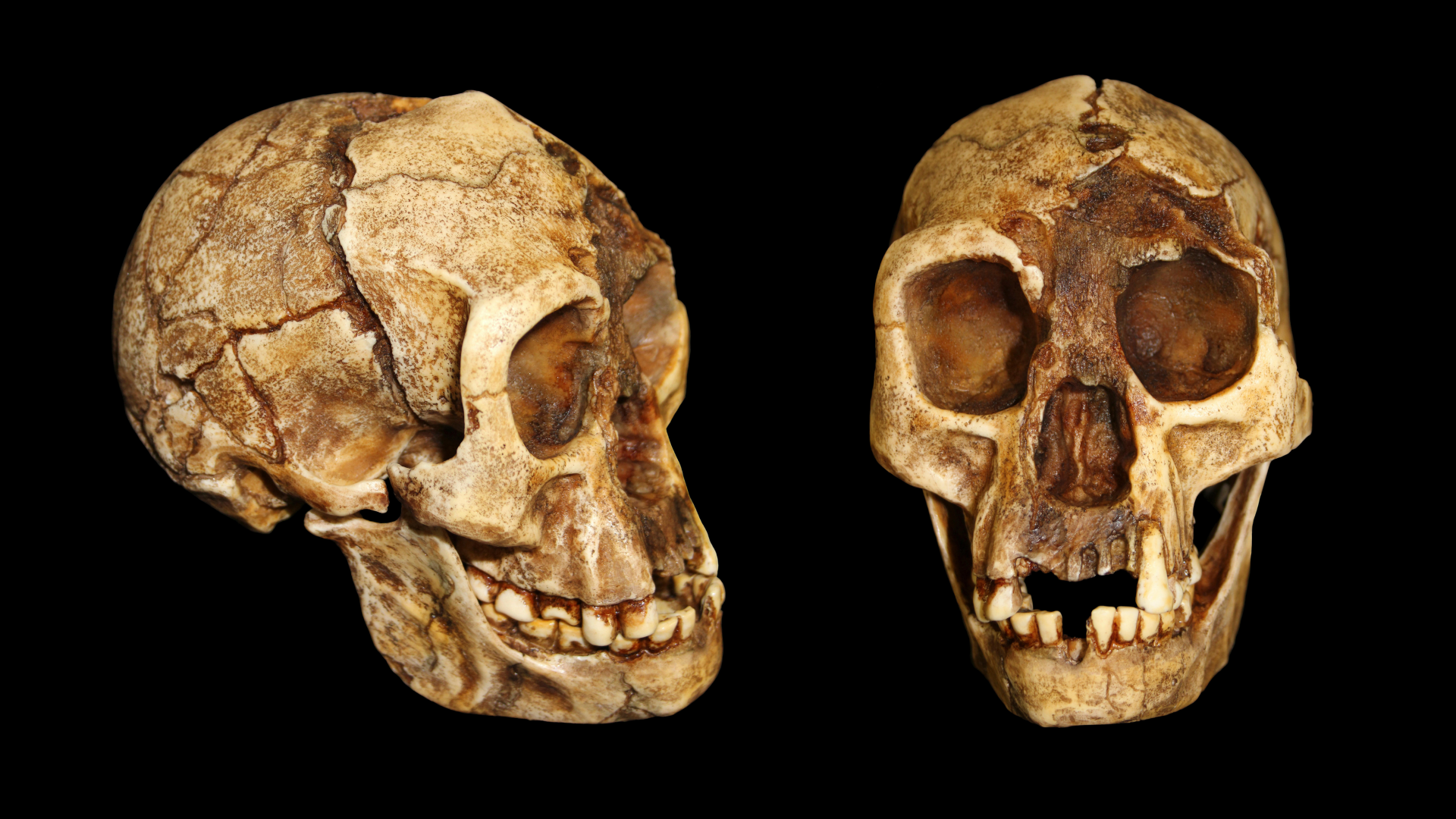
Homo floresiensis: The Hobbit’s Hip Bones Reveal How It Walked
The extinct human relative Homo floresiensis, often called the “hobbit,” may have walked upright in a more human-like way than previously believed. However, researchers say its short, unusual body was probably not built for fast walking or long-distance travel.
A new analysis of the hobbit’s pelvic bones suggests that Homo floresiensis was a capable biped, although its walking style was probably less efficient than that of modern humans. The findings offer new clues about how this mysterious species moved—and deepen the debate over its evolutionary origins.
“If we only use the hip bone as a reference, Homo floresiensis generally appears similar to humans and other members of the genus Homo. It probably could move in a human-like way,” Kristi Lewton, a biological anthropologist at the University of Southern California, told Live Science.
Even so, Homo floresiensis was unlikely to be a particularly fast biped. Its anatomy suggests that the species may not have traveled long distances and could have retained some climbing or arboreal abilities.
From the latest videosLive Science
Lewton and her colleagues examined the pelvic bones of LB 1, an adult female Homo floresiensis who stood approximately 3.5 feet (1 meter) tall. LB 1 lived on the Indonesian island of Flores between about 100,000 and 60,000 years ago.
The researchers searched the pelvis for anatomical features that could show whether the hobbit moved more like modern humans, other Pleistocene hominins or earlier species such as Australopithecus, including the famous “Lucy” specimen.
The study was published Aug. 25 in the American Journal of Biological Anthropology.
Since Homo floresiensis was discovered in 2003, scientists have debated why the species was so small and which earlier human relative it evolved from. The hobbit skeleton combines human-like and more primitive features. Its hand bones, for example, resemble those of Australopithecus, while parts of its shoulder and upper arm appear more similar to humans.
One important feature is the shape of the ilium, the broad upper portion of the hip bone. Scientists measure how far the ilia flare outward from the center of the body, a characteristic known as iliac flare.
A pronounced iliac flare is often associated with australopithecine anatomy and less mechanically efficient upright walking. However, previous methods for measuring iliac flare in fossil hominins have produced inconsistent results, making it difficult to determine how the hobbit moved.
For the new study, the researchers compared LB 1’s pelvis with the hip bones of chimpanzees, gorillas, Australopithecus, living humans and extinct human species. By developing a standardized measurement for iliac flare and combining it with other pelvic dimensions, they found that LB 1’s pelvis was statistically similar to other Pleistocene hominins, including Homo erectus, rather than to apes or Australopithecus.
“These results suggest that Homo floresiensis was likely a bipedal creature very similar to humans,” the researchers wrote in their study.
That does not mean the hobbit walked exactly like modern humans. The shape of its pelvis indicates that it may have been less efficient at walking, moved more slowly and avoided long-distance travel. The species may also have retained some ability to climb trees, researchers said.
Caley Orr, a paleoanthropologist at the University of Colorado Denver who was not involved in the study, said the findings are consistent with earlier research on fossil pelvises.
“The study also found that LB 1’s pelvis was almost human-like,” Orr told Live Science, while noting that the results do not yet resolve the question of where the hobbit came from.
The new research highlights the considerable variation in the size and shape of early human skeletons. However, the meaning of those differences for the origins of Homo floresiensis remains uncertain.
Although Lewton and her colleagues analyzed only part of the hobbit skeleton, their results are compatible with two leading theories about the species’ evolution.
One possibility is that Homo floresiensis evolved from a population of Homo erectus that reached Flores and gradually became smaller through island dwarfism. This evolutionary process, known as insular dwarfism, has occurred in other large mammals living on isolated islands.
Another theory is that Homo floresiensis descended from an earlier, smaller-bodied human relative that reached Flores before Homo erectus. Under this scenario, the hobbit’s small size would not have evolved from a large-bodied ancestor on the island.
Future genetic research and the study of ancient proteins could help determine which theory is correct. For now, however, the precise evolutionary history of the hobbit remains one of paleoanthropology’s most intriguing unanswered questions.
KL Luton, AS Hammond, N Alamshah, S Norwidi, T Stichna, MM Skinner, MW Toceli (2026). Comparative morphometric analysis of the pelvis of LB 1 (Homo floresiensis). American Journal of Biological Anthropology.
Find out how much you know about early humans with our tool: Take the human evolution quiz!