


Biomedical Engineering Research: China Leads as South Korea, Canada, Switzerland and the Netherlands Gain Ground
The Nature Index shows rapid growth in biomedical engineering research. Between 2021 and 2025, the number of papers related to the field increased by 70%—faster than the growth of the overall database. Biomedical engineering also grew as a share of all articles in the database, rising from 2.4% to 2.7%.
As the field expanded, the research landscape changed. Countries’ relative contributions shifted alongside new patterns of international collaboration and research specialization.
The most significant trend is biomedical engineering’s decisive shift toward China. From 2021 to 2025, China’s contribution to global output increased from 28.9% to 50.9%. Biomedical engineering accounted for 2.8% of China’s total Nature Index output in 2021, rising to 3.5% in 2025.
The United States and Germany remained in second and third place, respectively, throughout the period. Their focus on biomedical engineering remained relatively stable, accounting for approximately 2.3% to 2.5% of their total output.
This analysis examines the other four countries in the top 10 in 2025. Their performance in biomedical engineering reveals several more nuanced trends.
South Korea has maintained its top-five position by developing strong expertise in biomedical engineering. Switzerland has used private-sector research and international collaboration to remain a leading European center. Canada is one of the fastest-growing countries in the field, while the Netherlands has experienced slower growth but maintains a highly international research network.
South Korea: A Biomedical Engineering Specialist
Leading university in biomedical engineering, 2021–25: Yonsei University
Most-cited paper, 2021–25: “Ultra-strong, ultra-stiff, and conductive alginate hydrogels” (2022)1
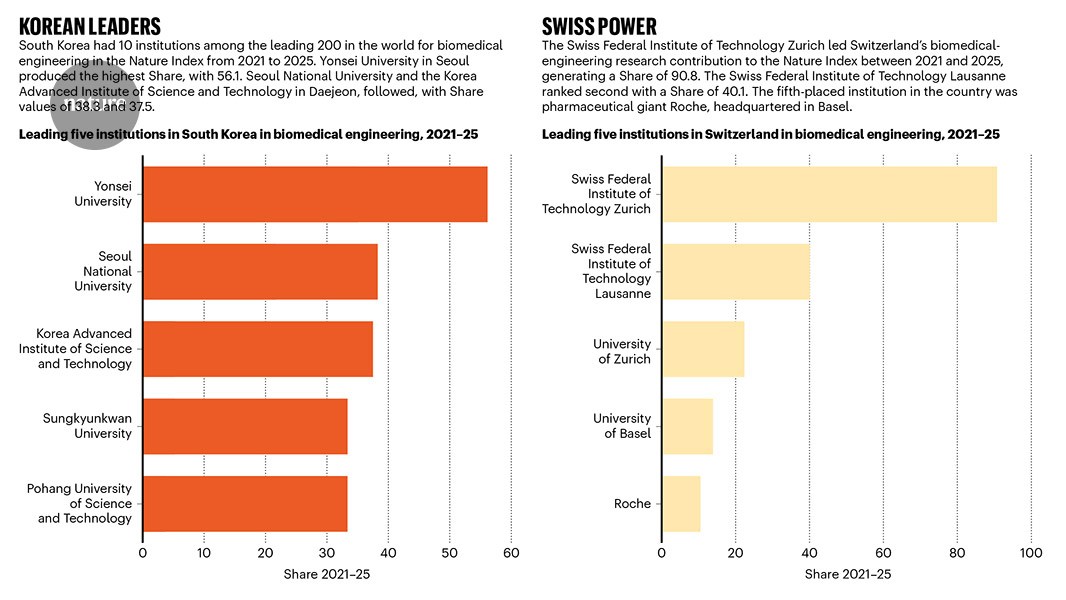
South Korea is an outlier among the leading biomedical engineering countries in the Nature Index. Research in the field accounts for 4.8% of the country’s total database output from 2021 to 2025—the highest proportion among the 25 major countries.
South Korea is also less dependent on international collaboration than the other three countries discussed in this article. Just over half of its biomedical engineering papers from 2021 to 2025 were co-authored by researchers outside the country.
Nature Index 2026 Biomedical Engineering
This clear specialization has helped South Korea establish itself as one of the five largest contributors to biomedical engineering. The country consistently ranks fourth in field-specific share—three places higher than its overall Nature Index ranking. It was also the third-fastest-growing country in the sector between 2021 and 2025.
South Korea’s most-cited biomedical engineering paper during this period was produced by researchers from Sungkyunkwan University in Seoul and published in Nature Communications.1 Published in 2022, the paper describes the development of highly strong and conductive seaweed-derived hydrogels.
The paper had received approximately 450 citations by July 2026, although it was not as highly cited as the leading papers from the other three countries featured here. Several factors may explain this difference. One possible factor is that the paper was authored by researchers from a single institution, whereas other highly cited papers included researchers from multiple institutions and locations.
Canada: Rapid Growth in Biomedical Engineering Research
Leading university in biomedical engineering, 2021–25: University of Toronto
Most-cited paper, 2021–25: “Proximity-dependent biotinylation map of human cells” (2021)2
Canada’s share of the biomedical engineering field increased by approximately 60% between 2021 and 2025. This was the second-largest increase among the 10 major countries, behind China.
Most of Canada’s growth occurred between 2021 and 2022, when its share increased by 51% in a single year. Part of this increase may be linked to the addition of health-science journals to the database in 2022. However, these new journals increased the overall Nature Index by 13%, suggesting that Canada still performed strongly in biomedical engineering that year.
Unlike South Korea, Canada’s growth does not appear to be associated with a high degree of specialization. Biomedical engineering remained a relatively small focus within Canada’s overall Nature Index output, accounting for approximately 2.3% of its total share from 2021 to 2025.
Canada’s broad-based growth coincided with significant life-sciences funding intended to address the country’s declining research and biological-production capacity. The federal government identified this decline as one reason Canada was unable to produce its own coronavirus vaccine.
In its 2021 budget, the federal government allocated C$2.2 billion (US$1.6 billion) to the Biomanufacturing and Life Sciences Strategy over seven years. The funding supports a combination of life-sciences and biomanufacturing companies, research institutes and universities.
Canada’s most-cited biomedical engineering paper in the Nature Index from 2021 to 2025 was produced by researchers based at the Lunenfeld-Tanenbaum Research Institute in Ontario, the University of Toronto and McGill University in Montreal.2 Published in Nature in 2021, the study showed how researchers created a detailed map of human cells by placing molecular markers throughout the cell.
Switzerland: Private-Sector Research Supports Global Standing
Leading university in biomedical engineering, 2021–25: Swiss Federal Institute of Technology Zurich
Most-cited paper, 2021–25: “Tissue shape drives deterministic organoid patterning” (2022)3
Switzerland’s biomedical engineering share rose from 41.5 to 49.2 between 2021 and 2025, an increase of 19%. Although the country’s growth was relatively slow, private-sector research helped keep Switzerland among the top 10 countries year after year.
Between 2021 and 2025, business organizations accounted for 7.2% of Switzerland’s biomedical engineering output in the Nature Index—the highest proportion among the 10 major countries.
This reflects a broader national research and development pattern. According to Eurostat, Switzerland’s gross domestic R&D expenditure was 3.2% of GDP in 2023. Corporate-sector R&D alone accounted for 2.2% of GDP, well above the European Union average of 1.5% but below South Korea’s 3.9%.
Source: www.nature.com