


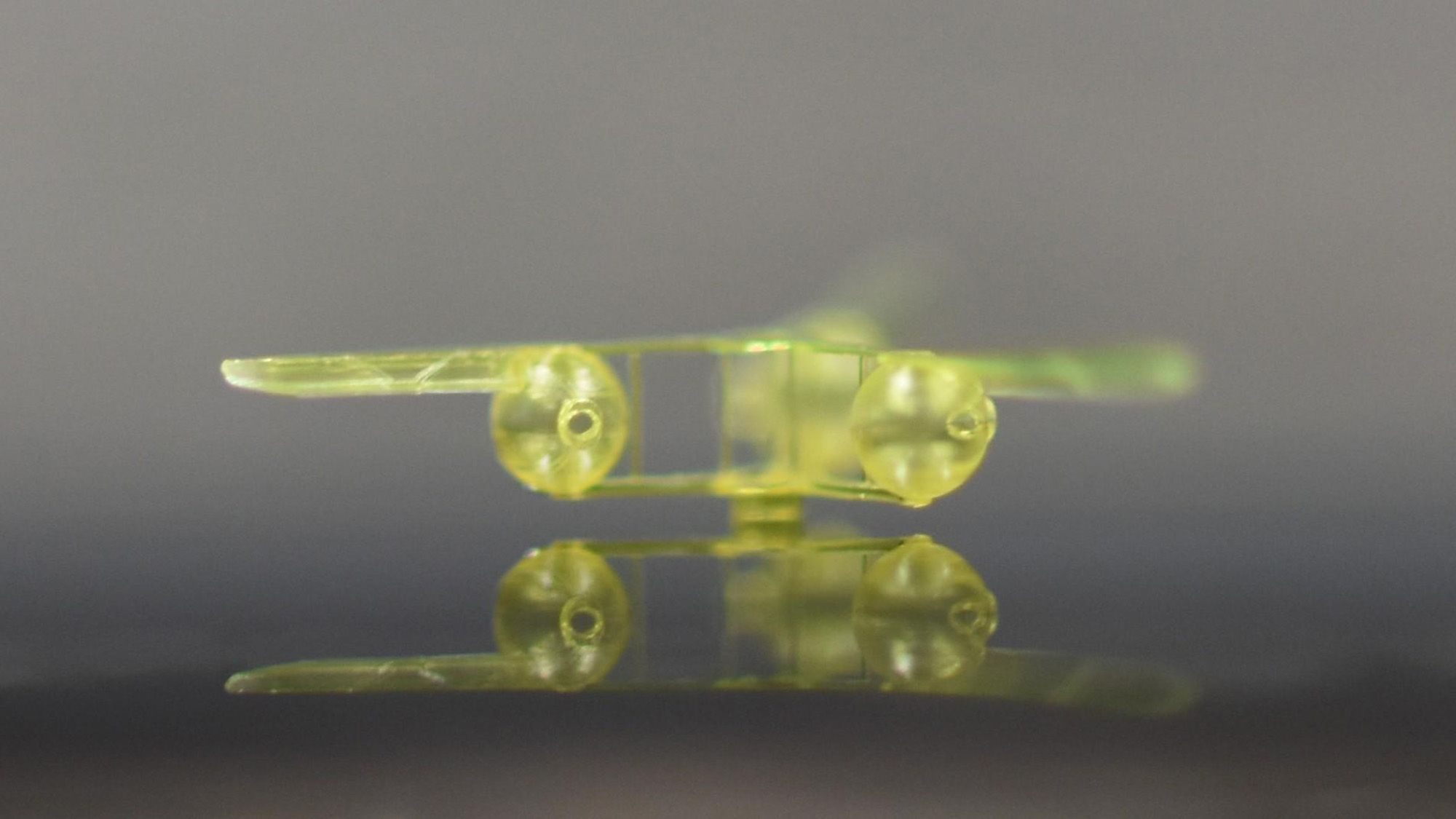
Sound-Powered Robots Move Without Motors Using Tiny Helmholtz Resonators
Engineers have developed tiny robots that move without conventional motors, batteries or moving mechanical parts. Instead, the devices use carefully tuned sound waves to generate thrust, lift and precise motion.
Inspired by the sound produced when someone blows across the top of an empty bottle, these miniature robots contain hollow chambers that resonate at specific frequencies. When sound is directed at the chambers, jets of air are expelled, creating enough force to steer small boats and lift microflying vehicles.
The research team described the technology in a study published Aug. 12 in the journal Science Advances.
From the latest videos
Live Science
How Helmholtz resonance powers the robots
The technology is based on Helmholtz resonance, a phenomenon first studied in the 19th century by German physicist Hermann von Helmholtz. He discovered that air trapped inside a cavity can resonate at a specific frequency and produce a small jet of air.
“When this effect is produced with an instrument, it is relatively weak because the pressure is low,” said study co-author Selman Sakar, an associate professor of mechanical engineering at École Polytechnique Fédérale de Lausanne in Switzerland. “But if you increase the pressure, that jet can become powerful enough to drive a machine.”
The researchers found that reducing the size of a Helmholtz resonator increases the frequency required to activate it. At miniature dimensions, the resonators respond to ultrasound, which is too high-pitched for humans to hear and can be focused with precision.
A larger resonator designed to produce the same force would need an extremely loud audible signal, potentially causing discomfort or hearing damage. Ultrasound allows the researchers to deliver energy more precisely while keeping the devices exceptionally small.
Using a specialized 3D-printing method known as two-photon printing, the team fabricated hollow resonator structures based on Helmholtz’s original equations. Laboratory experiments and computer simulations confirmed that the devices generated the predicted airflow and thrust.
Some of the microflyers resemble tiny propellers and are shown beside Swiss Franc coins for scale.
Sound-powered boats, rockets and microhelicopters
To demonstrate the technology, the researchers built a small boat measuring approximately 2 inches (5 centimeters) long. The boat contained several resonators, each tuned to a different frequency and aimed in a specific direction.
By changing the pitch produced by nearby speakers, the team controlled the direction of the air jets. This allowed the boat to move left, right or straight ahead without a motor or onboard power source.
At an even smaller scale, the researchers created “microflyers” measuring about 0.04 inches (1 millimeter) in diameter. Some devices operate like rockets, using air expelled from their resonators to generate thrust. Others resemble helicopters, using sound waves to spin small attached blades and produce lift.
Sound-powered resonators could offer important advantages over traditional motors for miniature robots. Conventional motors are difficult to shrink because they require physical components such as magnets, coils, shafts and other moving parts. In contrast, acoustic resonators are precisely shaped hollow cavities with no comparable mechanical limit to miniaturization.
The same principle could eventually enable researchers to rotate and manipulate tiny objects in midair without touching them. It may also support soft, flexible materials that bend or change shape when exposed to specific sound frequencies.
Potential applications could include biomedical devices, including technologies inspired by heart stents.
For now, the study provides a foundation for developing sound-powered robots and wireless microactuators. Future research could focus on practical designs, control systems and autonomous navigation, Sakar said.
Hwang, J., Angéloz, Q., Murugan, A.S., Lissek, H., and Sakar, M.S. (2026). Acoustic resonators as airborne wireless actuators for small robots. Science Advances, 12(33), eaef5620. Read the study.
Source: www.livescience.com