


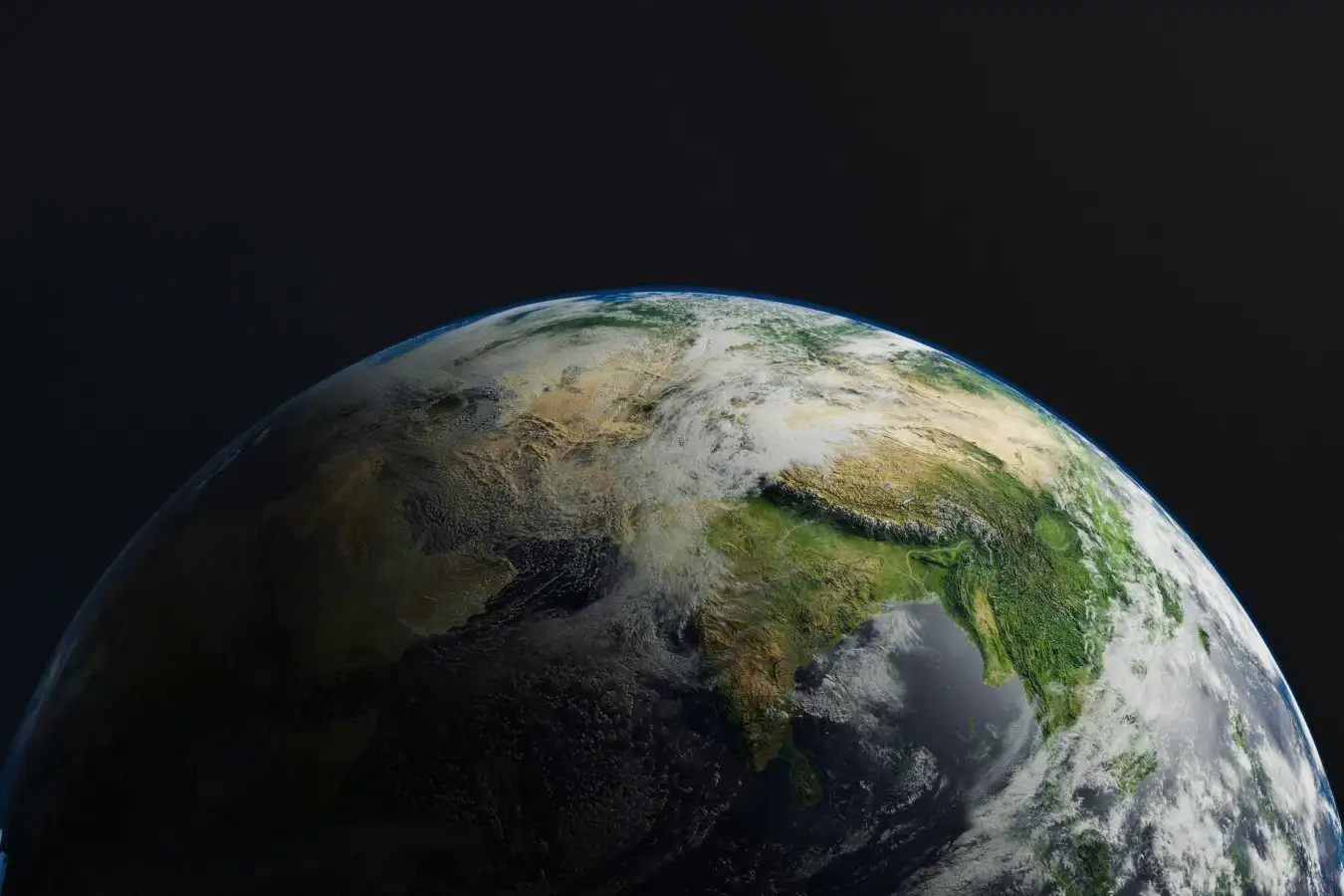

What Will Earth Look Like in the Distant Future?
Bimal S/Unsplash
The sun is gradually growing brighter and expanding with age, eventually transforming Earth into a hostile environment. However, research indicates that complex life could endure far longer in this extreme scenario than earlier predictions suggested.
Predictions based on studies of distant stars indicate that our Sun will enter a red giant phase, leading to Earth’s destruction in approximately 5 billion years. Yet, the timeline for habitability remains uncertain. Among complex life forms, the last to thrive will be the trophic biosphere, comprising both aquatic and terrestrial plants. Their survival largely hinges upon Earth’s temperature and the carbon dioxide levels essential for photosynthesis.
“The Earth’s temperature regulation operates largely through the greenhouse effect, balancing CO2 levels to maintain a habitable climate,” states Jacob Haq Misra of Blue Marble Space in Washington. As temperatures soar, CO2 is absorbed by rocks, decreasing atmospheric levels and facilitating some heat dissipation.
Thus, as the sun expands, CO2 becomes the critical limiting factor for plant life. Previous studies suggested a survival threshold of around 10 ppm CO2; below this, vegetation perishes, leaving microorganisms behind. This scenario is expected to unfold in about 1.35 billion years. The durability of remaining microbial life is unclear, but it could last much longer.
Recent simulations by Haq Misra and colleague Eric Wolf propose that plant survival could extend an additional 500 million years. Their comprehensive model accounts for plant types like cacti and pineapples that utilize Crassulacean acid metabolism, allowing them to efficiently extract CO2 from the atmosphere. This adjustment may lower the starvation threshold to 1 ppm, enabling the trophic biosphere to persist for over 1.8 billion years.
“Life on Earth could endure far longer than we currently perceive,” remarks Haq Misra. He emphasizes that with sufficient time, evolution may allow life forms to adapt to the sun’s gradual warming.
“These models indicate we might be at the beginning of our planet’s complex biosphere, rather than reaching its end, as some pessimistic scenarios have suggested,” adds Edward Schwieterman of the University of California, Riverside.
This insight is promising; moreover, it implies that if Earth reflects a typical habitable world, the likelihood of discovering biospheres on other planets may be greater than previously thought. “This isn’t merely a theoretical consideration; it has significant practical implications: they’re developing a model of a future Earth that could be observable within the next two decades.”
Topic:
Source: www.newscientist.com