


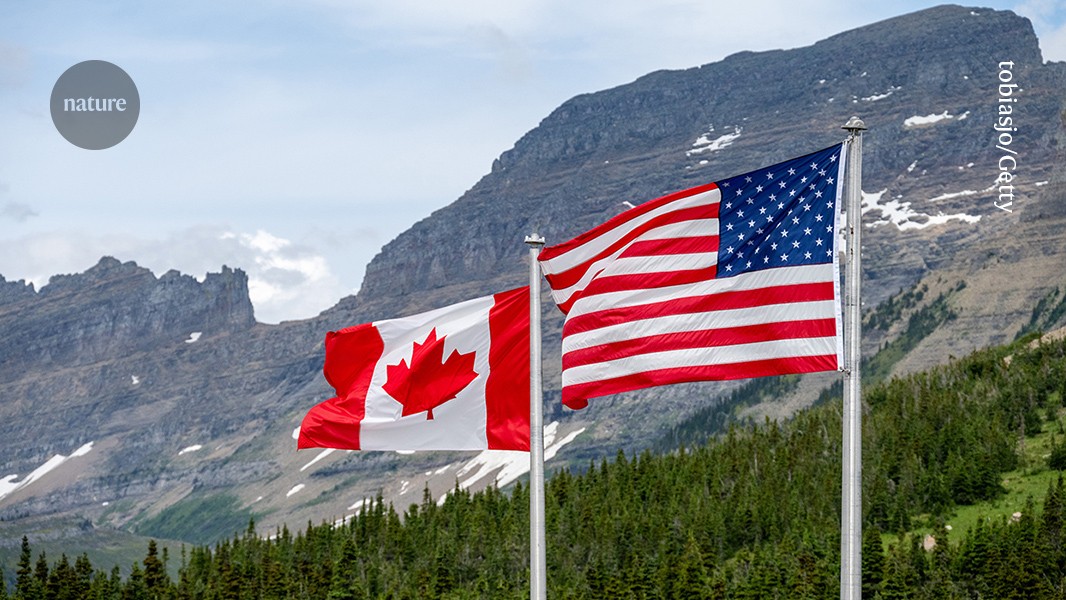
Canada has recruited 48 researchers from the United States in a major scientific talent drive.
Credit: tobiasjo/Getty
As Canada and the United States clash over tariffs, Canada is gaining an advantage in the competition for scientific talent. On August 27, the Canadian government announced the first group of researchers recruited through its international talent initiative. Of the 64 scientists selected from around the world, 48 are moving to Canada from the United States.
How is China trying to attract the world’s top scientific talent?
The initiative aims to support “ambitious research in areas important to Canada’s prosperity, sovereignty, health and resilience,” according to the announcement. The newly recruited scientists will receive a combined C$500 million — approximately US$360 million — over eight years through the Eddie Goldenberg Research Chairs of Canada and Canada Impact+ Emerging Leaders programmes.
The programmes are the centrepiece of a broader Canadian campaign to attract international researchers, which began in December. Canada is competing with countries around the world for scientific talent as US President Donald Trump’s administration moves to reduce research funding and increase government influence over American universities.
Other countries are also seeking to recruit US-based scientists. Earlier this year, France hired 41 researchers through its Choose France for Science programme. High-profile scientists, including Nobel Prize-winning chemist Omar Yaghi, have also moved from US institutions to overseas universities.
For some researchers selected for Canada’s programmes, uncertainty over US research funding was a major factor in their decision. Philippe Zamor, director of the RNA Therapeutics Laboratory at the University of Massachusetts Chan Medical School in Worcester, will move to McGill University in Montreal.
One of Zamor’s National Institutes of Health grants remained undecided for 18 months, an unusually long delay. “We had to downsize our lab,” he says. Some members of his team left, while he was unable to replace them because “we didn’t know if we had the money.” Zamor will receive the programme’s highest level of support, worth US$1.1 million annually.
“While parts of the world are turning their backs on science, Canada is stepping up,” Canadian Industry Minister Mélanie Joly said when announcing the recruitment initiative.
Michael Rubel, a physicist who studies science policy at the City University of New York, described the loss of US-based researchers as “completely predictable” given the Trump administration’s policies. “This is just the beginning,” he added.
The White House Office of Science and Technology Policy did not respond to Nature‘s request for comment.
US brain drain accelerates as Canada recruits researchers
The 48 US-based researchers moving to Canada work across health, biotechnology, engineering, physics, climate and environmental science, and the social sciences. They will join 21 Canadian universities, including McGill University, the University of British Columbia in Vancouver and the University of Toronto.

Dozens of researchers move from US to France following high-profile talent bid
The University of Michigan in Ann Arbor lost the largest number of researchers, with three academics in engineering and sustainability relocating to Canada. Harvard University and the Massachusetts Institute of Technology, both in Cambridge, Massachusetts, each lost two researchers. The University of Michigan did not respond to a request for comment from Nature.
The number of researchers leaving the United States for Canada remains small compared with the size of the US scientific workforce. However, many of those recruited are established leaders in their fields, Rubel says. Their departures could encourage other scientists to explore research opportunities abroad.
The impact could also extend beyond senior academics. Graduate students, postdoctoral researchers and other laboratory staff are moving with some of the recruits, potentially affecting the next generation of scientists. “At least one graduate student, two postdocs and a lab manager will be travelling with me,” Zamor says.
“I think the current policy is a cause for concern and could ultimately lead to more withdrawals,” says Megan McGarvey, an economist at Boston University’s Questrom School of Management in Massachusetts.
Source: www.nature.com