


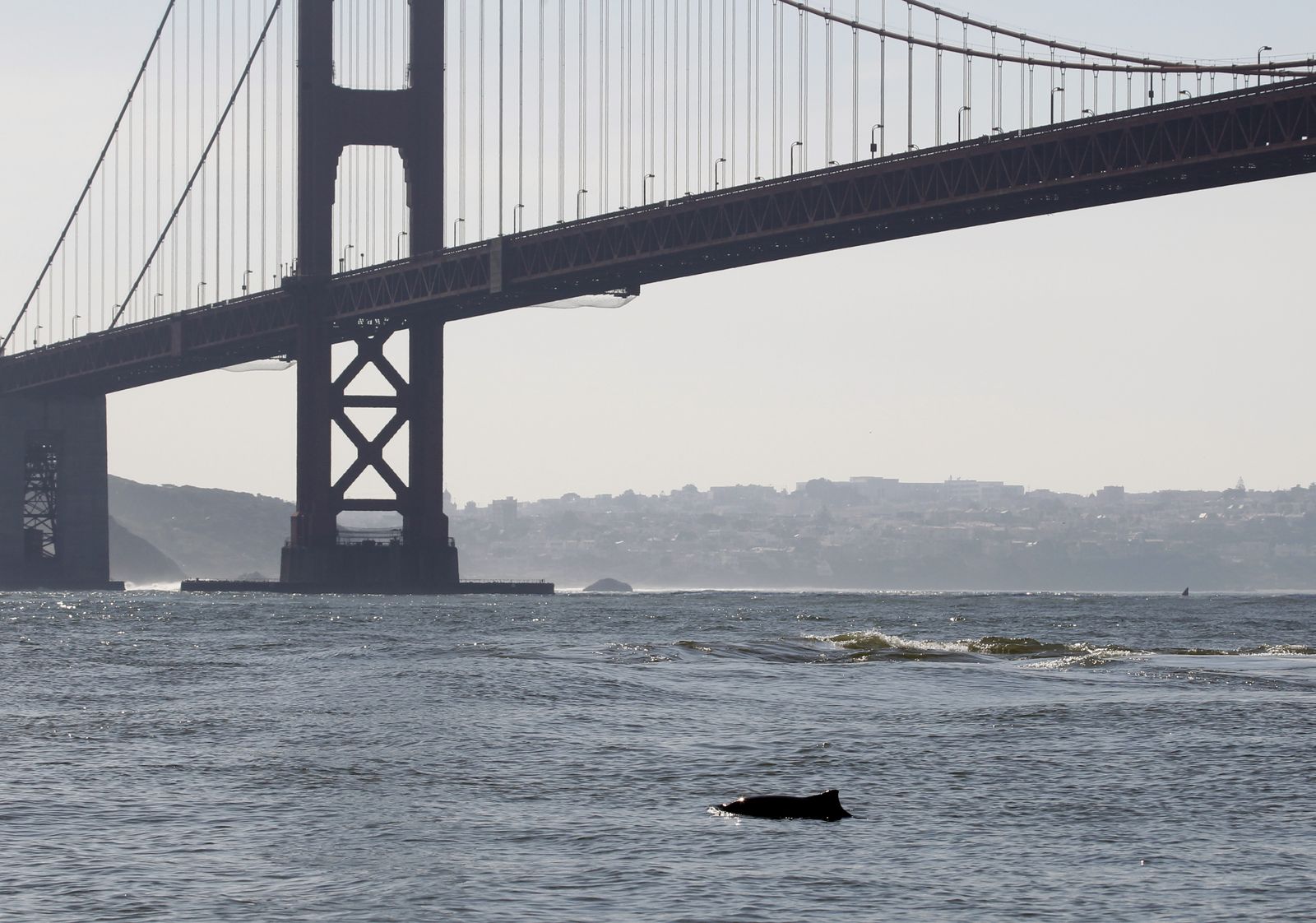
Harbor Porpoises Reveal Their Secret Mating Ritual Beneath the Golden Gate Bridge
Harbor porpoises returned to San Francisco Bay in 2008 after disappearing from the area for decades. Scientists seized the rare opportunity to study their behavior—and discovered mating patterns that could help protect endangered porpoise populations.
Paul Chinn / San Francisco Chronicle via Getty Images
Key takeaways: Harbor porpoise mating behavior
- Harbor porpoises mate near the mouth of San Francisco Bay, beneath the Golden Gate Bridge. Researchers call the narrow channel the “funnel of love.”
- Scientists documented the porpoises’ brief mating attempts with photographs, video, drones and underwater recordings.
- The findings reveal unusual left-sided mating behavior and may help conservationists protect vulnerable porpoise populations, including the critically endangered vaquita.
After spending hundreds of hours watching harbor porpoises from the Golden Gate Bridge pedestrian walkway, William Keener learned how to say “porpoise” in a dozen languages. In German, the word is schweinswal, or “pig whale.” In French, it is marsouin, meaning “sea pig.” His favorite term is the Norwegian nise, which comes from the word for “sneeze.” The vocabulary helped Keener explain to curious tourists why he was studying the water through binoculars.
Keener, a research biologist at the Marine Mammal Center in Sausalito, California, originally visited the bridge to observe harbor porpoise behavior. He did not expect to become an expert on the species’ mating rituals. But after realizing that the animals were mating beneath the Golden Gate Bridge, “we focused on that,” he says.
Harbor porpoises have lived alongside people for thousands of years along coastal waters throughout the Northern Hemisphere. Despite that long association, these small, dolphin-like marine mammals are difficult to study. Their secretive behavior has left many aspects of their lives—including how they reproduce—poorly understood.
Documenting sexual behavior is an important first step in understanding what a species needs to reproduce successfully. “Mating is key to the success of a population,” Keener says. Knowing what harbor porpoises are doing, where they mate and how often they reproduce can be essential for protecting healthy populations and helping those in decline.
Scientists had long recognized that harbor porpoise calves are born from late spring through early fall, depending on the region. Researchers also knew that males have a distinct breeding season: During the fertile months, a male harbor porpoise’s testes can weigh more than his brain. Yet no one had produced clear, undisputed observations of harbor porpoises mating in the wild.
In 2008, hundreds of harbor porpoises returned to San Francisco Bay, creating an unusual opportunity to study the species. The animals had been rare in the bay for roughly six decades, likely because of pollution, reduced fish populations and a World War II-era anti-submarine net that once stretched across the Golden Gate, Keener says.
The returning porpoises also gave researchers a chance to examine how the animals behaved in a busy urban marine environment.
/https://tf-cmsv2-smithsonianmag-media.s3.amazonaws.com/filer_public/15/eb/15ebb8ce-8540-4c92-8027-df5955f35d44/porpoise_10_july_2010_sf_bay_jon_stern_tmmc.jpg)
Jonathan Stern / The Marine Mammal Center
Observing harbor porpoises is challenging. The animals usually remain almost entirely underwater, exposing their dorsal fins for only a second or two when they breathe. Compared with energetic bottlenose dolphins, which may leap from the water whenever they surface, harbor porpoises are remarkably subdued.
Researchers initially tried to watch the animals from boats, but the porpoises avoided the vessels. The team eventually discovered that the Golden Gate Bridge provided an ideal vantage point. Its pedestrian walkway rises about 230 feet above the water, offering a broad view of the channel below. The porpoises appeared unaffected by the traffic overhead—or by scientists watching from the bridge.
When Keener first noticed a porpoise splash into the water, he assumed the animal was feeding. Perhaps it had pursued a fish to the surface and leapt after it. The scientists began photographing the splashes with a telephoto lens. In 2010, one image revealed that the splash involved something entirely different: the penis of a male harbor porpoise, which can reach approximately one-third the length of his five- to six-foot body.
The discovery showed that the splashes were part of harbor porpoise mating behavior.
Harbor porpoises travel in and out of San Francisco Bay with the tides. The Golden Gate, the researchers soon realized, may be a particularly important mating site. It is the deepest section of the inlet, and males sometimes wait there for females to pass. Keener and his colleagues began calling the location the “funnel of love.”
Over the next eight years, Keener and his team collected 144 photographs and videos of harbor porpoise mating activity in San Francisco Bay. The footage revealed a consistent pattern: The male approached the female from her left side. If he began on her right, he often moved across her body to reach the left.
“To have an extreme sidedness, ‘lateralization’ as we call it, in mating is unusual,” Keener says. Mammalian mating is generally belly-to-belly or rear-mounted. Even when animals approach from different directions, the behavior is usually symmetrical rather than restricted to one side.
In most observed encounters, the male surged upward from below as the female surfaced to breathe. He then splashed back into the water. The entire encounter lasted only one or two seconds.
Harbor porpoise mating attempts

Researchers saw only two confirmed penetrations. In both cases, the male was positioned crosswise to the female, with his belly against her left side. The remaining 99 percent of the observed attempts appeared unsuccessful. In nearly 20 percent of encounters, the male displayed his penis but did not approach the female closely enough to mate.
The frequency of these attempts was also surprising. Harbor porpoises can become pregnant only during a specific fertile season, yet the researchers observed mating behavior throughout the year. Keener suggests the animals’ unusual reproductive strategy may require considerable practice because successful mating depends on the right angle, timing and speed.
The team’s findings, published in 2018, represented the first detailed description of mating behavior in any porpoise species.
Keener and his colleagues then contacted harbor porpoise researchers in other parts of the world to determine whether the same behavior occurred elsewhere. One of the scientists they consulted was Cindy Elliser, founder and research director of the nonprofit Pacific Mammal Research. Elliser studies harbor porpoises in Washington’s San Juan Islands and visited the Golden Gate Bridge team during a 2015 scientific conference.
While reviewing the San Francisco photographs, Elliser recognized a pattern in her own images. She had captured similar splashes in Burrows Pass, a narrow channel between two San Juan Islands. Although her pictures did not clearly show a penis, the behavior matched the San Francisco observations.
“They were mating and I didn’t know it,” Elliser says. “After that, everything clicked into place.”
/https://tf-cmsv2-smithsonianmag-media.s3.amazonaws.com/filer_public/39/62/3962daa1-fdd5-4296-9460-b8b72ef2e0f2/022421_porpoise_group_tsss_td_nowatermark.jpg)
Trevor Derie / Pacific Mammal Research. Taken under NMFS permit 23253
Magnus Wahlberg, chief scientist at the Fjord&Baelt Center in Kerteminde, Denmark, studies some of the world’s few captive harbor porpoises. His office overlooks a pool where the animals are housed. Wahlberg and his team used underwater hydrophones to listen to the porpoises’ echolocation clicks during mating attempts.
If a male stopped clicking as he approached a female, it could indicate that he was attempting to surprise her. “There were indications that the males may not have said so much when they approached the females,” Wahlberg says. However, capturing the brief, two-second encounters with perfectly positioned hydrophones is difficult. “The results are not solid yet,” he adds.
Wahlberg and his colleagues also used drones to observe wild harbor porpoises and confirmed the mating behavior documented by Keener. His research group and Elliser’s were among approximately a dozen teams in Europe and North America that recorded harbor porpoise mating behavior after the original study. Together, their findings supported the conclusion that males consistently approach females from the left.
To investigate whether anatomy explained the animals’ left-sided mating strategy, Keener consulted Dara Orbach, a marine biologist at Texas A&M University, Corpus Christi, who specializes in the genital anatomy of whales, dolphins and porpoises.
By examining reproductive organs from harbor porpoises that died after stranding, Orbach found that the animals’ penises end in thin, flexible tips that consistently curve toward the left. That anatomical feature may help explain the males’ preferred approach, but it may not be the only factor involved.
The female harbor porpoise’s reproductive anatomy may also play an important role. The vagina contains numerous folds, sharp turns and pockets. According to Orbach’s research, a male may need to approach from the left to navigate these structures and improve the likelihood of fertilization.
Female harbor porpoises may also influence the outcome. Although males appear to rely on surprise, Orbach believes the female’s vaginal folds could play a role in sexual selection. “Since I started studying this in 2010, I’ve thought that those vaginal folds play a role in sexual selection, because there is so much diversity across species,” she says.
By twisting her body, a female may be able to accept or reject a male’s advances. She could potentially direct sperm toward the egg—or into a dead end—giving her some control over which male fertilizes her. This possibility is supported by research on porpoise mating behavior and Orbach’s work on female reproductive anatomy.
Experiments using silicone models of bottlenose dolphin vaginas suggest that internal folds may improve sperm quality compared with sperm collected through artificial insemination. The folds could also help remove seawater from the penis, potentially preventing sperm-damaging water from entering the uterus during mating.
Although the connection remains speculative, Orbach says this research could eventually assist efforts to save the vaquita, the world’s most endangered marine mammal. The vaquita is a close relative of the harbor porpoise and lives only in the northern Gulf of California. Scientists estimate that as few as seven to ten individuals remain.
Capturing vaquitas is currently impossible because the animals can die from the stress of handling. This has prevented researchers from creating a vaquita breeding program. If scientists eventually develop a safe method to work with the animals, silicone reproductive models could theoretically help collect high-quality sperm for artificial insemination, Orbach says.
/https://tf-cmsv2-smithsonianmag-media.s3.amazonaws.com/filer_public/d7/64/d764e8b0-ff54-48e5-bb48-9a84fcd6a092/keener_porpoise_crissy_field_nov_2015.jpg)
Bill Keener / The Marine Mammal Center
Andrea Bonilla, head of science at the Sea Shepherd Conservation Society, notes that harbor porpoises and vaquitas have similar anatomy and can produce viable offspring with other porpoise species. Those similarities could theoretically make harbor porpoises useful in future reproductive research, including as a possible host for a cloned vaquita embryo.
For now, however, such interventions are not a conservation priority. Bonilla says the vaquita’s habitat must first be protected, particularly from gillnets, which remain the species’ greatest threat. Mexican authorities and conservation researchers are focusing on protecting vaquitas in the wild before considering captive breeding, cloning or relocation.
Even so, a better understanding of harbor porpoise mating anatomy and behavior could eventually help vaquita conservation. “I was surprised at these new findings, learning that the mating process in harbor porpoises is superfast,” Bonilla says. Vaquita mating behavior remains unknown. “In many years of visual surveys of vaquitas, we haven’t seen anything similar, so far.”
Harbor porpoises remain widespread from California to Alaska and are classified as a species of least concern by the International Union for Conservation of Nature. However, some regional populations face serious threats. The Baltic Sea harbor porpoise population is listed as critically endangered, while the status of Black Sea porpoises remains uncertain, Keener says. Research in that region has also been limited by the war in Ukraine.
Recognizing that splashes may signal mating activity can help scientists identify important harbor porpoise breeding areas. Sites such as the channel beneath the Golden Gate Bridge could be considered for marine protected areas or other conservation measures.
Keener, Elliser, Wahlberg, Orbach and other researchers have contributed a chapter on harbor porpoise mating behavior and anatomy to the forthcoming scientific book The Complex Behaviors of Marine Organisms. The chapter brings together the field observations, anatomical research and conservation implications of their work.
Even though harbor porpoises have been studied more extensively than many other marine mammals, scientists still know relatively little about their lives. The observations from the Golden Gate Bridge demonstrate how a rare return to a familiar habitat—and careful attention to an unexplained splash—can reveal behavior that had remained hidden for generations.
“We still know so little about their lives,” Wahlberg says. But when Keener and his colleagues connected the evidence, behavior that had puzzled researchers suddenly became clear. “Maybe that’s how science works.”
Source: www.smithsonianmag.com