


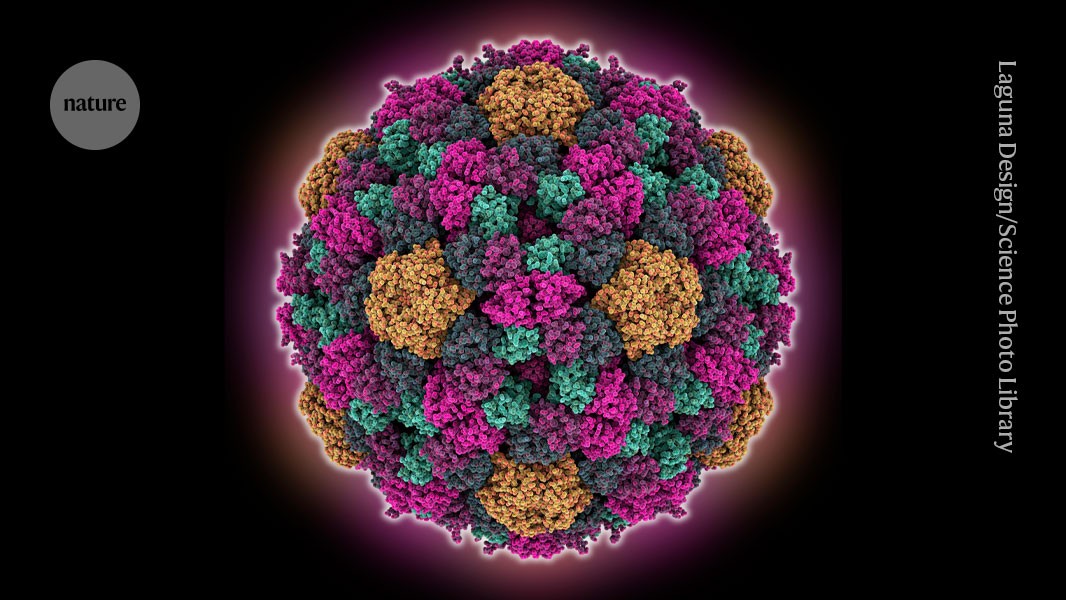
Computer-generated model of the capsid of bacteriophage ΦX174.
Credit: Laguna Design/Science Photo Library
Few biological systems have been studied as extensively as bacteriophage ΦX174, also known as Phi-X. Yet new research suggests that scientists still do not fully understand how mutations affect this simple virus.
The ΦX174 viral genome is a circular, single-stranded DNA molecule containing 5,386 nucleotides and encoding 11 proteins. Scientists first sequenced the complete genome in the 1970s, marking the first time an entire genome had been sequenced.1 The genome was chemically synthesized in the 2000s.2 More recently, ΦX174 became the basis for the first viral genome designed with artificial intelligence.3 Now, researchers have systematically mutated nearly every nucleotide in the complete genome and measured the effects of those changes.4
Most of the mutations reduced viral fitness, but the effects of many individual changes were difficult to explain. “Even in this very well-studied system, it doesn’t explain why a quarter of the mutations kill the virus,” says Ben Lehner, a molecular biologist at the Wellcome Sanger Institute in Hinxton, UK. Lehner co-led the study, which was posted to the bioRxiv preprint server in July.
Advanced artificial intelligence systems are increasingly being used to predict harmful mutations. However, these tools have struggled to accurately forecast the effects of genetic changes in phages. The findings demonstrate why larger and higher-quality experimental datasets are needed to improve AI models for biological research.
Systematically testing ΦX174 mutations
Lehner and his colleagues generated more than 44,000 ΦX174 genome variants. They tested every possible single-nucleotide substitution, with three alternative changes at each position, as well as every possible amino acid substitution in the virus’s proteins.
To assess how each variant affected viral fitness, Lehner worked with molecular biologist Huijing Wei of the Center for Genome Regulation in Barcelona, Spain, and geneticist Shanhua Li of King’s College London. The researchers grew thousands of virus variants in Escherichia coli cultures for 80 minutes, allowing enough time for two or three rounds of infection. Variants that increased in abundance during the experiment were considered more successful, whereas variants carrying harmful mutations became less common or disappeared.
The competition experiments, analyzed through DNA sequencing, produced surprising results. Around half of the single-nucleotide mutations harmed phage fitness, as did approximately 60% of amino acid substitutions. These proportions were much higher than Lehner expected. Although ΦX174 has been studied for decades and is generally considered highly adapted to laboratory conditions, a small number of mutations further improved its ability to reproduce.
The world’s first AI-designed virus, a step towards life created by AI
Researchers suspect that about half of the harmful amino acid substitutions disrupt interactions with other proteins, including proteins produced by ΦX174 and its Escherichia coli host. Approximately one-quarter occur in amino acids buried inside proteins, where they could weaken protein structure. The effects of the remaining mutations are unknown. “There are hundreds of mutations here, and we have no idea what they’re doing,” Lehner says.
Putting biological AI to the test
Source: www.nature.com