


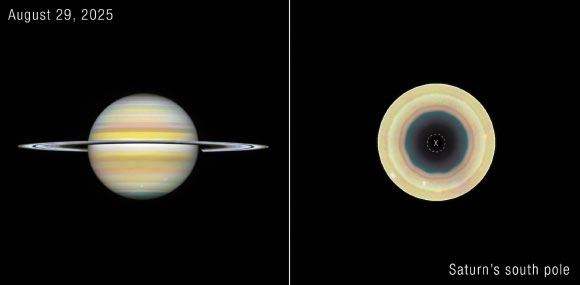
Astronomers have discovered a developing 10-sided atmospheric pattern near Saturn’s south pole, offering a possible counterpart to the gas giant’s famous northern hexagon. The newly observed feature, known as a decagonal wave, was identified in images from NASA’s Hubble Space Telescope and appears to be strengthening over time.
Hubble Space Telescope images reveal atmospheric waves near Saturn’s south pole, including a developing 10-sided decagonal pattern. Image credits: NASA / ESA / STScI / Agustin Sánchez-Lavega, UPV / Amy Simon, NASA Goddard Space Flight Center / Michael Wong, University of California, Berkeley / Alyssa Pagan.
Saturn’s north pole is famous for its persistent six-sided jet stream, known as the Saturn Hexagon. First observed by NASA’s Voyager spacecraft in the 1980s, the northern hexagon has remained visible for more than four decades.
Because Saturn’s rotational axis is tilted, the planet’s southern hemisphere gradually moved out of view from Earth in 2012. It became visible again in 2023, allowing astronomers to search for a possible southern counterpart to the north polar hexagon.
Images captured by the NASA/ESA Hubble Space Telescope in October 2023 revealed a faint polygonal pattern with 10 vertices near 63 degrees south latitude. By August 2024, the shape had become more distinct. Hubble and ground-based observations made in August and September 2025 showed all 10 vertices, although their brightness varied around the pattern.
The observations were obtained through Hubble’s Outer Planet Atmospheres Legacy (OPAL) Program, which has monitored the atmospheres of the Solar System’s outer planets for more than a decade.
“We’ve never seen anything quite like this in Saturn’s southern hemisphere,” said Dr. Amy Simon, principal investigator of the OPAL program and an astronomer at NASA’s Goddard Space Flight Center.
“The north hexagon has been visible every time we have observed it for more than 40 years. This southern feature is different. It appears to be intensifying, giving us a rare opportunity to study the development of a large-scale atmospheric pattern.”
“Given the symmetry of Saturn’s north-south jet-stream system, we have been searching since 1990 for a southern equivalent of the north polar hexagon,” said Dr. Agustín Sánchez-Lavega, an astronomer at the University of the Basque Country.
“Images from NASA’s Cassini spacecraft, which orbited Saturn from 2004 to 2017, did not reveal any clear evidence of a long-lived structure of this kind. Hubble’s observations confirm that the decagonal feature was already present by 2023.”
The decagonal wave is embedded in one of Saturn’s powerful jet streams and appears to extend through several atmospheric layers. This suggests that it is a vertically developed atmospheric structure rather than a pattern limited to the upper cloud tops.
“The most interesting aspect is that this feature appears to have formed relatively recently,” Dr. Simon said. “The key question is why it is developing now when we have never observed anything similar before.”
Additional observations with the Hubble Space Telescope and the NASA/ESA/CSA James Webb Space Telescope, along with computer modeling, could help scientists determine how Saturn’s southern decagon formed, how long it will survive, and how it compares with the planet’s long-lasting northern hexagon.
The discovery was published in the journal Science Advances. Read the research paper.
_____
Agustin Sanchez Labega et al. 2026. A decagonal wave around Saturn’s south pole. Science Advances 12(36); doi: 10.1126/sciadv.aee4251
Source: www.sci.news