


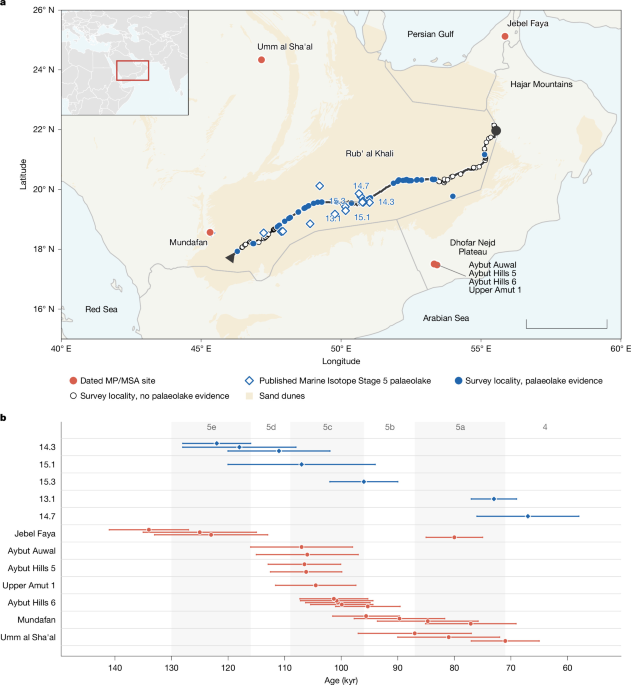
The supplied material is a bibliography of 67 works on early human migration, climate change and settlement in Arabia and neighboring regions. Together, the sources examine how Late Pleistocene humid phases, palaeolakes, rivers and ecological corridors may have enabled hominin movement out of Africa, while archaeological studies trace occupations, stone-tool production, raw-material procurement and mobility across Arabia, Africa, Europe and the Americas. The references also include climate models, geological maps, remote-sensing datasets and research published through 2026.
Climate and human dispersal
Several studies investigate how changing climate created temporary opportunities for human movement. Timmermann and Friedrich examined Late Pleistocene climate drivers of early human migration, while Beyer and colleagues modelled “climatic windows” for migration out of Africa during the past 300,000 years. Other research identifies palaeohydrological corridors in the Middle East and multiple hominin dispersals into Southwest Asia over the past 400,000 years.
Research on Arabia describes repeated humid or “green” phases that transformed parts of today’s deserts. Studies of southern Arabia, the Nafud Desert and the Rub’al-Khali document former lakes, pluvial periods and monsoonal effects. These environmental changes may have supported human occupation and movement, although the archaeological record indicates that dispersal was episodic rather than a single, continuous expansion.
Archaeological evidence from Arabia
Archaeological investigations have identified Middle Palaeolithic occupations at sites including Jebel Faya in the United Arab Emirates, Mundafan and Jubbah in Saudi Arabia, and Dhofar and south-central Oman. Evidence includes stone tools, occupation deposits and palaeolake sediments. One study reports Homo sapiens in Arabia by 85,000 years ago, while another documents multiple phases of human occupation in Southeast Arabia between 210,000 and 120,000 years ago.
The sources also describe the Nubian Complex in Dhofar, southern Oman, and examine whether similarities between African and Arabian stone-tool industries reflect movement of people, technological transmission or both. More recent work addresses Middle Palaeolithic occupation in south-central Oman and the relationship between Nubian cores and the quality of available chert.
Stone tools, mobility and raw materials
A major theme of the bibliography is how researchers reconstruct mobility from stone technology. The cited studies examine lithic production rates, technological change, raw-material procurement and the transport of stone over long distances. They include analyses of obsidian in Kenya and northern Tanzania, silcrete in South Africa, stone resources in Saudi Arabia and Neanderthal mobility in Italy and Spain.
Other references consider the earliest Middle Stone Age, stone-tool miniaturisation along the Southern Dispersal Route out of Africa and the effects of stone-tool production on Saharan environments. Together, these studies show how artefact technology and geological sourcing can provide evidence about movement even when direct traces of ancient travel are absent.
Evidence, models and research tools
The bibliography combines archaeology with climate modelling, palaeoenvironmental reconstruction, geology, remote sensing and geographic information systems. It includes work on Arabian palaeohydrology, the structural geology of the Rub’Al-Khali Basin, river networks, the distribution of streams and rivers, digital terrain modelling and geological maps of the Arabian Peninsula.
The collection also provides data and code associated with the study “Stone and water governed early human settlement of the desert,” along with references to modern research on humid phases in the Nefud Desert, the origin of Umm Al Heesh lake and monsoonal landscapes in the Rub’al Khali. These sources indicate that interpretations of ancient migration depend on integrating environmental records with archaeological evidence and chronological data.
References
- Timmermann, A. & Friedrich, T. “Late Pleistocene climate drivers of early human migration.” Nature 538, 92–95 (2016). Article.
- Beyer, R. M., Krapp, M., Eriksson, A. & Manica, A. “Climatic windows for human migration out of Africa in the past 300,000 years.” Nature Communications 12, 4889 (2021). Article.
- Breeze, P. S. et al. “Palaeohydrological corridors for hominin dispersals in the Middle East ∼250–70,000 years ago.” Quaternary Science Reviews 144, 155–185 (2016). Article.
- Groucutt, H. S. et al. “Multiple hominin dispersals into Southwest Asia over the past 400,000 years.” Nature 597, 376–380 (2021). Article.
- Rose, J. I. et al. “A failed human expansion out of Africa 100,000 years ago.” Preprint at Research Square (2026).
- Breeze, P. S. et al. “Remote sensing and GIS techniques for reconstructing Arabian palaeohydrology and identifying archaeological sites.” Quaternary International 382, 98–119 (2015). Article.
- Rosenberg, T. et al. “Humid periods in southern Arabia: windows of opportunity for modern human dispersal.” Geology 39, 1115–1118 (2011). Article.
- Rosenberg, T. M. et al. “Middle and Late Pleistocene humid periods recorded in palaeolake deposits of the Nafud desert, Saudi Arabia.” Quaternary Science Reviews 70, 109–123 (2013). Article.
- Nicholson, S. L. et al. “Pluvial periods in Southern Arabia over the last 1.1 million-years.” Quaternary Science Reviews 229, 106112 (2020). Article.
- Crassard, R. et al. “Middle Palaeolithic and Neolithic occupations around Mundafan palaeolake, Saudi Arabia: implications for climate change and human dispersals.” PLoS ONE 8, e69665 (2013). Article.
- Groucutt, H. S. et al. “Human occupation of the Arabian empty quarter during MIS 5: evidence from Mundafan Al-Buhayrah, Saudi Arabia.” Quaternary Science Reviews 119, 116–135 (2015). Article.
- Kuhn, S. L. The Evolution of Paleolithic Technologies. Routledge (2020).
- Kuhn, S. L. In Neanderthal Lifeways, Subsistence and Technology: One Hundred Fifty Years of Neanderthal Study, edited by Conard, N. J. & Richter, J., 99–110. Springer (2011).
- Muller, A. & Clarkson, C. “Identifying major transitions in the evolution of lithic cutting edge production rates.” PLoS ONE 11, e0167244 (2016). Article.
- McClure, H. “Radiocarbon chronology of late Quaternary lakes in the Arabian Desert.” Nature 263, 755–756 (1976). Article.
- Matter, A., Neubert, E., Preusser, F., Rosenberg, T. & Al-Wagdani, K. “Palaeo-environmental implications derived from lake and sabkha deposits of the southern Rub’al-Khali, Saudi Arabia and Oman.” Quaternary International 382, 120–131 (2015). Article.
- Armitage, S. J. et al. “The southern route ‘out of Africa’: evidence for an early expansion of modern humans into Arabia.” Science 331, 453–456 (2011). Article.
- Bretzke, K. et al. “Archaeology, chronology, and sedimentological context of the youngest Middle Palaeolithic assemblage from Jebel Faya, United Arab Emirates.” Archaeological and Anthropological Sciences 17, 60 (2025). Article.
- Crassard, R., Hilbert, Y. H., Preusser, F., Wulf, G. & Schiettecatte, J. “Middle Palaeolithic occupations in central Saudi Arabia during MIS 5 and MIS 7: new insights on the origins of the peopling of Arabia.” Archaeological and Anthropological Sciences 11, 3101–3120 (2019). Article.
- Rose, J. I. et al. “The Nubian complex of Dhofar, Oman: an African middle stone age industry in southern Arabia.” PLoS ONE 6, e28239 (2011). Article.
- Usik, V. I., Rose, J. I., Hilbert, Y. H., Van Peer, P. & Marks, A. E. “Nubian Complex reduction strategies in Dhofar, southern Oman.” Quaternary International 300, 244–266 (2013). Article.
- Groucutt, H. S. et al. “Homo sapiens in Arabia by 85,000 years ago.” Nature Ecology & Evolution 2, 800–809 (2018). Article.
- Bretzke, K. et al. “Multiple phases of human occupation in Southeast Arabia between 210,000 and 120,000 years ago.” Scientific Reports 12, 1600 (2022). Article.
- Merrick, H. V. & Brown, F. H. “Obsidian sources and patterns of source utilization in Kenya and northern Tanzania: some initial findings.” African Archaeological Review 2, 129–152 (1984). Article.
- Spinapolice, E. E. “Raw material economy in Salento (Apulia, Italy): new perspectives on Neanderthal mobility patterns.” Journal of Archaeological Science 39, 680–689 (2012). Article.
- Nash, D. J., Coulson, S., Staurset, S., Smith, M. P. & Ullyott, J. S. “Provenancing silcrete in the Cape coastal zone: implications for Middle Stone Age research in South Africa.” Journal of Human Evolution 65, 682–688 (2013). Article.
- Brooks, A. S. et al. “Long-distance stone transport and pigment use in the earliest Middle Stone Age.” Science 360, 90–94 (2018). Article.
- Herrero-Alonso, D. et al. “Neanderthal mobility over very long distances: the case of El Castillo cave (northern Spain) and the ‘Vasconian’ Mousterian.” Journal of Human Evolution 205, 103715 (2025). Article.
- Edgell, H. S. Arabian Deserts: Nature, Origin, and Evolution. Springer (2006).
- Stewart, S. “Structural geology of the Rub’Al-Khali Basin, Saudi Arabia.” Tectonics 35, 2417–2438 (2016). Article.
- Kazak, E. S., Al Gaoud, A., Ahmed, S. M., Souid, F. & Nabi, A. “Origin of Umm Al Heesh lake in the Rub’Al Khali desert, Saudi Arabia.” Scientific Reports 15, 34850 (2025). Article.
- Clark-Wilson, R. et al. “Assessing the intensity of Late Quaternary humid phases in the Nefud Desert, northern Arabia.” Journal of Quaternary Science 41, 207–218 (2026). Article.
- Zaki, A. S. et al. “Monsoonal imprint on late Quaternary landscapes of the Rub’al Khali Desert.” Communications Earth & Environment 6, 255 (2025). Article.
- Petraglia, M. D., Groucutt, H. S., Guagnin, M., Breeze, P. S. & Boivin, N. “Human responses to climate and ecosystem change in ancient Arabia.” Proceedings of the National Academy of Sciences USA 117, 8263–8270 (2020). Article.
- Scerri, E. et al. “Neolithic pastoralism in marginal environments during the Holocene wet phase, northern Saudi Arabia.” Antiquity 92, 1180–1194 (2018).
- Maiorano, M. P. et al. “Living and moving in Maitan.” Proceedings of the Seminar for Arabian Studies 50, 83–100 (2020).
- Petraglia, M. D. et al. “Hominin dispersal into the Nefud desert and Middle Palaeolithic settlement along the Jubbah palaeolake, northern Arabia.” PLoS ONE 7, e49840 (2012). Article.
- Groucutt, H. S. et al. “Middle Palaeolithic raw material procurement and early stage reduction at Jubbah, Saudi Arabia.” Archaeological Research in Asia 9, 44–62 (2017).
- Chlachula, D. et al. “Evidence of Middle Palaeolithic human occupation in south-central Oman.” Antiquity 99, e9 (2025). Article.
- Eren, M. I. et al. “Examining the distribution of Middle Paleolithic Nubian cores relative to chert quality in southern (Nejd, Dhofar) and south-central (Duqm, Al Wusta) Oman.” Geoarchaeology 40, e22019 (2025). Article.
- Cancellieri, E., Cremaschi, M., Zerboni, A. & Di Lernia, S. In Africa from MIS 6-2: Population Dynamics and Paleoenvironments, edited by Jones, S. C. & Stewart, B. A., 123–145. Springer (2016).
- Yang, Z. et al. “Terminal Pleistocene human occupation of the Qomolangma region: new evidence from the Su-re site.” Land 13, 1064 (2024). Article.
- Leplongeon, A., Bailly, M. & Graff, G. “Raw-material exploitation in the earlier and middle Stone Age in the Eastern Desert of Egypt: evidence from Wadi Abu Subeira.” Antiquity 98, e13 (2024). Article.
- Van Peer, P., Vermeersch, P. M. & Paulissen, E. Chert Quarrying, Lithic Technology and a Modern Human Burial at the Palaeolithic Site of Taramsa 1, Upper Egypt, Vol. 5. Leuven University Press (2010).
- Will, M. et al. “Specialised and persistent raw material procurement by humans in the Middle Pleistocene.” Nature Communications 17, 2702 (2026). Article.
- Miller, G. L. et al. “Hunter-gatherer gatherings: stone-tool microwear from the Welling Site (33-Co-2), Ohio, USA supports Clovis use of outcrop-related base camps during the Pleistocene Peopling of the Americas.” World Archaeology 51, 47–75 (2019). Article.
- Foley, R. A. & Lahr, M. M. “Lithic landscapes: early human impact from stone tool production on the central Saharan environment.” PLoS ONE 10, e0116482 (2015). Article.
- Rose, J. I. et al. “Lithic miniaturization and technological innovation on the Southern Dispersal Route out of Africa.” Journal of Paleolithic Archaeology 8, 40 (2025). Article.
- Field, J. S., Petraglia, M. D. & Lahr, M. M. “The southern dispersal hypothesis and the South Asian archaeological record: examination of dispersal routes through GIS analysis.” Journal of Anthropological Archaeology 26, 88–108 (2007). Article.
- Jennings, R. P. et al. “The greening of Arabia: multiple opportunities for human occupation of the Arabian Peninsula during the Late Pleistocene inferred from an ensemble of climate model simulations.” Quaternary International 382, 181–199 (2015). Article.
- Féblot-Augustins, J. “Mobility strategies in the late Middle Palaeolithic of central Europe and western Europe: elements of stability and variability.” Journal of Anthropological Archaeology 12, 211–265 (1993). Article.
- Brantingham, P. J. “A neutral model of stone raw material procurement.” American Antiquity 68, 487–509 (2003). Article.
- Brantingham, P. J. “Measuring forager mobility.” Current Anthropology 47, 435–459 (2006). Article.
- Meltzer, D. J. In The First Americans: The Pleistocene Colonization of the New World, edited by Jablonski, N. G., 27–58. California Academy of Sciences (2002).
- Meltzer, D. J. In The Colonization of Unfamiliar Landscapes, edited by Rockman, M. & Steele, J., 246–262. Routledge (2003).
- Anthony, D. W. “Migration in archeology: the baby and the bathwater.” American Anthropologist 92, 895–914 (1990). Article.
- Kelly, R. L. In The Colonization of Unfamiliar Landscapes, edited by Rockman, M. & Steele, J., 68–68. Routledge (2003).
- Hitchcock, R. K., Whallon, R. & Lovis, W. A., eds. Information and its Role in Hunter-Gatherer Bands. Cotsen Institute of Archaeology Press (2011).
- Rockman, M. In The Colonization of Unfamiliar Landscapes, edited by Rockman, M. & Steele, J., 27–43. Routledge (2003).
- Meltzer, D. J. In The Settlement of the American Continents: A Multidisciplinary Approach to Human Biogeography, edited by Barton, C. M. et al., 123–137. University of Arizona Press (2004).
- Zeller, E. & Timmermann, A. “The evolving three-dimensional landscape of human adaptation.” Science Advances 10, eadq3613 (2024). Article.
- Pollastro, R. M., Karshbaum, A. S. & Viger, R. J. Maps Showing Geology, Oil and Gas Fields and Geologic Provinces of the Arabian Peninsula, Open-File Report 97-470-B. US Geological Survey (1999).
- Bramkamp, R. A., Ramirez, L. F., Brown, G. F., Pocock, A. E. & Sander, N. J. Geologic Map of the Arabian Peninsula, Miscellaneous Geologic Investigations Map I-270-A. US Geological Survey (1963).
- Lehner, B. & Grill, G. “Global river hydrography and network routing: baseline data and new approaches to study the world’s large river systems.” Hydrological Processes 27, 2171–2186 (2013). Article.
- Downing, J. A. et al. “Global abundance and size distribution of streams and rivers.” Inland Waters 2, 229–236 (2012). Article.
- Ho, Y. & Hengl, T. “Global Ensemble Digital Terrain Model 30 m (GEDTM30).” Zenodo (2026).
- Dellmour, R. et al. “Data and code for ‘Stone and water governed early human settlement of the desert’ (Version 3.0).” Zenodo (2026).
Source: www.nature.com