


A possible dark matter signal Several kilometers beneath the surface at South Dakota’s Sanford Underground Research Facility, researchers recorded an unusual collision inside a detector filled with liquid xenon. The event caused a xenon nucleus to recoil after receiving energy—an interaction that scientists cannot yet fully explain and that could represent one of the most intriguing potential signs of dark matter ever detected.
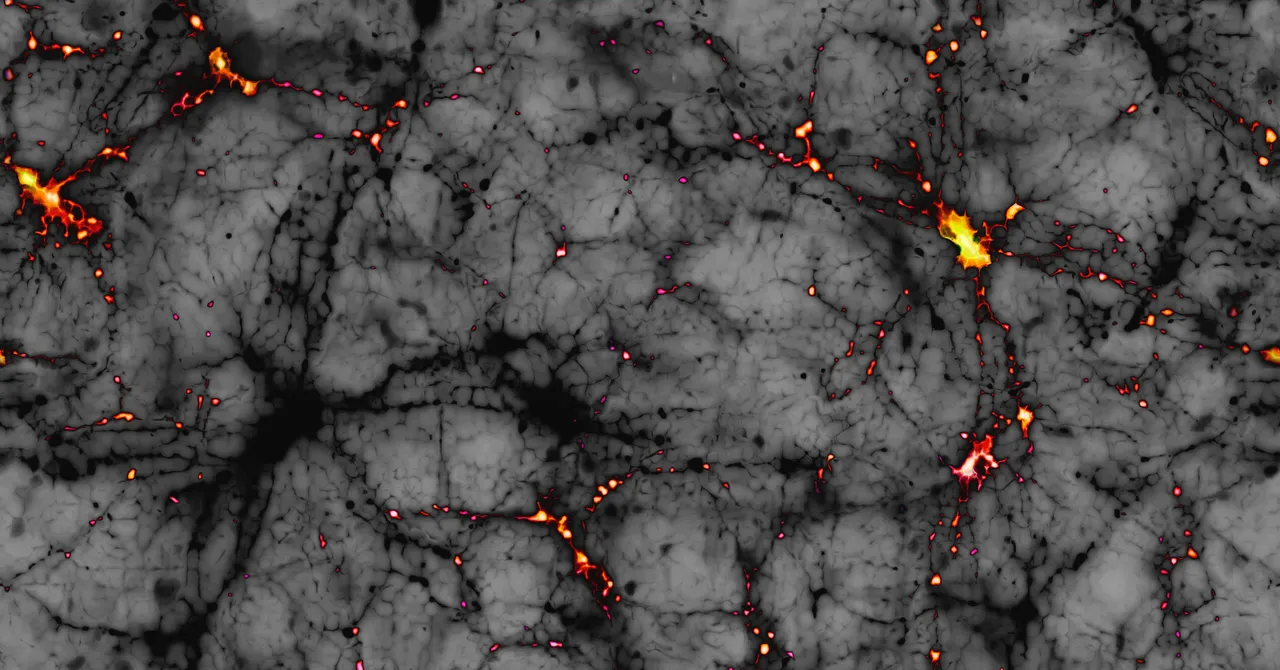
Dark matter is among the greatest mysteries in astrophysics. It is believed to account for approximately 85 percent of all matter in the universe, yet it cannot be observed directly because it does not interact with light. Instead, scientists infer its existence from its gravitational effects, including the way dark matter helped shape the cosmic web of stars, galaxies, and intergalactic structures.
The nature of dark matter remains unknown. Scientists are still trying to determine whether it consists of a single type of particle or a broader family of particles with interactions that are not yet understood. Some theories even propose that dark matter could be made up of black holes. One of the leading explanations involves WIMPs, or Weakly Interacting Massive Particles. These hypothetical particles would have mass and gravity but would interact only very weakly with ordinary matter.
If WIMPs make up part of the dark matter in the Milky Way, enormous numbers could be passing through Earth without leaving any detectable trace. On rare occasions, however, a WIMP could collide with an atomic nucleus and transfer some of its energy. Detecting an unexplained nuclear recoil is therefore highly significant in the search for dark matter particles.
The unusual event was recorded by the LUX-ZEPLIN, or LZ, dark matter experiment at the Sanford Underground Research Facility in South Dakota. The detector monitors a large tank of liquid xenon for tiny flashes of energy produced when particles interact with xenon atoms. In this case, a xenon nucleus appeared to recoil after receiving energy. Although the cause remains uncertain, some WIMP models predict precisely this type of interaction.
Researchers emphasize that a single event is not enough to confirm the discovery of a new particle. During 220 days of observations between 2023 and 2024, the experiment detected only one event matching the unusual signal. “We don’t want to get ahead of ourselves with just one event. We’re not claiming to have seen dark matter. But we did see something interesting and we want to share the scientific community’s opinion,” said Rick Gaitskell, a Brown University professor and member of the team leading the experiment. According to the project’s press release.
The LZ team has also posted its findings as a preprint, meaning the research has not yet undergone peer review. The scientists presented the results to the wider physics community at the 2026 TeV Particle Astrophysics Conference in Japan.
Potential dark matter discoveries are often met with cautious excitement. In November 2025, a team of Japanese astronomers reported possible signs of dark matter in the Milky Way, while also warning that the evidence required further investigation before any definitive conclusions could be drawn.
Even so, the LZ result could be important if additional observations reveal similar events. If the collision was ultimately caused by dark matter, researchers may be able to begin estimating the properties of the particle involved. Based on the WIMP model analyzed by the team, the particle could have a mass approximately 200 times greater than that of a proton. Studying how such a particle interacts with xenon and other forms of ordinary matter could provide valuable insight into the composition of the universe.
Source: www.wired.com