


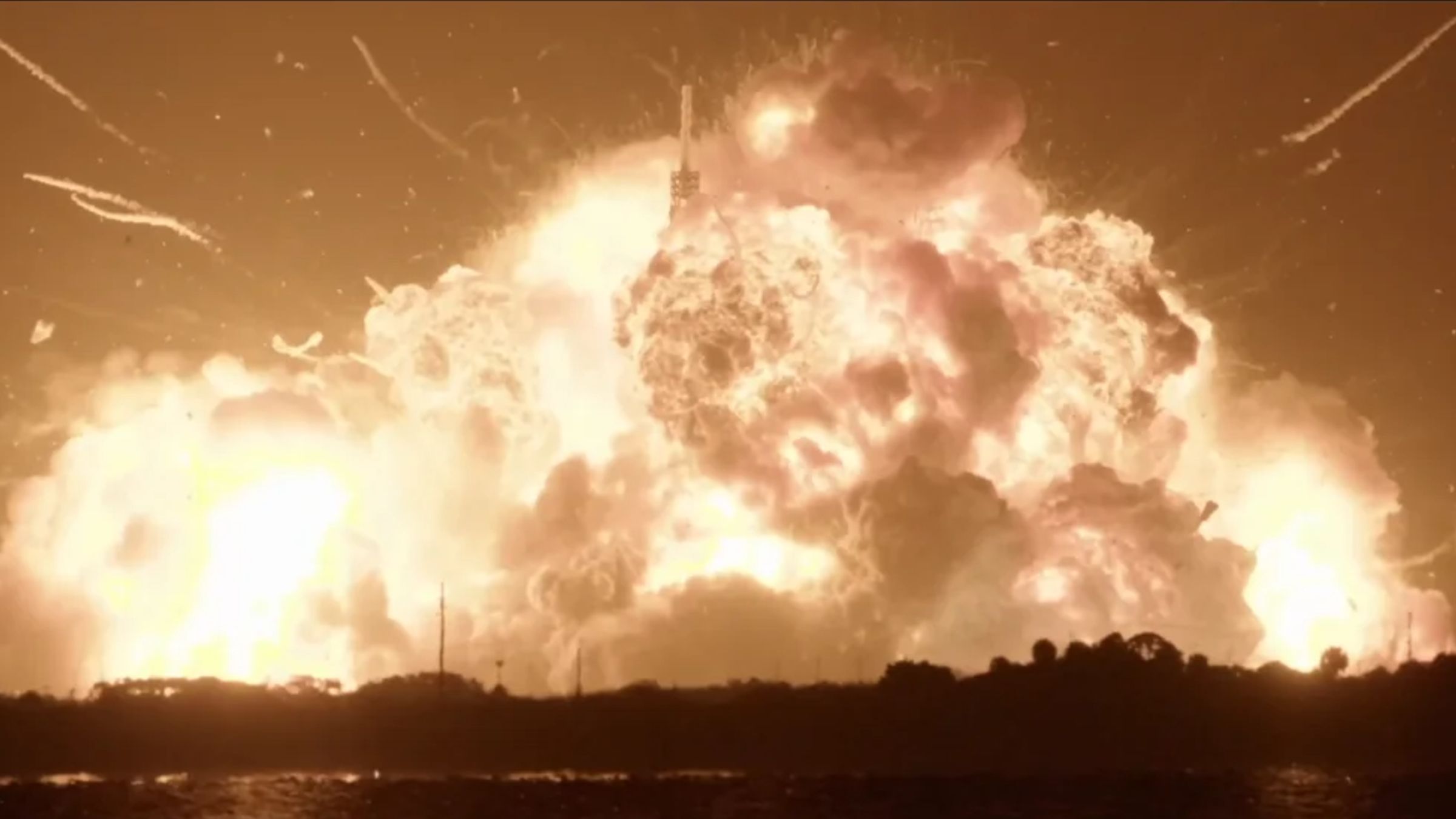
Blue Origin’s New Glenn Rocket Explosion Detected More Than 1,000 Miles Away
When Blue Origin’s New Glenn rocket exploded during a pre-launch test in Florida, the blast generated low-frequency sound waves that traveled more than 1,000 miles (1,600 kilometers) across the United States. The vibrations were too deep for humans to hear, but researchers used them to study the scale and energy of the explosion.
Blue Origin’s New Glenn is one of the largest commercial rockets ever developed. Standing approximately 320 feet (98 meters) tall, it is designed to compete with NASA’s Space Launch System and SpaceX’s Starship.
New Glenn first launched in January 2025. Subsequent missions carried spacecraft toward orbit, including NASA-related payloads. The rocket’s most recent launch, in April 2026, reached space but did not successfully deploy a communications satellite. Blue Origin has also demonstrated the ability to land New Glenn’s reusable booster, an important milestone in the company’s launch program.
On May 29, shortly before the fourth planned New Glenn launch, the rocket’s booster failed during a static “hot-fire” test at Cape Canaveral Space Force Station. The vehicle exploded without warning, sending burning debris into the air and producing a large fireball that briefly illuminated the night sky.
Blue Origin later said the explosion may have been linked to a defective oxygen valve, according to reporting by Space.com. The company has not attempted another New Glenn launch since the incident.
Latest videos fromLive Science
The New Glenn explosion is considered one of the most powerful pre-launch rocket failures ever recorded. The resulting damage could require at least a year of repairs, potentially affecting Blue Origin’s launch schedule and NASA’s plans to use New Glenn for future lunar missions.
No one was injured, but residents across Florida reported hearing a loud roar and feeling shockwaves. The effects were detected as far as 135 miles (217 kilometers) from the launch site, according to Florida Today.

New Glenn launched for the first time from Cape Canaveral Space Force Station on Jan. 16, 2025.
(Image credit: U.S. Space Force)
Infrasound revealed the scale of the rocket explosion
A study published Aug. 12 examined infrasound generated by the New Glenn explosion. Infrasound consists of low-frequency pressure waves below the range of human hearing. Researchers analyzed recordings from specialized monitoring stations across the United States and found signals from the blast at 36 locations.
The farthest detection came from northeast Texas, approximately 1,046 miles (1,684 kilometers) from Cape Canaveral Space Force Station. The findings demonstrate how infrasound can help scientists study rocket failures, industrial accidents and other large-scale energy events.
Lead author Elizabeth Silver, a physicist and planetary scientist at Sandia National Laboratories, described the event as an unusually valuable opportunity to analyze a major explosion in the real world. The research was published in The Seismic Record.
Get the world’s most fascinating discoveries delivered straight to your inbox.
How powerful was the New Glenn blast?
Using the frequency and travel distance of the infrasound waves, researchers estimated that the explosion released energy equivalent to approximately 0.131 kilotons, or 144 U.S. tons, of TNT. That estimate is slightly greater than some estimates for the initial explosion at the Chernobyl nuclear power plant in 1986.
The researchers also estimated that only about 3% to 6% of the booster’s cryogenic propellant was consumed during the initial blast. Although the fireball appeared enormous, rocket fuel and oxidizer do not necessarily mix and react simultaneously.
“In a major propellant incident, the fuel and oxidizer don’t necessarily mix and react all at once,” Silver said. “Some materials may contribute to the initial explosion, while others may burn gradually in a fireball or plume.”

The latest New Glenn launch took place on April 19, 2026. The rocket reached space but failed to deploy a communications satellite correctly.
(Image credit: Paul Hennesy/Anadolu via Getty Images)
Scientists believe infrasound could become an important tool for investigating spacecraft accidents and other powerful explosions around the world. Because these sound waves can travel vast distances, monitoring stations may help researchers locate an event, estimate its energy and reconstruct what happened even when direct observations are limited.
The same research team has previously used low-frequency sound waves to track a meteor’s path through Earth’s atmosphere and analyze the return capsule from NASA’s OSIRIS-REx mission in 2023.
Source: www.livescience.com