


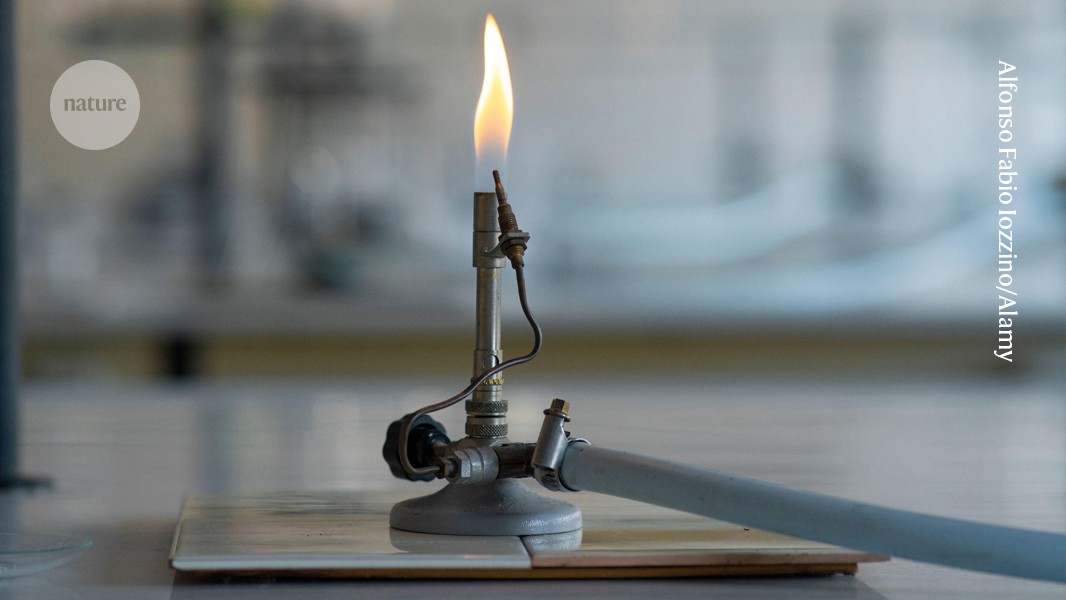
The role of Bunsen burners in modern microbiology laboratories is being questioned.
Credit: Alfonso Fabio Izzino/Alamy
Bunsen burners have been standard equipment in biology and chemistry laboratories for nearly two centuries. However, new research suggests that their reputation as a tool for reducing laboratory contamination may be undeserved.
Scientists have traditionally used Bunsen burners to help decontaminate laboratory air and work surfaces. The idea was that heat from the flame creates convection currents, carrying airborne particles and microorganisms away from the workbench. But a new study found that Bunsen burners do not reliably remove bacteria from laboratory workspaces and could, under some conditions, increase contamination.
The research was published in August in Microbiology Spectrum1.
Biologists have long disagreed about the effectiveness of Bunsen burners, says study co-author Hannah Gavin, a microbiologist at Providence College in Rhode Island. Some researchers have trusted the flames to sterilize nearby work areas, while others have questioned whether the practice is supported by evidence. The findings could intensify debate over whether Bunsen burners still belong in modern biology laboratories. Amir Mitchell, a systems biologist at the University of Massachusetts Chan Medical School in Worcester, says the results could be a “nail in the coffin” for the use of burners in microbiology labs.
Long-standing laboratory practice questioned
Researchers began using Bunsen burners almost 200 years ago. Despite their long history, Gavin found no experimental evidence in the scientific literature demonstrating that the devices decontaminate surrounding surfaces or air. This lack of evidence, she says, allowed assumptions, theories and laboratory folklore about Bunsen burners to persist.
To test whether Bunsen burners can prevent the spread of airborne bacteria, Gavin and her colleagues used Gordonia rubripertincta, a bright-orange bacterium that is easy to identify on Petri dishes and is unlikely to contaminate a laboratory. The team designed experiments to mimic common sources of bacterial contamination, including dust disturbed by vacuum cleaners, sneezes and skin particles shed by laboratory workers.
Your lab is contaminated: Here’s how to stop it
In the experiments, the researchers contaminated the air above a laboratory bench by spraying a liquid containing G. rubripertincta into the air or by shaking a bacteria-coated dry towel. Immediately afterwards, they lit a Bunsen burner and placed an open Petri dish beside it. They also placed dishes beside inactive burners in separate contaminated workspaces, where the flames could not influence the surrounding air. The dishes remained open long enough for airborne bacteria to settle and grow on their surfaces before being closed.
The researchers tested different burner sizes, bacterial concentrations and experimental conditions. In almost every experiment, dishes placed beside an operating Bunsen burner contained the same number of bacteria as, or more bacteria than, dishes placed beside an inactive burner. The only test in which active burners were associated with fewer bacterial colonies involved contamination levels “orders of magnitude higher” than those typically found in modern laboratories, Gavin says.
Source: www.nature.com