


How Five 60-Sided Dice Create a Perfectly Fair First Roll
Around 2010, board game designer James Ernest posed an intriguing question to his friend Eric Hershberger over dinner at a gaming convention: Could you design a set of dice that allows any number of players to roll for first place with exactly equal odds?
The rules seemed simple. Each player takes one die, rolls it, and the person with the highest number goes first. The challenge was creating a system that remained completely fair for two players, three players, four players or any other group size—without ties or rerolls.
Hershberger, a mathematician at Auburn University in Alabama, did not solve the puzzle that night. But the question stayed with him. Over the next 15 years, he and a small network of collaborators worked on what became known as the “go first dice” problem.
The team has now found an answer: five 60-sided dice containing every number from 1 to 300 exactly once. Each die uses a carefully selected group of numbers so that any subset of players can roll and still have an equal chance of winning.
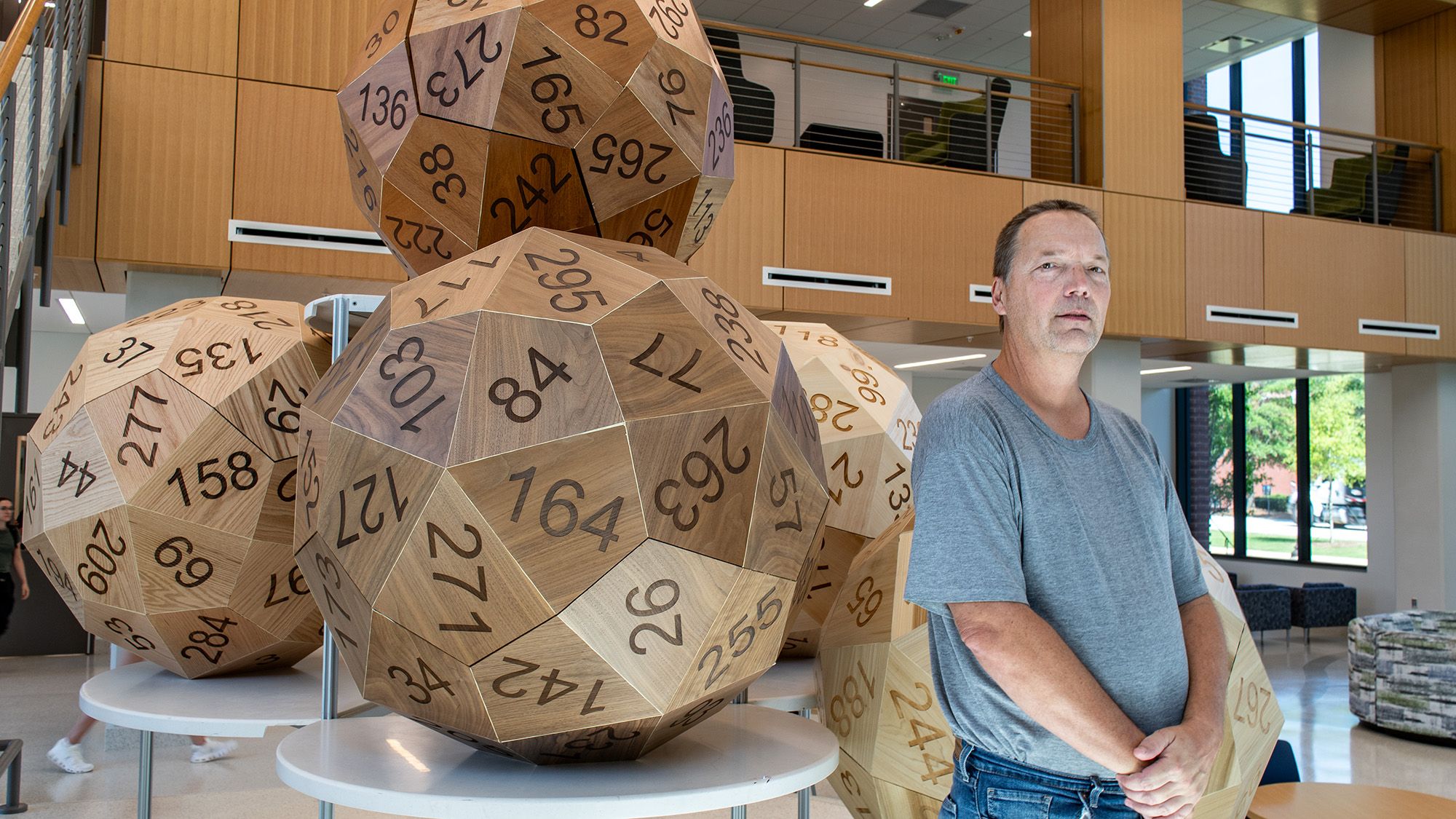
To celebrate the achievement, Hershberger built five oversized wooden replicas of the dice. Each sculpture was made from a different type of wood and placed on permanent display in Auburn University’s new mathematics building.
The Mathematical Challenge Behind Fair Dice
The basic requirement is easy to understand: every die must produce a unique result during a roll, eliminating the possibility of a tie. But avoiding ties is only the beginning.
“The simple thing is to avoid ties. Just roll different numbers on all the dice,” Hershberger told Live Science. “The question becomes, how do we distribute these different numbers across the dice so that the probabilities are equal not just for the entire set but for every subset?”
That second condition makes the problem difficult. The dice must remain fair regardless of how many players participate. If five people play, each person can take one die. If only three people play, any three dice selected from the set must still give every player the same chance of rolling the highest number.
In other words, fairness must be built into every possible combination of dice—not just the complete set.
From Three Dice to Five-Player Fairness
Hershberger eventually brought the problem to his childhood friend Robert Ford, a mathematician at Dalton State University. Within a few weeks, the pair developed a three-player solution using three standard six-sided dice.
The numbers 1 through 18 were distributed across the dice in a precise pattern. Ford later created a four-player version using four 12-sided dice, which he made by hand.
By 2012, Hershberger was presenting the four-player dice at mathematics conferences. The Guardian covered the project, and interest quickly grew. Hershberger began producing handmade sets from his home, using a laser cutter to etch the numbers before coloring them by hand.
As demand increased, he shipped dice sets to customers around the world. But the mathematical properties of the dice turned out to be even more interesting than their ability to determine who goes first.
What Is Permutation Fairness?
The dice do not merely identify the winner of the first roll. They can also establish a completely fair turn order for every player.
“If four people roll, a player is just as likely to finish in the order A, B, C, D as they are to finish C, B, D, A—or any other combination,” Hershberger explained.
This property became known as permutation fairness. It means that every possible ranking of the players has the same probability of occurring. The phrase “first-roll dice” is therefore something of an understatement: the dice can determine the entire order of play.
A Search Space Larger Than the Number of Atoms
Finding a fair arrangement for four players was difficult. Designing one for five players was vastly more challenging.
The mathematicians knew that a five-player solution should exist, but the number of possible configurations was enormous. Hershberger estimated that the search involved roughly 10128 combinations—an unimaginably large number, far exceeding the estimated number of atoms in the observable universe.
Brute-force computing was not a realistic option. The team had to use mathematical shortcuts, symmetry and recurring patterns to reduce the number of possibilities. Even then, years passed without a practical five-player design.
The theoretical solutions often required dice that were too large to manufacture or too unwieldy to roll. Hershberger wanted a set that could be produced, held in a player’s hand and purchased by board-game enthusiasts—not a design involving an impractical 180-sided die.
The five fair first-roll dice each have 60 sides. Together, they contain every number from 1 to 300 exactly once.
Image credit: Eric Hershberger
Five 60-Sided Dice Solve the Problem
In mid-2023, Canadian software engineer Paul Mayer contacted Hershberger after studying the patterns in the existing four-player designs. Mayer developed computer programs to search for a workable five-player arrangement.
His approach succeeded. Mayer discovered a configuration of five 60-sided dice that met every requirement.
Each die contains 60 numbers, and together the five dice use every integer from 1 to 300 without repetition. Any group of players can select dice from the set, roll them and receive an equal chance of winning. The same design also produces a fair probability for every possible turn order.
“I looked back at his work and thought, ‘Oh my God, we’ve been looking for this for a long time. This is great,’” Hershberger said.
From Handmade Dice to Mathematical Art
The four-player version of the dice has been available through retailers such as Maths Gear in the United Kingdom and Math Art Fun in the United States. Hershberger eventually stopped producing the sets himself, but the five-player solution was compact enough to make commercial manufacturing possible.
The project also inspired a permanent public art installation. When Auburn University built a new home for its mathematics department, the university sought ideas for a sculpture. Hershberger proposed creating enormous wooden versions of the five fair dice.
He spent months building the sculptures in a woodworking shop. The five dice were made from pine, poplar, oak, walnut and mahogany. They now stand in Auburn’s new mathematics building, which opened in 2026.
For Hershberger, the project shows how an abstract mathematical idea can become a practical object and a piece of art.
“When people see giant dice or small dice, they’re fascinated by the geometric patterns,” he said. “I hope they look at them and think, ‘This is math too. This is interesting.’ Some of the most enjoyable math problems are easy to understand—but much harder to solve.”
Source: www.livescience.com