


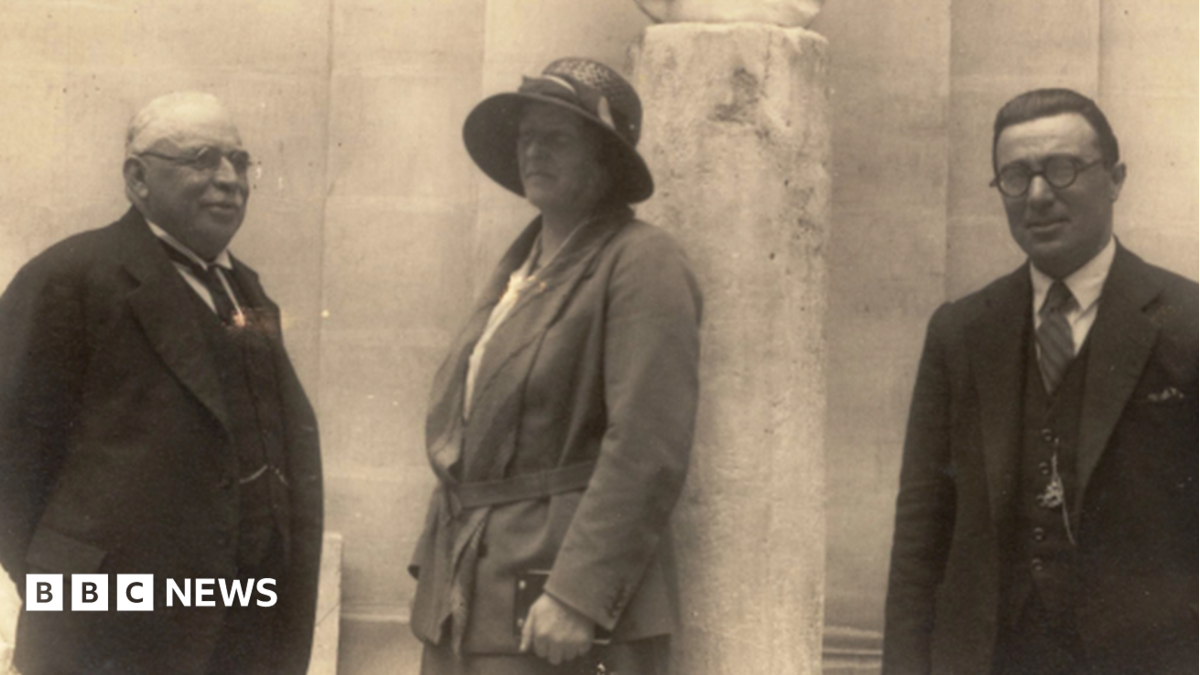
Pioneering fossil hunter Dorothea Bate, one of the first women employed by the Natural History Museum, has been recognized with a National Blue Shield for her contribution to palaeontology.
Bate, who died in 1951 at the age of 72, transformed scientists’ understanding of prehistoric animals and ancient environments through her groundbreaking fossil research, according to Historic England.
Her achievements are commemorated by a plaque at the Natural History Museum in Tring, Hertfordshire. The plaque describes the pioneering palaeontologist as “Director of this Museum since 1948”.
Dorothea Bate was born in Carmarthen, Wales, in 1878 and developed a fascination with the natural world from an early age.
After moving with her family to rural Gloucestershire, she spent much of her time exploring the countryside, caves and surrounding landscapes while collecting fossils.
Despite receiving little formal education, Bate became largely self-taught. In 1900, she secured behind-the-scenes work at the Natural History Museum in London, where her determination and scientific ability quickly impressed museum staff.
She was appointed as an assistant, beginning a relationship with the museum that lasted for more than 50 years and established her as a leading female palaeontologist.
Bate published her first scientific paper in 1901. Titled “A Short Description of Bone Caves in the Carboniferous Limestones of the Wye Valley”, the study reflected her early expertise in fossil discoveries and cave deposits.
She later undertook expeditions across the Mediterranean, often travelling alone into remote caves to search for evidence of ancient life.
In Cyprus, Bate discovered a previously unknown species of dwarf elephant. In 1909, during an expedition to the Balearic Islands, she identified the myotragus, an extinct goat-like antelope.
Throughout her career, she published more than 80 scientific papers, despite spending much of her professional life without a regular paid position.
In 2017, a blue plaque was unveiled at Napier House in Carmarthen, the birthplace of Dorothea Bate, commemorating the pioneering fossil hunter’s lasting contribution to science and palaeontology.
Source: www.bbc.co.uk