


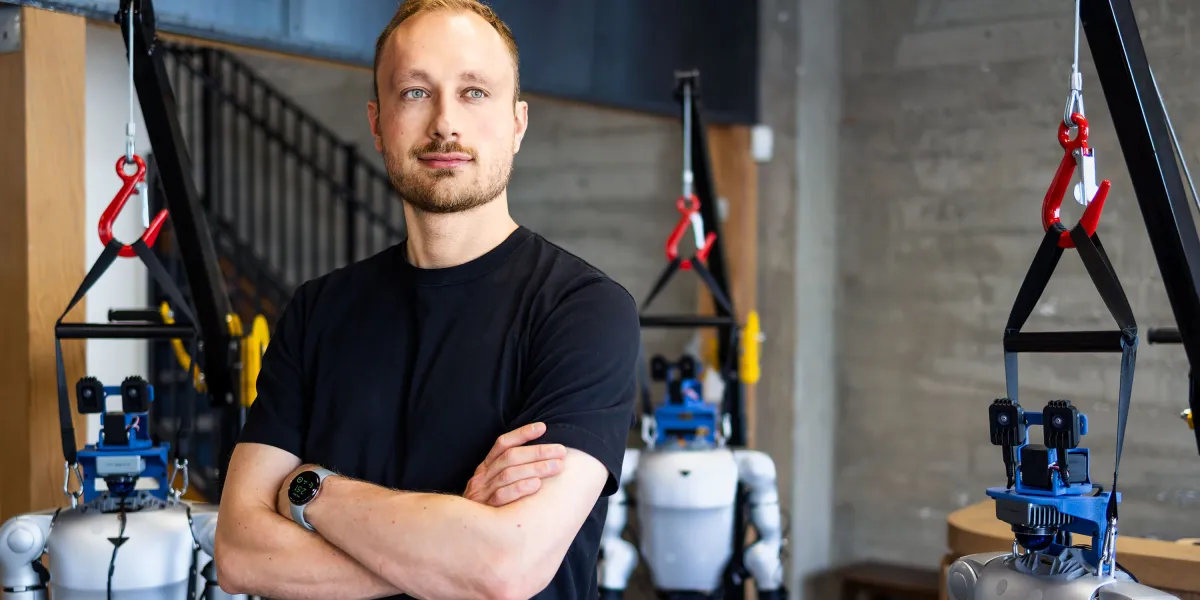
Hafner’s approach is based on model-based reinforcement learning, a method that enables artificial intelligence to learn by simulating real-world conditions. He develops world models—AI systems designed to replicate how the physical world works—and trains intelligent agents inside those simulations. The agents use these virtual environments to learn how to respond to different situations. Their experiences are then used to predict future outcomes, a process Hafner describes as “dreaming” or “imagining.” This technology could help AI agents and robots navigate unfamiliar environments more effectively.
“I get to interact with a lot of really smart people in research at Google, and he could easily be in the top half of the 1%.”
Timothy Lillicrap, Google DeepMind
Unlike many traditional robotics systems, Hafner’s technology enables AI agents and the robots they control to perform highly complex tasks without relying on extensive real-world trial-and-error training. By learning inside AI-generated simulations, robots can develop skills more efficiently, safely, and cost-effectively.
Hafner grew up in a rural town in northeastern Germany, where both of his parents were classical musicians. He learned to program with help from a neighbor and began taking online artificial intelligence courses while still in high school. He quickly developed a passion for AI and computer science. “I’ve always been interested in how thinking works,” he says. Artificial intelligence gave him a way to explore and replicate aspects of human thought using computers.
In 2015, while studying engineering as a second-year undergraduate at the Hasso Plattner Institute in Potsdam, Hafner secured a position as a student researcher at Google Brain. He went on to complete 12 internships and hold other research positions at Google Brain and Google DeepMind, which have since been combined under DeepMind, in the United Kingdom, Canada, and the United States. During his career, he worked with leading AI researchers, including Geoffrey Hinton—widely known as one of the godfathers of artificial intelligence—and Ashish Vaswani, co-author of the influential research paper “Attention Is All You Need.” The paper introduced Transformer technology, which now powers many of today’s large language models.
Source: www.technologyreview.com