


Traditional steelmaking relies heavily on coal, and the global steel industry produces approximately 7% of climate-changing carbon emissions—roughly the same share as the fashion industry. Decarbonizing steel production has proven difficult because profit margins are tight and industrial furnaces typically operate for decades, making major upgrades challenging to justify.
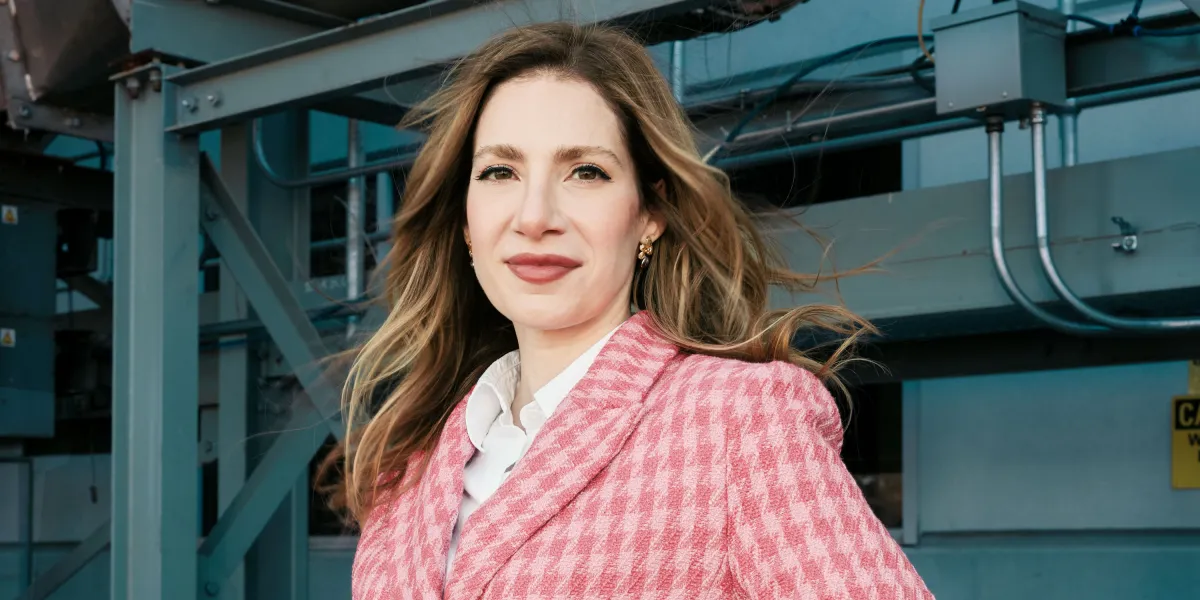
Laureen Meru may have developed a way to make steel production cleaner without increasing prices. Meru, the founder of Herta Metals, invented a furnace that simplifies the chemistry of steelmaking. Her technology converts iron ore into refined liquid steel in a single step while replacing coal with natural gas. According to Meru, these innovations could cut emissions by at least 50% and reduce production costs by 25% compared with conventional steelmaking.
If adopted at scale, Herta Metals’ low-carbon steel technology could transform the industry. “There is great value in scaling down this production system,” says Irina Zhenyuk, director of the National Fuel Cell Research Center at the University of California, Irvine. “Traditional steel facilities are huge, inefficient and require a significant amount of energy, so improving energy efficiency alone would be a major step forward.”
Herta’s approach focuses on improving what can be changed in the steel industry today, rather than waiting for a completely zero-carbon system.
Although launching a new steelmaking technology is a risky undertaking, pushing boundaries is nothing new for Meru. At age 12, she was accepted into a pilot program that allowed her to take college-level courses through Florida Atlantic University instead of following a traditional secondary education. She quickly developed an interest in engineering and studied subjects including calculus and ocean-wave energy.
Despite her demanding coursework, Meru spent hours sitting in trees and surfing, cultivating a deep appreciation for nature and a commitment to protecting it. “I don’t know why I wouldn’t be drawn to trying to protect it,” she says.
Now 34, Meru has turned that passion into a professional mission. After earning a PhD in mechanical engineering from the Massachusetts Institute of Technology, she led a green-hydrogen startup before founding Herta Metals in 2022. A first-generation Lebanese American from a family of entrepreneurs, she viewed launching her own company as a natural career path. “I saw how common it was to jump in and start my own business, and I thought, ‘This is normal,’” she explained during a video call from Herta’s pilot plant in Conroe, Texas, north of Houston.
The facility can produce one tonne of steel per day. “One tonne per day is a major milestone in steel production,” says Rajesh Swaminathan, a partner at Khosla Ventures, one of Herta Metals’ investors. As of July 2026, Herta had raised approximately $20 million in funding.
Swaminathan describes the company’s growth as “impressive,” particularly given its relatively low spending. He says far fewer competitors are producing steel with only $50 million to $100 million in funding.
Source: www.technologyreview.com