


8/10
Scientists Complete the First Full Connectome of an Adult Male Fruit Fly
After nearly 20 years of research, scientists have completed the first wiring diagram of the entire central nervous system of an adult male fruit fly, Drosophila melanogaster.
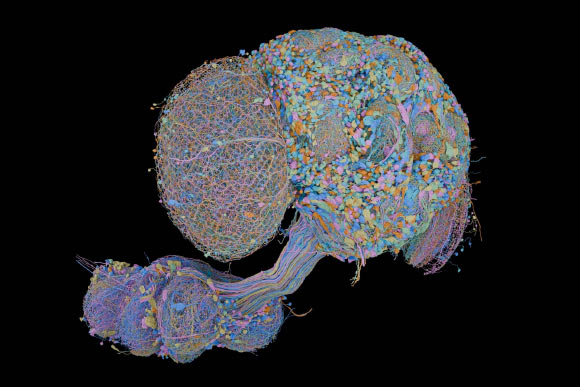
The complete connectome of an adult male fruit fly could help scientists understand how neural circuits control sensory perception, movement, and behavior. Image credit: FlyEM Project Team, HHMI Janelia Research Campus / Cambridge Connectomics Group / Google Research / Philip Hubbard, HHMI Janelia Research Campus.
Researchers have created a complete connectome of the adult male fruit fly, mapping approximately 166,700 neurons and millions of connections throughout the brain and ventral nerve cord.
A connectome is a detailed wiring diagram of the nervous system. Scientists use these maps to study how neural circuits process information and generate behavior.
“We felt that we would not be able to understand the brain to a satisfactory level without wiring diagrams, but this was not a widely accepted idea,” said Dr. Jerry Rubin, founding executive director of the Howard Hughes Medical Institute’s Janelia Research Campus.
“We knew it was possible. It was a well-defined problem. We just had to figure out how to make it happen.”
The newly completed fruit fly connectome is the first comprehensive map of the insect’s entire complex central nervous system. In 2020, the same research team published a partial “half-brain” connectome covering approximately half of the fly’s brain.
How the Fruit Fly Brain Connectome Could Advance Neuroscience
The complete wiring diagram will allow researchers to trace neural pathways from sensory input to behavior. By following these circuits, scientists can investigate how fruit flies perceive their surroundings, make decisions, move toward goals, and respond to environmental cues.
The map may also help researchers compare male and female nervous systems. Such comparisons could provide new insight into sexually dimorphic behaviors, including mating, aggression, and social interactions.
Because the fruit fly has a relatively compact nervous system but displays complex behaviors, Drosophila melanogaster is an important model organism for neuroscience and genetics.
“Humans have a certain lack of imagination, but eventually they see something and say, ‘I get it,’ and that’s why this is so important,” Dr. Rubin said.
“This is what the half-brain has done for neuroscientists by showing us what we can learn from the connectome. It just changed people’s attitudes about what’s possible.”
The research team says the project represents the culmination of nearly two decades of work involving scientists, engineers, and data-analysis specialists.
“For me, I’ve been working on this longer than I’ve worked on any other scientific goal in my life, and I’m ready to stop and think about something else,” Dr. Rubin said.
“But there was an immense sense of pride and accomplishment in the group of people we brought together here, and that made it a success.”
The findings are described in a paper published in the journal Cell.
_____
Stuart Berg and colleagues. “Complete Sexual Dimorphism in the Drosophila Male Central Nervous System Connectome.” Cell, published online September 3, 2026. doi: 10.1016/j.cell.2026.08.015.
Sources: HHMI, Google Research, and Cell.
Source: www.sci.news