


The Smith Hat Monotile Reveals a New Connection Between Aperiodic Geometry and Light
A mathematical shape that captured global attention by solving a decades-old puzzle is now revealing an unexpected connection to physics. Researchers have discovered that structures based on the Smith Hat monotile can make light form unusual chiral patterns, offering a new way to explore how geometry influences optical behavior.
How the Smith Hat solved the Einstein problem
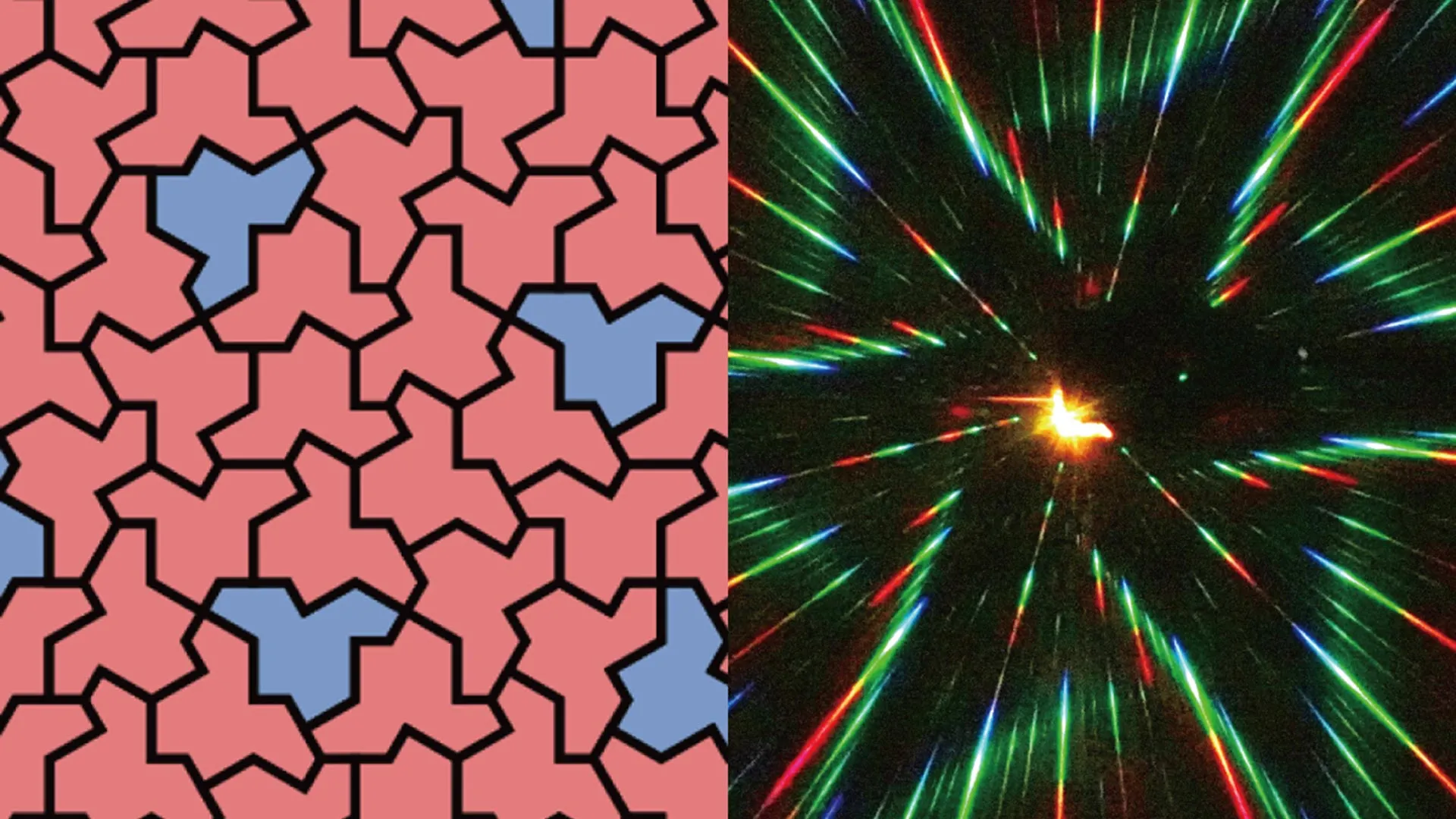
In a study published in Nature Communications, researchers at the Institute of Industrial Science at the University of Tokyo and a joint research institute constructed an optical structure inspired by the “Smith Hat.” This unusual shape is known for solving the mathematical “Einstein problem.” When the researchers illuminated the structure with laser light, they observed diffraction effects that differed from those seen in conventional quasicrystals.
The Einstein problem asks whether a single tile shape, known as a monotile, can cover an entire surface without creating a repeating pattern.
Familiar arrangements, such as checkerboards and honeycombs, repeat regularly. By contrast, aperiodic monotiles can fill a surface without settling into a repeating arrangement.
In 2023, researchers discovered the first known monotile of this type, the Smith Hat. The discovery attracted widespread attention because it provided a long-sought solution to a major question in mathematics.
“What is particularly interesting about the hat tiles is that although the resulting pattern appears irregular at first glance, it is actually composed of a honeycomb lattice,” says lead author Yuto Mori. “We wanted to see if this unique shape could cause unexpected physical phenomena.”
Turning a mathematical pattern into an optical structure
To test that possibility, the researchers used electron-beam lithography to create a nanoscale version of the Smith Hat pattern on a silicon nitride film.
When laser light was directed at the structure, the resulting diffraction pattern formed a distinctive pinwheel-like shape. These patterns directly revealed the chiral nature of the aperiodic structure.
Chirality is a property of handedness in which a structure and its mirror image do not match perfectly. In this case, the unusual arrangement of the monotile pattern caused the light to exhibit a chiral response.
“We found that because the structure lacks mirror symmetry, the diffraction pattern itself becomes chiral,” explains senior author Masaya Notomi. “This kind of optical response is fundamentally different from that observed in conventional quasicrystalline materials.”
Light responds to direction and polarization
The researchers also found that the diffraction pattern changes depending on both the direction and the polarization of the incident light.
When the physical structures were mirrored, their optical behavior was reversed as well. This demonstrates that the optical response is directly tied to the symmetry of the underlying pattern, revealing a new type of symmetry-controlled optical behavior.
“These results open new directions for research on the fusion of quasi-periodic order and chirality,” said Professor Moritake. “Monotile patterns provide a platform to explore optical phenomena that emerge from the interactions of symmetry, chirality, and aperiodicity.”
From abstract mathematics to new optical physics
Researchers say monotile-inspired structures could eventually contribute to technologies designed to manipulate light, control polarization, and support advanced optical devices.
More broadly, the findings show how discoveries that begin as abstract mathematical puzzles can lead to unexpected physical effects. The Smith Hat was first celebrated for solving the question of how a single shape could cover a surface without forming a repeating pattern. Now, its unusual geometry may also help researchers discover new ways to control and study light.
Source: www.sciencedaily.com