


James Webb Space Telescope Reveals Chariklo’s Rings Are Changing
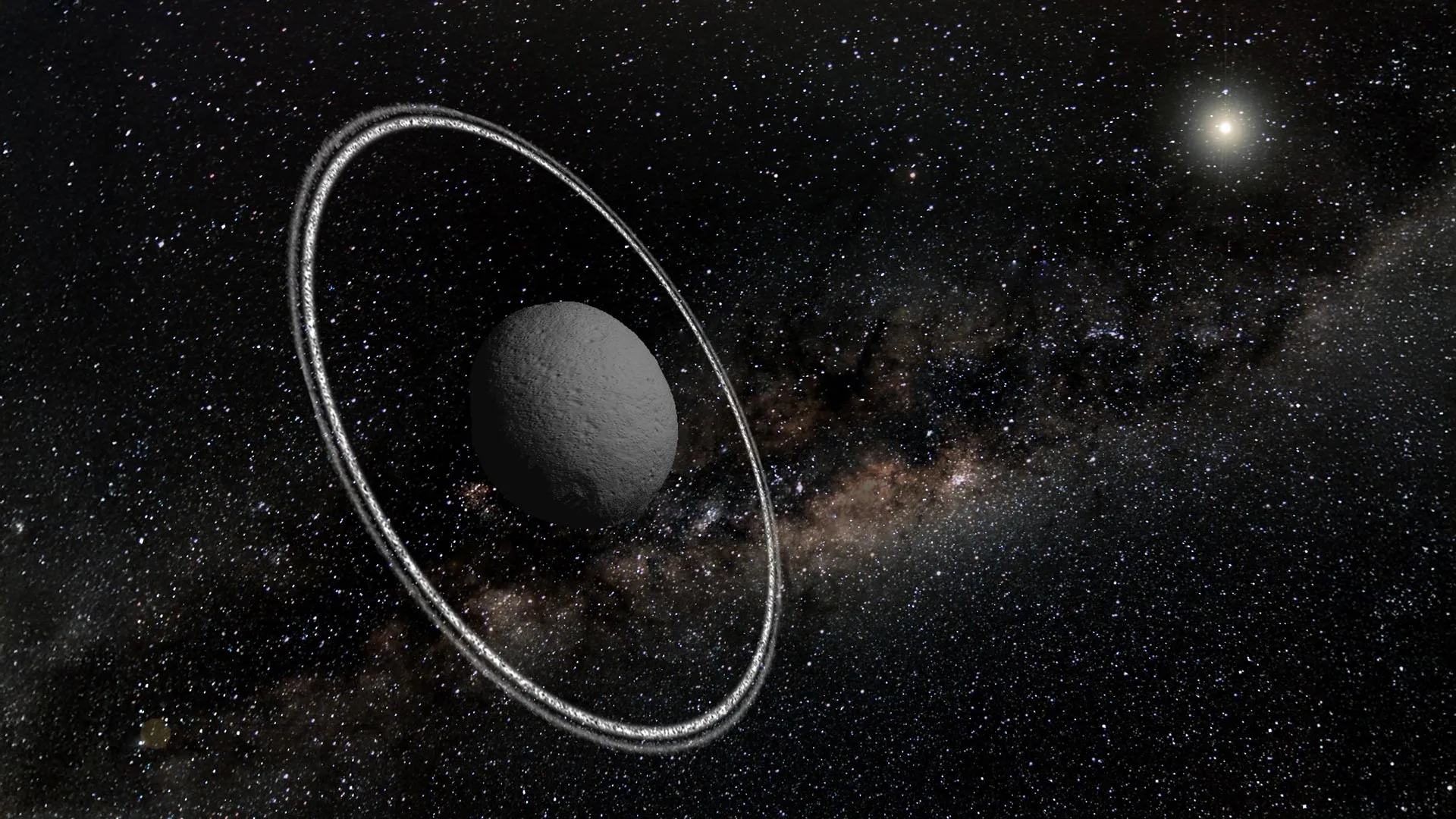
For most of modern astronomy, rings were associated only with the solar system’s giant planets: Jupiter, Saturn, Uranus and Neptune. That changed in 2013, when astronomers discovered two dense rings around Chariklo, a small object about 250 kilometers in diameter that travels between Saturn and Uranus.
Now, new observations from the James Webb Space Telescope (JWST) show that Chariklo’s rings may be less stable than scientists once believed. A study published in Science Advances, led by the Andalusian Institute of Astrophysics (IAA-CSIC), provides the first evidence that the ring system changed over just a few years.
James Webb detects changes in Chariklo’s two rings
The key observation took place on October 18, 2022, when researchers used JWST to observe Chariklo passing in front of a distant star. This event, known as a stellar occultation, gives astronomers a way to study objects that are too small or distant to image directly.
As Chariklo and its rings passed across the star, they temporarily blocked some of its light. The resulting changes in the star’s brightness allowed researchers to measure the structure and opacity of the rings.
The team compared the JWST data with earlier stellar occultation observations collected over the previous decade. The comparison revealed that Chariklo’s two rings have changed in different ways.
“By comparing the JWST observations with those obtained during other stellar occultations over the past decade, we discovered opposite changes in the two rings: the inner ring shows significantly higher opacity, while the outer ring shows lower opacity,” explains IAA-CSIC researcher Pablo Santos Sanz, who led the study.
In practical terms, the inner ring blocks more light than it did before, while the outer ring blocks less. This unexpected contrast suggests that Chariklo’s rings are active, evolving structures shaped by physical processes that are more complex than scientists previously realized.
A first for the James Webb Space Telescope
The observation also marked a technical milestone for JWST. It was the first stellar occultation specifically predicted, planned and successfully observed using the space telescope.
Making the observation possible required extraordinary precision. Researchers needed accurate information about Chariklo’s orbit, the position of the background star and JWST’s own movement through space.
“To achieve this, we have to use Chariklo’s orbit, the star’s position thanks to ESA’s Gaia mission, and JWST’s own orbit around the L2 Lagrangian point, a region of space about 1.5 million kilometers from Earth, with extraordinary precision,” said Yucel Kilic, a postdoctoral researcher at IAA-CSIC and a co-author of the study. “JWST follows an orbit around this region, which requires periodic corrections through station-keeping maneuvers.”
A rare, detailed view of an otherwise invisible ring system
During the occultation, Chariklo was moving at about 2.5 kilometers per second relative to JWST. This unusually slow relative motion enabled researchers to obtain highly detailed spatial information about the rings.
Direct photography of the rings is not possible. Chariklo is so distant, and its rings are so narrow, that they cannot be resolved in images from JWST or even the largest ground-based telescopes.
Stellar occultation provides a powerful alternative. Distant stars act as natural backlights: whenever one of Chariklo’s rings crosses in front of a star, the star’s light temporarily decreases. By analyzing those changes, astronomers can measure ring properties that would otherwise remain hidden.
Small ring systems may be more dynamic than expected
Scientists generally considered the rings around small solar system bodies to be relatively stable structures. Chariklo now provides evidence that this assumption may need to be reconsidered.
The changes detected over only a few years suggest that small ring systems can evolve on surprisingly short timescales.
“Our results force us to reconsider how they form, how they evolve, and what mechanisms maintain their stability,” Santos Sanz says. “The ability to detect these changes opens new windows for understanding the evolution of these systems, and perhaps the evolution of other ring systems in the solar system.”
The exact cause of the apparent changes remains unknown. They could reflect genuine evolution within Chariklo’s rings, differences resulting from the filters used during separate observations, or a combination of both possibilities.
What Chariklo’s changing rings could reveal
The Andalusian Institute of Astrophysics led the major stages of the research, including the project’s scientific design, the prediction of the Chariklo occultation observed by JWST, the analysis of the data and the interpretation of the physical processes involved.
The IAA-CSIC team also played a central role in modeling the rings and conducting statistical analyses to determine whether the observed changes were real. Researchers from Spain, Brazil, France, Hungary and the United States contributed to the study.
By showing that Chariklo’s seemingly stable rings can change within only a few years, the observations give astronomers a new way to investigate how ring systems around small worlds form, evolve and remain intact over time.
Source: www.sciencedaily.com