


NASA Artemis Mission Recommendations on EVA Prebreathing, Decompression Sickness, VTE and PFO
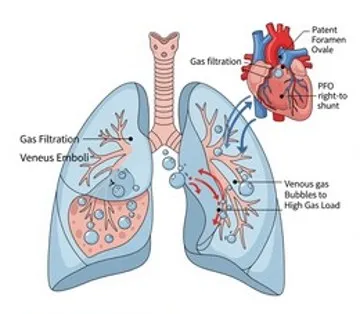
The NASA working group brought together an expert panel to review the latest data on extravehicular activity (EVA) prebreathing tests, decompression sickness (DCS) events, onboard venous thromboembolism (VTE), and patent foramen ovale (PFO) in support of the Artemis Moon and Beyond missions.
The recommendations incorporate the September 2024 report Evaluation of Patent Foramen Ovale (PFO) Associated with Decompression Sickness (DCS) During Spaceflight Environments and Ground Tests (NASA/SP-20240010473), the April 2026 NASA Spaceflight Venous Thromboembolism Risk Working Group report (NASA/SP-20240010473), and the results of 20260005258/REV1. They also reflect the latest DCS prevention standards reviewed by the DCS Panel in NASA-STD-3001 Volume 2: Human Factors, Habitability, and Environmental Health (NASA-STD-3001 Vol. 2, Rev. F).
The working group focused specifically on risk-reduction interventions, including PFO closure. Its recommendations are summarized below.
Key Recommendations for Artemis EVA and DCS Risk Management
-
Do not exclude terrestrial study participants solely because of LVGE.
Terrestrial studies should no longer exclude subjects solely because LVGE is present. Study protocols should balance participant safety with population representativeness. Subjects must be fully informed about their LVGE status and associated risks.
-
PFO should not change astronaut selection criteria for VTE risk.
The consensus was that PFO is not a major risk factor for VTE formation in normoxic or hypoxic space habitats. It is also not considered a major risk factor for complications caused by embolism migrating from the left internal jugular vein or from the site where it initially formed in the cerebrum. The group therefore did not recommend changing astronaut selection criteria based on PFO.
-
Bubble grade has no definitive association with DCS risk during partial-gravity ambulation.
For prebreathing protocols involving partial gravity and ambulation, the group found no definitive association between bubble grade and the risk of DCS at altitude.
-
The predictive value of DCS bubble scores remains uncertain.
Although minimizing bubbles is desirable, the committee concluded that the DCS bubble score has uncertain predictive value, particularly for lunar surface operations.
-
Small PFOs are not considered a significant risk.
A “small” PFO, defined as grade 1 or 2, was not determined to pose a significant risk. Opinions varied on whether screening or closing “large” PFOs, defined as grade 3 or higher, would significantly reduce the risk of venous gas embolism (VGE) crossing to the arterial side and causing a critical mission health event.
The group did not recommend universal PFO screening or exclusion of astronauts with large PFOs. Instead, it emphasized risk mitigation through protocol design and continued data collection. If crew members are assessed, they should be informed about the condition and recommended for major PFO closure.
-
Establish clear medication guidance before and after EVA.
The committee concluded that clear clinical guidance is needed regarding medication use by all crew members before EVA. Protocols should specifically address aspirin use for DCS prevention and analgesia.
Analgesics, including acetaminophen, ibuprofen, naproxen, and celecoxib, may mask DCS symptoms. Guidance is therefore needed for their use before and after EVA.
Source: www.nasa.gov