


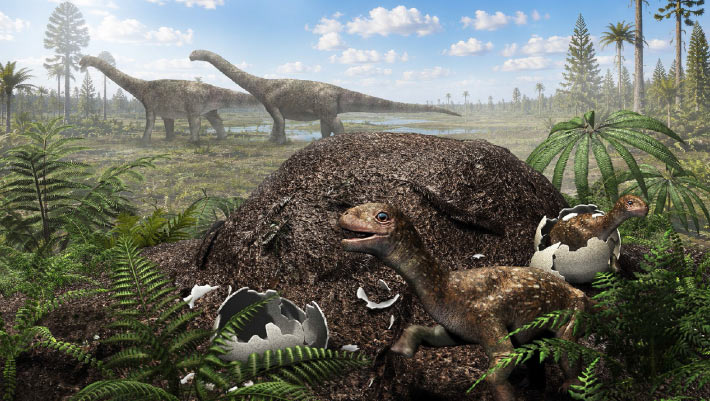
70-Million-Year-Old Dinosaur Eggs Reveal Titanosaurs Nested in Southern Patagonia
Fossilized eggshells discovered in Patagonia, Argentina, show that non-avian dinosaurs nested farther south than previously documented in the Southern Hemisphere.
Paleontologists examined more than 250 dinosaur eggshell fragments from the Chorrillo Formation in Santa Cruz province. The discovery provides rare evidence that dinosaurs nested in high-latitude environments in the Southern Hemisphere.
Dinosaur eggs found at an unusually high southern latitude
The fossils date to approximately 70 million years ago, during the Maastrichtian stage of the Cretaceous Period. At that time, the site was located at an estimated paleolatitude of 55 to 60 degrees south.
According to the researchers, the Chorrillo Formation represents the highest-paleolatitude location in the Southern Hemisphere with definitive dinosaur egg fossils.
“There have been very few discoveries that provide fossil evidence that non-avian dinosaurs nested in high paleo-latitudes,” lead author Kohei Tanaka of the University of Tsukuba and colleagues wrote in their study.
“Such paleoenvironments, with long periods of seasonal low temperatures and lack of sunlight, likely posed nesting challenges, where dinosaurs likely employed different reproductive strategies to incubate their eggs.”
Eggshells linked to titanosaur dinosaurs
The eggshell fragments belong to Fusioolithus, an egg genus long associated with titanosaurs. Titanosaurs were a group of long-necked dinosaurs that included some of the largest animals to ever walk on Earth.
Although dinosaur eggs and eggshells were not found directly alongside skeletal remains, titanosaur bones and teeth have been recovered from the same site, supporting a possible connection between the eggs and these giant dinosaurs.
The researchers used microscopy and micro-computed tomography scans to analyze the eggshells’ thickness, surface ornamentation and pore structure.
Porous eggshells suggest buried, mound-shaped nests
The eggshells were highly porous, a feature shared by other titanosaur eggs and by modern animals such as crocodiles and megapode birds. These animals bury their eggs rather than incubating them by sitting directly on the nest.
The eggshell structure indicates that the Chorrillo Formation eggs were probably completely covered by nesting material. The dinosaurs may have built mound-shaped nests that used heat produced by decaying vegetation to incubate the eggs.
“The eggs likely hatched in nests filled with nesting material, as evidenced by the high porosity of the eggshells, taking advantage of the heat generated by decaying plants,” the scientists said.
“Similar nesting styles have been inferred for brooding dinosaurs, perhaps in higher northern paleolatitudes where they did not receive sufficient heat from solar radiation.”
Dinosaurs also nested in high northern latitudes
Previous discoveries have shown that non-avian dinosaurs nested in Arctic environments. Hadrosaur and theropod eggshells recovered from Late Cretaceous sites in Siberia correspond to approximately 70 to 75 degrees north paleolatitude.
Theropod perinatal bones, along with small hadrosaur footprints and perinatal bones, have also been found in Late Cretaceous deposits in Alaska. Fossilized eggshells and perinatal bones of hadrosaurid and theropod dinosaurs discovered in Alberta, Canada, indicate nesting at approximately 57 to 65 degrees north latitude.
By contrast, evidence for dinosaur nesting at high southern latitudes has been limited, partly because definitive dinosaur eggs and eggshells are rare in Antarctica and Australia.
“To our knowledge, the Chorrillo Formation is the highest paleolatitude region in the Southern Hemisphere with definitive dinosaur egg fossils, demonstrating that titanosaurs nested at higher latitudes than previously known,” the researchers said.
The team’s paper was published in Royal Society Open Science.
_____
Kohei Tanaka et al. 2026. Latest Cretaceous titanosaur eggshells from Patagonia, Argentina: Implications for nesting at high latitudes. Royal Society Open Science 13 (9): 260333. doi: 10.1098/rsos.260333
Source: www.sci.news