


NASA’s Curiosity Rover Explores Valle Grande on Mars
By Catherine O’Connell-Cooper, APXS Strategic Planner and Payload Uplink/Downlink Lead, University of New Brunswick, Canada
Earth Plan Date: Friday, September 11, 2026
Monday was Labor Day in North America, where much of the Curiosity team is based. As a result, the Mars Science Laboratory team had two planning days this week, on Tuesday and Friday. Labor Day, celebrated on the first Monday in September, marks the end of summer vacations and the return to a more typical routine, including the start of the school year.
Curiosity Reaches Major Mars Exploration Milestones
The MSL team has achieved several important milestones over the past few weeks. On August 6, the mission completed its 14th “Randyversary.” In early September, Curiosity crossed the 1-kilometer altitude mark and reached 5,000 sols, or Martian days.
The next major date is November 26, the 15th anniversary of Curiosity’s release. For now, the rover’s operations have returned to a more routine schedule.
Climbing Through Valle Grande
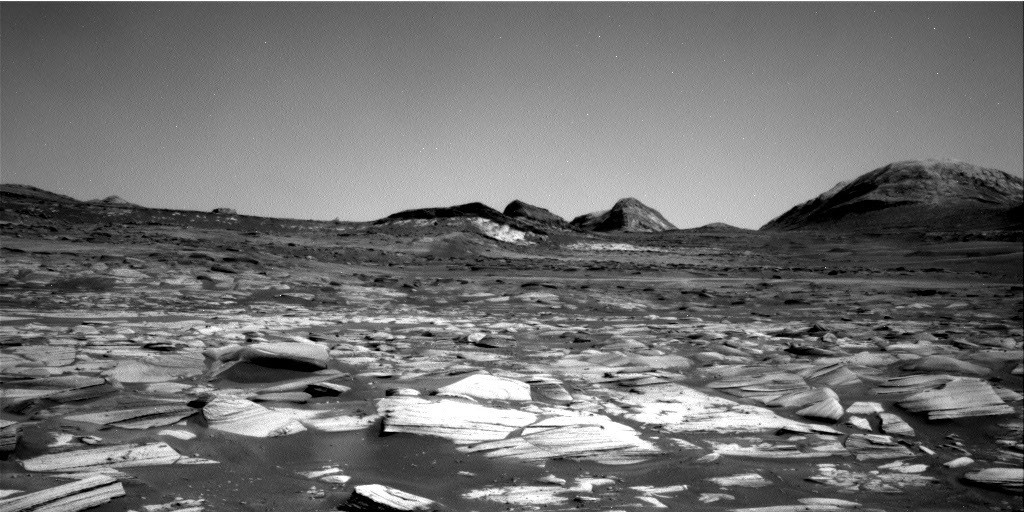
Curiosity continues climbing the valley informally known as “Valle Grande.” In recent weeks, the rover crossed what scientists interpret as an “eroded supersurface,” which indicates a gap in the normal rock record. Curiosity is currently traversing the formation’s slightly striped area.
The bands range from 25 to 200 meters in diameter, or approximately 80 to 650 feet. They also show morphological variations. Some contain more sand and less exposed rock, often appearing darker from a distance, while others have more continuous outcrops that may mark rough contacts between the bands.
View the slightly striped area
Curiosity Studies Nodular Rocks and Martian Outcrops
This week’s terrain featured sparse, coarse-textured outcrops, often with humped shapes, surrounded by abundant sand and coarse pebbly sand.
On Tuesday, the Alpha Particle X-ray Spectrometer (APXS) and Mars Hand Lens Imager (MAHLI) investigated brush-like nodular rock at the “Almazon Mountains” and “Monte Merimoyu.”
View the Almazon Mountains target
View the Monte Merimoyu target
ChemCam used its laser-induced breakdown spectroscopy (LIBS) instrument to examine a knot of dark-toned nodules on “Tuta Huallpas” and the dark-toned floating rock “Acclahuasi.”
A 60-Meter Drive Reveals an Interesting Rock
On Friday, Curiosity drove approximately 60 meters, or about 200 feet. The rover encountered mostly sand, with only one small rough outcrop close enough for contact science and LIBS analysis.
Fortunately, the block was scientifically interesting. It contained numerous small flakes and chips, while some laminated areas were relatively smooth. The team investigated the coarse textures with MAHLI at “Yungay” and “Chiu Chiu,” APXS at “Chiu Chiu,” and ChemCam LIBS at “Puya Raimondi.” Smoother areas were examined with LIBS at “Liolaemus Tacnae.”
View Yungay |
View Chiu Chiu |
View Puya Raimondi
Panoramic Images Capture Mars’ Hills and Sand Ridges
During both planning cycles, the ChemCam long-range imager and camera team remained busy. In addition to near-field images of the terrain close to the rover, Mastcam and ChemCam acquired several large mosaics looking back at the hills on either side of Curiosity: “Miche Mokwa” and “Cordillera.” The smaller hill “La Linea” was also imaged.
Mastcam photographed several mosaics documenting the Chocolatal abrasion targets analyzed last week, along with a larger mosaic of the Sullivan Field sandpit where Chocolatal is located.
Sullivan Field contains sand ripples, giant ripples, and lateral aeolian ridges. The area was named by the team in honor of the late Robert Sullivan, a world expert on Martian sand and a valued member of the Curiosity science team.
Monitoring Dust and the Martian Atmosphere
Alongside the geological investigations, the environmental science team planned its usual schedule of monitoring activities. These included dust-devil movies, “hyperhorizon” films aimed at the crater rim, and tau images used to measure dust in the atmosphere.
Imaging Curiosity’s Route Ahead
Navcam and Mastcam captured images of the path ahead in the direction Curiosity was driving. Subtle bands can almost be identified by observing differences in visual tone. It will be interesting to see how these bands look and how they differ from one another when the rover reaches them more closely.
Source: science.nasa.gov