


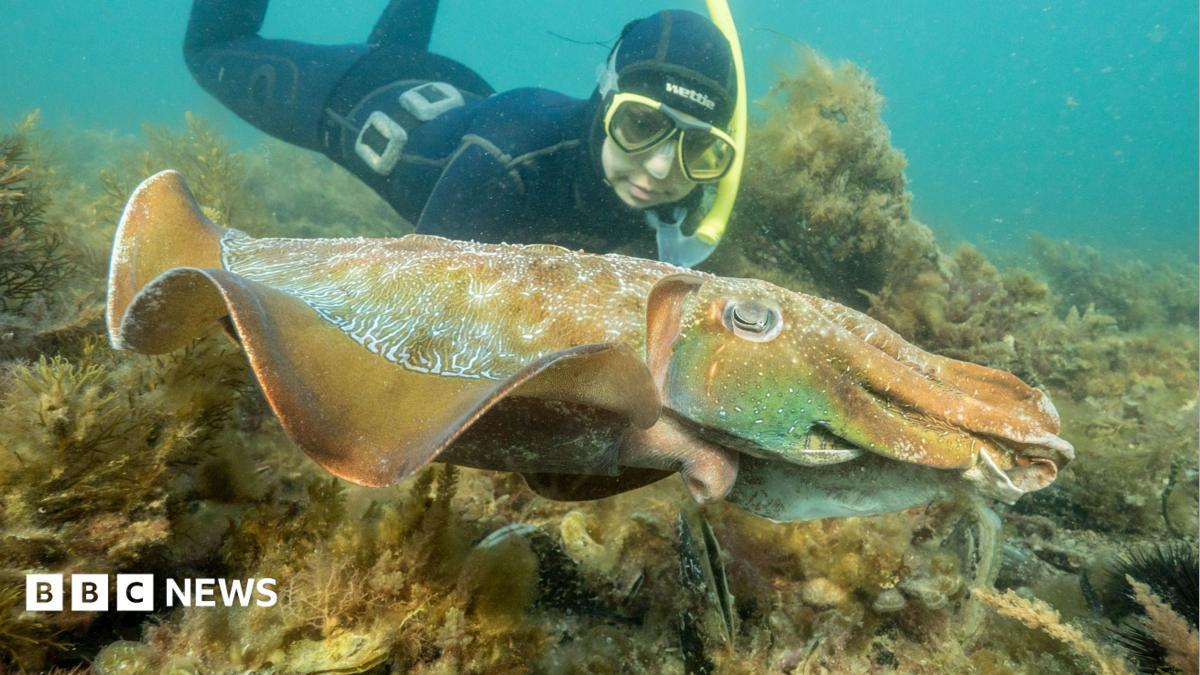
Every winter, South Australia’s Ika coastline becomes the site of the world’s largest giant Australian cuttlefish mating event.
Depending on the season, hundreds of thousands of these unique Australian marine animals gather along the coastline to breed. Their colorful, shape-changing bodies draw thousands of divers to the shallow waters each year.
This year, however, the giant Australian cuttlefish population reached its lowest recorded level, prompting concerns about a potentially “catastrophic decline” in the species.
Official figures released this month show that just 1,811 cuttlefish gathered to mate this year—97% fewer than the 63,000 recorded last year.
South Australia’s state government believes a toxic algae bloom, which has affected the coastline for more than 18 months, may be responsible for the dramatic population decline.
The sharp drop in numbers has prompted calls for the giant Australian cuttlefish to be listed as an endangered species.
Adult cuttlefish typically die after breeding, making every mating season vital to the species’ survival. In recent months, divers have counted only 440 eggs, compared with the millions usually laid along the coast.
Manny Katz, 28, was one of four divers from South Australia’s Department of Environment and Water (DEW) who spent hours monitoring the annual cuttlefish breeding season last month.
“With cuttlefish numbers so low, DEW believed it was important to survey the coastline and count the remaining eggs to estimate what the population could look like next year,” he said.
Over two days in July, the team completed eight one-hour dives, searching beneath the reef and recording the number of cuttlefish eggs they found.
“There would normally be millions of eggs along an 8-kilometer (5-mile) stretch of coastline,” Katz said. Each female lays dozens of eggs, with tens of thousands of cuttlefish typically gathering in the area to breed.
“We searched beneath almost every rock and found only about 440 eggs.”
Source: www.bbc.co.uk