


700-Year-Old Chinese Skull May Be the First Archaeological Evidence of Punitive Nose Cutting
A middle-aged woman whose skull was found in a Chinese cemetery appears to have survived the painful punishment for years before her death, researchers say.
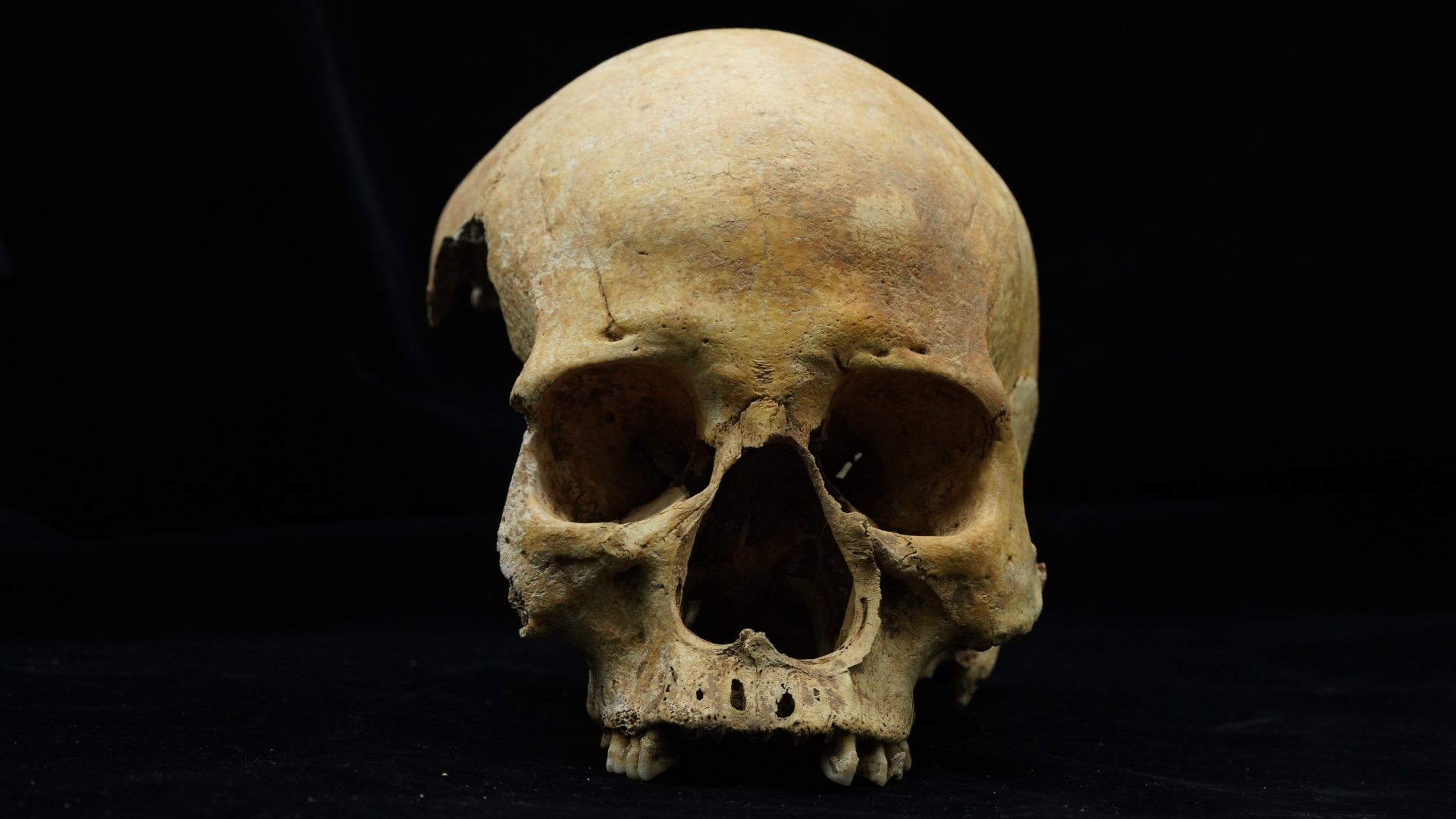
A 700-year-old female skull discovered in China may represent the world’s first archaeological evidence of punitive nose cutting, according to a new study. The middle-aged woman survived the facial mutilation for several years, suggesting that her nose may have been severed as punishment for a crime such as theft or adultery.
Researchers believe the woman may have faced discrimination after her death. She was buried face down, alone and with very few personal items—circumstances that could indicate social disapproval.
A rare discovery in a Chinese cemetery
The woman’s skeleton was discovered among approximately 300 others during excavations at Sanzhizono Cemetery in Henan province, eastern China, in 2019. She was buried face down in a wooden coffin at the southern end of the cemetery, with only a copper hairpin found with her remains.
Radiocarbon dating indicated that she lived between 1298 and 1404, a period corresponding to China’s Yuan Dynasty and the beginning of the Ming Dynasty. Because the initial excavation was a rapid salvage operation conducted before construction, researchers did not initially recognize the skull as evidence of nasal amputation.
Archaeologists from Zhengzhou University later analyzed the human remains. The findings were described in a study by Zhou Yawei, Qian Wang and their colleagues in the Journal of Archaeological Science: Reports.
Skull damage points to a severed nose
The most distinctive feature of the skull was an enlarged piriform opening, the anatomical opening at the front of the nasal cavity. The woman’s two nasal bones had been partially severed, leaving approximately half of the bridge of her nose intact.
Several bones inside the nose were also broken. Their edges showed signs of healing, indicating that the injuries were not inflicted shortly before death. The damage would likely have left the center of the woman’s face with a sunken appearance.
The researchers could not completely rule out disease or a congenital condition as the cause of the deformity. However, they concluded that punitive nose cutting was the most likely explanation, particularly because of the woman’s unusual face-down burial.
Nose cutting was one of ancient China’s punishments
Punitive nose cutting was recorded in ancient China and was one of the “five punishments” used during early dynastic periods. Other punishments included tattooing, amputation of the leg, castration and execution.
According to the researchers, nose cutting appears in an oracle bone inscription from the Shang Dynasty, which lasted from approximately 1600 to 1046 B.C. The punishment is represented by Chinese characters depicting a knife thrust into the left or right side of the nose.
At the end of the Yuan Dynasty, serious offenses such as livestock theft may have been punished by cutting off the nose. In an agricultural society, the theft of animals such as cows and donkeys could have been a serious crime. The researchers also noted that adultery may have been another possible reason for the punishment.

The first archaeological case of punitive nasal mutilation
“We were surprised by this discovery,” Wang said. “So far, no scientific reports or descriptions of punitive nasal mutilation in archaeological human bones have been published.”
Because the procedure was performed without anesthesia, many similar cases may have occurred throughout history without being identified in human remains. Researchers may also find it difficult to distinguish punishment from disease, congenital conditions or accidental injuries.
Elizabeth Berger, a bioarchaeologist at the University of California, Riverside, who was not involved in the research, said the study makes a convincing case that the woman’s facial disfigurement resulted from punitive nose cutting.
Berger added that future research could examine other archaeological cases to determine who was subjected to the punishment, how it was carried out and how survivors were treated medically, including whether prosthetics were used.
More evidence could emerge from ancient human remains
The skull was evaluated as part of the Asia module of the Health World History Project, which examines disease and trauma in human remains.
“In the future, more human bones will be examined for disease and trauma,” Wang said. “We hope that similar cases will be discovered in a more defined archaeological context in the future.”
Study: Zhou, Y., Zhang, C., Yan, F. and Wang, Q. (2026). “The first skeletal evidence of facial mutilation as a form of punishment in ancient China (AD 1298–1404): A unique archaeological case of nasal mutilation from the Yuan to Ming dynasties.” Journal of Archaeological Science: Reports.
Source: www.livescience.com