


James Webb Space Telescope Reveals Tiny “Failed Stars” in Stunning IC 348 Panorama
Simple facts
What is it: IC 348, a star-forming reflection nebula
Where is it: The Perseus region, about 1,000 light-years away
When shared: September 15, 2026
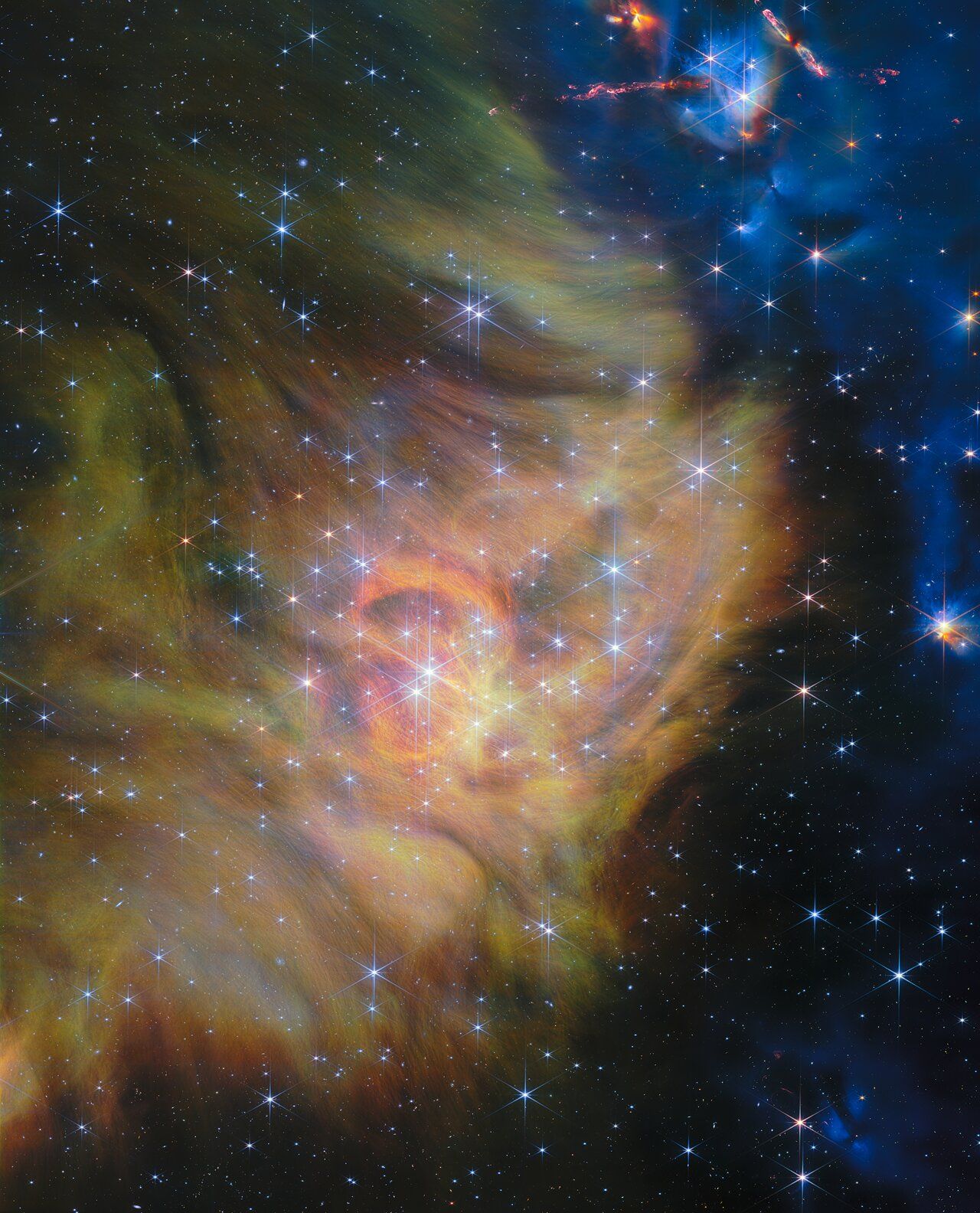
Behold one of the largest panoramas released to date by the James Webb Space Telescope (JWST). This breathtaking near-infrared image offers an incredibly detailed view of IC 348, a nearby stellar nursery where astronomers are studying some of the smallest objects produced by star formation.
Located about 1,000 light-years away in the Perseus region, IC 348 is one of Earth’s closest stellar nurseries. In this JWST image, the nebula appears as a complex landscape of young stars, glowing material, and expanding clouds of gas and dust.
Young stars are scattered throughout the scene, punctuating both dark and illuminated clouds. The concentration of stars is highest near the center, where several bright objects display JWST’s distinctive diffraction spikes. These spikes are produced by the telescope’s optical structure.
In the upper-right portion of the image, a still-forming protostar is shooting streams of material into the surrounding gas and dust. Elsewhere in the colorful nursery, astronomers have found unusual objects that challenge the traditional definition of a star.
From the latest video
Live Science
Stars form in a wide range of sizes. The largest stars can explode as supernovas after only a few million years, while the smallest and most common stars, known as red dwarfs, can last for billions of years.
Between giant gas planets such as Jupiter and ordinary stars is another class of object: the brown dwarf. Often called “failed stars,” brown dwarfs form from collapsing clouds of gas and dust, just like stars do. However, their cores never become hot enough to fuse hydrogen into helium.
The enlarged details highlight six features in the panorama: 1. A star embedded in a nebula. 2. The central star cluster. 3. Stars and faint outflow. 4. A Herbig-Haro object. 5. Gravitational lenses that distort light. 6. A spiral galaxy.
Image credits: ESA/Webb, NASA, CSA, K. Luhman, C. Alves De Oliveira, M. Zamani
Webb Finds Brown Dwarf Candidates in IC 348
To search for small brown dwarfs in IC 348, researchers used Webb’s NIRCam instrument to examine part of the nebula in 2024. The observations revealed 39 brown dwarf candidates.
Over the following year, Webb’s NIRSpec instrument studied 15 of those candidates. Nine new substellar members of the cluster were identified. The faintest is estimated to have a mass of about two Jupiters, making it the lightest brown dwarf ever discovered.
How small brown dwarfs can become remains an open question in astrophysics. The objects in this JWST image may help researchers determine the lower limit for brown dwarf formation.
A Protostar’s Jets Stretch Across the Nebula
In the upper-right portion of the panorama, another stage of star formation is visible. Hidden within a dusty environment, protostars fire jets into nearby gas and dust, creating a Herbig-Haro object. These enormous jets can stretch trillions of miles into space, yet this feature occupies only a small part of one of JWST’s biggest images to date.
IC 348 has also been photographed by NASA’s Chandra X-ray Observatory. In Chandra’s view, the stellar nursery and other space objects glow purple under vivid X-ray light, providing a different perspective on this nearby region of star formation.
Topics
Source: www.livescience.com