


Astronomers using the 4-m Daniel K. Inouye Solar Telescope in Hawaii have observed tiny plasma vortices on the Sun’s surface for the first time. The discovery provides new evidence for how energy may be transported from the solar photosphere into the million-degree corona.
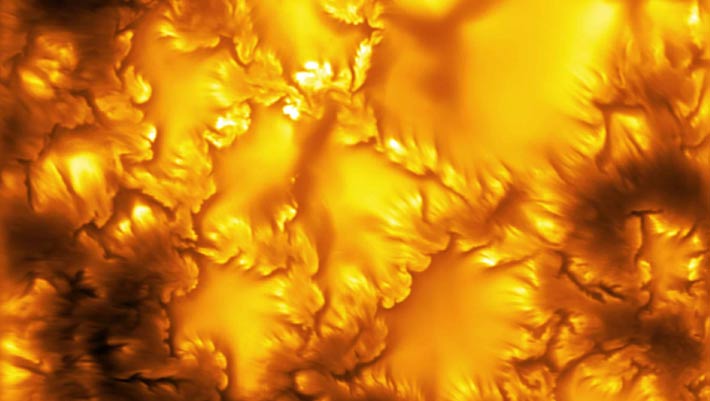
The highest-resolution image of the Sun’s surface, or photosphere, ever captured. Taken at 416 nm by the Inouye Solar Telescope, it shows distorted magnetic elements and ultra-fine stripes associated with Kelvin-Helmholtz instability. Image credit: NSF / NSO / AURA / MPS.
The observations produced the highest-resolution images ever recorded of the Sun’s visible surface, revealing whirlpool-like plasma structures measuring only about 20 km (12 miles) across.
Researchers identified the features as Kelvin-Helmholtz instabilities. These vortices form when layers of plasma moving at different speeds slide past one another, creating shear that develops into wave-like spirals similar to breaking ocean waves.
“We believe that the discovery of Kelvin-Helmholtz instability in the solar photosphere, backed up by analysis of numerical simulations, is a major step forward in our understanding of the dynamics and evolution of solar and stellar plasma, and will serve as a basis for future discoveries,” said Dr. David Boboltz, deputy director at the National Solar Observatory.
Kelvin-Helmholtz instability has previously been observed on Earth, in planetary atmospheres and in the Sun’s corona. However, this is the first confirmed detection of the phenomenon in the Sun’s visible surface layer, known as the photosphere.
“An effect caused by fluid motion, Kelvin-Helmholtz instability occurs when two fluids slide past each other at different velocities, creating a ‘shear’ at the interface,” the scientists explained. “Small disturbances can then grow into prominent waves or spiraling vortices that resemble breaking ocean waves.”
First described by Lord Kelvin and Hermann von Helmholtz around 1870, the instability is important across several fields of physics, including fluid dynamics, meteorology, oceanography, heliophysics and astrophysics.
The same process can appear in Earth’s lakes and oceans, cloud formations, the atmospheres of gas giants such as Jupiter and Saturn, and the interaction between the solar wind and planetary magnetic fields.
According to the research team, these small-scale solar vortices may act as hidden engines that twist and tangle magnetic field lines in the photosphere.
As the magnetic fields become stressed, they can release energy that contributes to solar flares, coronal mass ejections and other solar eruptions. The process may also help transfer energy into the Sun’s outer atmosphere and explain how the corona reaches temperatures of around one million degrees.
The findings indicate that tiny plasma motions, previously too small to resolve with solar telescopes, may have a major influence on solar activity and the behavior of the Sun’s magnetic field.
“It is very exciting to see that the highest-resolution observations of the solar photosphere revealed a new dynamical regime in the form of Kelvin-Helmholtz vortices at the edges of magnetic field concentrations,” said Dr. Matthias Rempel, an astronomer at the High Altitude Observatory.
“These observations also provide the highest-resolution validation of solar magnetohydrodynamic simulations to date, and the agreement in physical details is impressive.”
“Kelvin-Helmholtz instability is likely a mechanism that contributes to the heating of the outer atmosphere and is part of the solution to the longstanding enigma of why stars have million-degree-hot coronae,” said Dr. Thomas Rimmele, chief technologist at the National Solar Observatory.
The Sun’s magnetic field is generated by dynamo processes that convert the star’s rotational energy into magnetic energy.
“The Sun’s magnetic field is generated by dynamo processes that act like giant cosmic engines that turn the star’s rotational energy into magnetic fields,” said Dr. David Kuridze, an astronomer at the National Solar Observatory.
“However, because the solar magnetic cycle is only 11 years, a remarkably rapid timescale in cosmic terms, the generated magnetic flux must dissipate efficiently.”
Current solar models have difficulty explaining how magnetic flux can diffuse so quickly. The newly observed Kelvin-Helmholtz vortices may provide an important source of this missing magnetic diffusion, helping scientists better understand the solar cycle and the evolution of stellar magnetic fields.
The discovery is described in a paper published this week in the journal Nature.
_____
D. Kuridze et al. Ubiquitous Kelvin-Helmholtz instabilities driving plasma mixing on the Sun. Nature, published online August 5, 2026; doi: 10.1038/s41586-026-10871-3
Source: www.sci.news