


Ancient Fossils Reveal Oxygen Was Crucial to the Origin of Complex Life
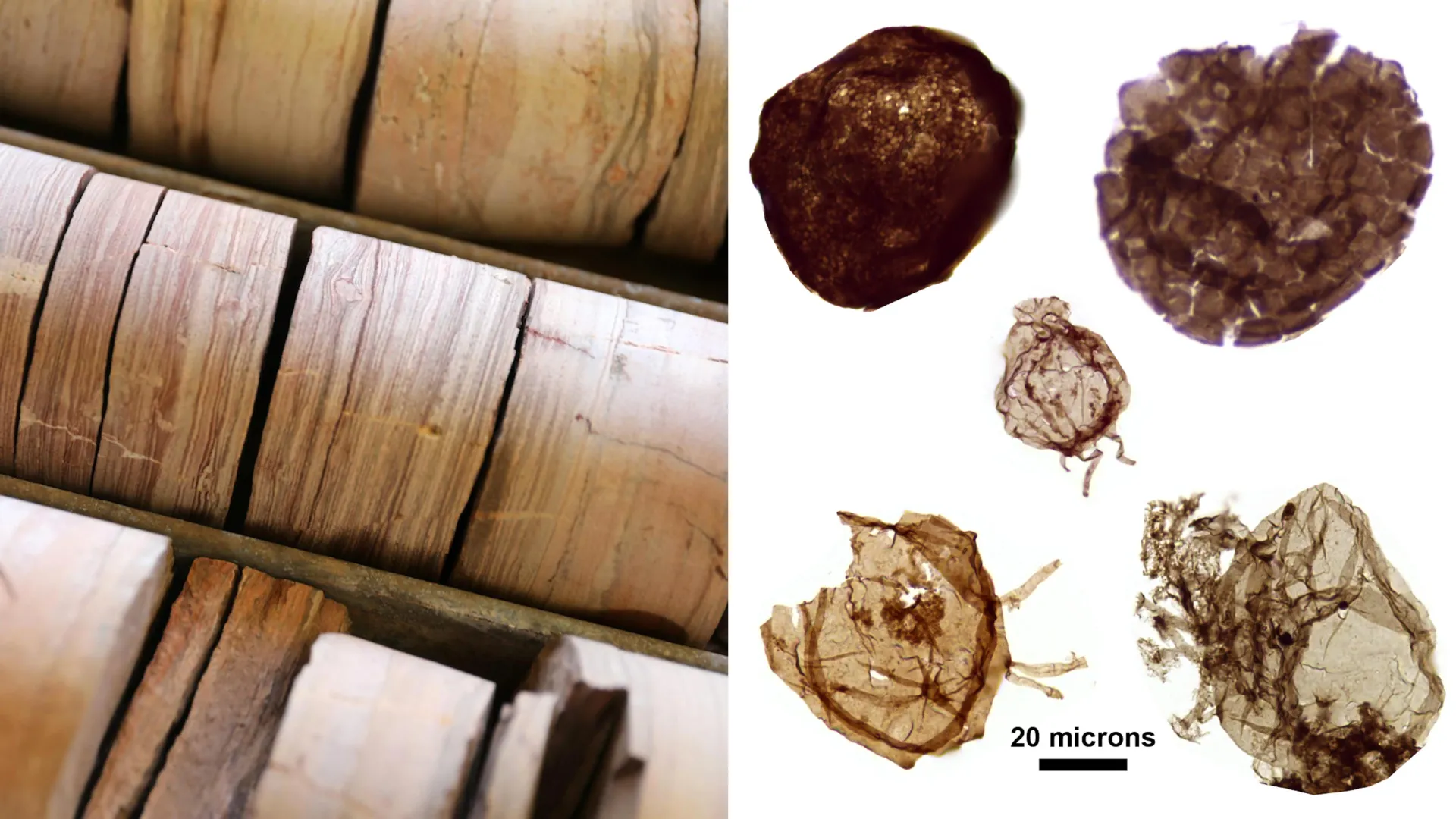
Dozens of trays containing cylindrical rock cores sit in an outdoor warehouse in tropical Darwin, Australia. The cores came from boreholes drilled hundreds of metres below the surface by mineral exploration companies decades ago.
Some of these cores contain mudstone, a sedimentary rock formed from solidified mud on the ocean floor. Within the mudstone are microbial fossils that were buried beneath the ocean floor of an ancient inland sea covering much of northern Australia more than 1.5 billion years ago.
In a new study published in Nature, researchers show that these fossils are critical to solving a long-standing mystery: how eukaryotes originated and made the evolutionary leap that eventually produced all complex life on Earth.
What Makes Eukaryotes Different?
At the cellular level, all life on Earth can be classified into one of two fundamentally different groups.
Prokaryotes, including bacteria and archaea, have relatively simple cell structures and are mostly single-celled. Eukaryotes—including animals, plants, algae and fungi—have much more complex cells. Their cells contain a nucleus and specialized structures called organelles, which perform specific tasks.
The emergence of eukaryotes transformed the planet. It eventually led to the appearance of animals and, ultimately, humans. Based on genetic studies of living organisms, scientists generally agree that the last common ancestor of all living eukaryotes arose through a symbiotic union involving at least two types of prokaryotes: archaea and bacteria.
The earliest evidence of eukaryotes comes from fossils of single-celled organisms. These fossils show a level of cellular complexity not found in prokaryotes but common among eukaryotes.
Eukaryotic fossils have been discovered in rocks around the world dating back at least 1.5 billion years. The fossils found in Australia’s Northern Territory date back 1.75 billion years, making them the oldest known eukaryotic fossils.
Did Early Eukaryotes Need Oxygen?
The ancient world in which early eukaryotes evolved remains shrouded in mystery. Many fundamental aspects of that environment are still unknown, including the role oxygen played in the development of complex cells.
Many bacteria can live and reproduce without oxygen. However, almost all eukaryotes alive today use oxygen to survive. Aerobic respiration, which uses oxygen to break down food, provides the large amounts of energy required by complex life.
In recent years, the idea that oxygen was always essential to eukaryotes has come under scrutiny. Researchers discovered a mysterious eukaryote capable of thriving in oxygen-free conditions.
There is also growing evidence from the geological record that oxygen may have been scarce when eukaryotes first evolved. Ocean habitats without oxygen may have been common at the time. Together, these observations raised questions about whether eukaryotes depended on oxygen from the beginning.
Genetic studies of living microorganisms thought to be closely related to the earliest eukaryotic ancestors can offer important clues. However, only fossils can reveal information about lineages that became extinct, while geology provides a window into the environments in which those organisms lived.
More Than 12,000 Ancient Microfossils
For the new research, scientists crushed and dissolved samples of mudstone from the rock cores stored in Darwin. They then used microscopes to analyze the organic residue left behind, identifying more than 12,000 fossils.
The researchers also studied the mudstones surrounding the fossils to determine the conditions present when the sediments were deposited. This provided clues about the habitats occupied by these ancient eukaryotes.
By analyzing the chemistry of the mudstones, the scientists determined whether oxygen was present in the ancient seawater.
Ancient Eukaryotes Lived in Oxygenated Environments
The fossils came from environments ranging from coastal tidal flats to the open ocean. However, they were found only in samples deposited in oxygenated environments.
Samples from oxygen-free, or anoxic, environments contained only simple prokaryotic forms.
The findings suggest that even the oldest known eukaryotes—organisms that lived between 1.7 and 1.4 billion years ago—depended on oxygen. The results support the long-standing hypothesis that oxygen played an important role in driving the evolution of early eukaryotes.
Understanding the forces and environmental conditions behind the major evolutionary leaps represented by early eukaryotes remains one of the most important unanswered questions in the life sciences.
Continued research into these mysterious ancient microfossils could reveal more about the origins of complex life—and our place in the universe.
Source: www.sciencedaily.com