


A Cosmic “Fart” Is Making a Zombie Star Blast X-Rays at Earth
A giant plume of stellar wind is repeatedly triggering powerful X-ray flares from a mysterious “zombie star,” according to unprecedented observations of one of the universe’s most extreme binary star systems.
About 13,000 light-years from Earth, the unusual system known as BP Crucis contains a blue supergiant star called Wray 977 and an ultra-dense neutron star known as GX 301-2. The neutron star is the collapsed remnant of a star that exploded in a supernova.
GX 301-2 has roughly the same mass as the sun packed into an object only about 12 miles (20 kilometers) across. It also has an exceptionally powerful magnetic field and rotates rapidly, making it a type of pulsar. As it spins, it sends beams of electromagnetic radiation, including X-rays, into space.
When one of those beams sweeps across Earth, telescopes detect a pulse roughly every 11 minutes. But GX 301-2 also produces much brighter X-ray flares at regular intervals—an unusual behavior that scientists had not been able to explain.
Why does GX 301-2 flare?
In a new study published Sept. 18 in Science Advances, researchers used the X-ray Imaging and Spectroscopy Mission, or XRISM, to examine BP Crucis in detail. XRISM is a space telescope jointly operated by NASA and the Japan Aerospace Exploration Agency.
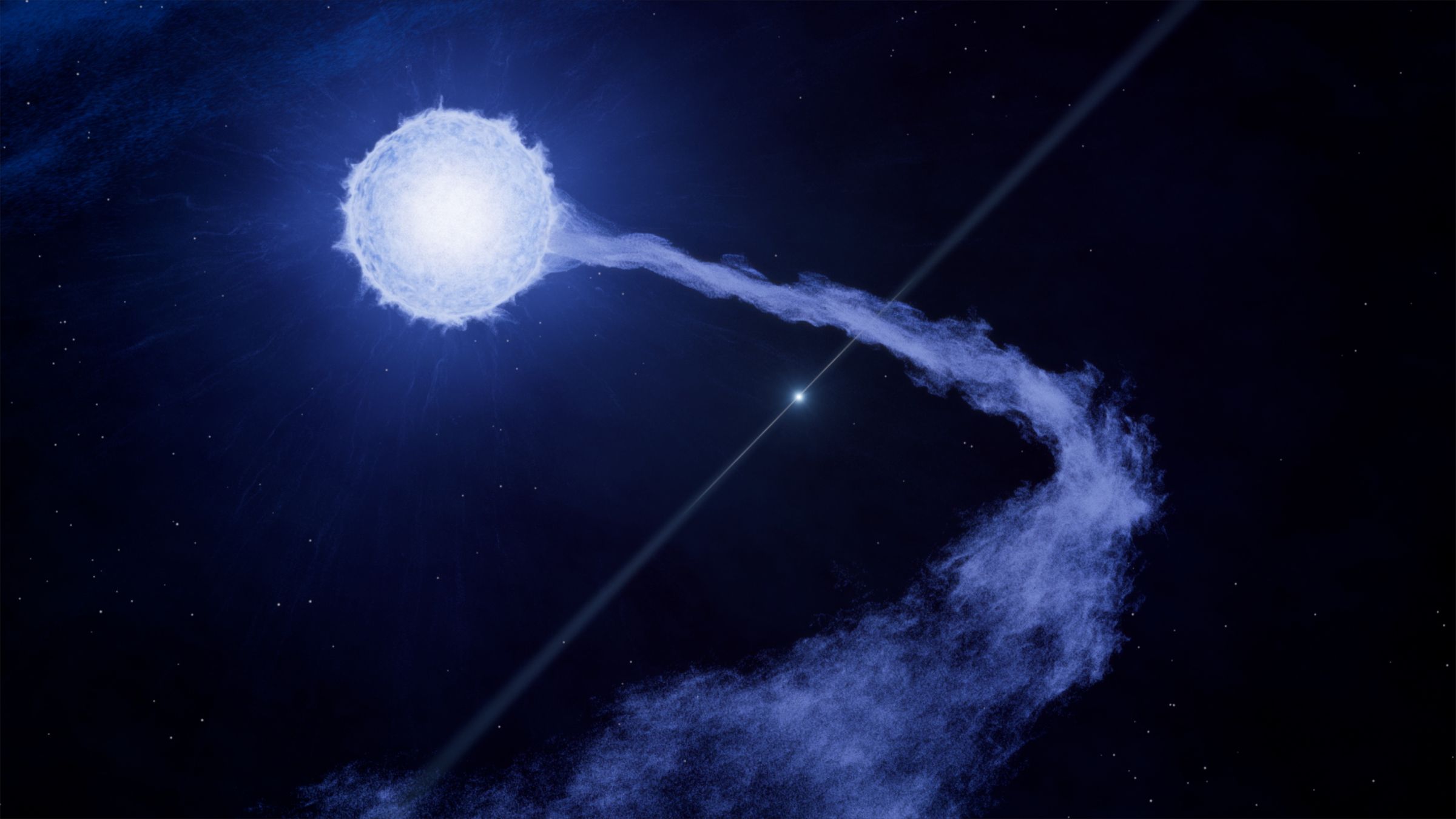
The observations revealed that GX 301-2 flares when it passes through a concentrated plume of stellar-wind plasma streaming from Wray 977. As the neutron star moves through the dense column of ionized gas, some of the material is pulled toward it by the neutron star’s intense gravity.
New observations show GX 301-2 flaring as it passes through a stellar-wind column ejected by Wray 977. The animation illustrates how plasma interacts with the neutron star.
Image credit: NASA Goddard Space Flight Center/Conceptual Imagery Laboratory
“We have never seen clear signs of wind plasma falling onto compact objects,” lead author Roy Rahin of the University of Maryland, Baltimore County and NASA’s Goddard Space Flight Center said in a statement. “We can now test our understanding of these processes in more detail.”
A powerful stellar-wind plume
All actively burning stars release streams of radiation and charged particles called stellar winds. The sun’s stellar wind can interact with Earth’s magnetic field and help produce auroras near the planet’s poles.
Massive blue supergiants such as Wray 977 generate much more powerful winds. The star’s concentrated plume of ionized gas travels at about 335,000 miles per hour (540,000 kilometers per hour). Scientists believe the extreme gravitational forces in the system may help shape the stellar wind into a narrow column.
GX 301-2 completes an orbit around Wray 977 every 41.5 days. It produces X-ray flares both when it approaches and when it moves away from its companion, with the most powerful flare occurring when the neutron star is closest to Wray 977.
That pattern had led researchers to suspect that the flares were caused by GX 301-2 passing through the supergiant’s stellar-wind column. However, they lacked direct evidence that the neutron star was interacting with the plume.
XRISM captures the neutron star feeding
During a 16-hour observation that coincided with one of GX 301-2’s flares, XRISM captured highly detailed X-ray spectra. The data contained rapidly changing emission and absorption lines, revealing how the stellar-wind plume ebbed and flowed around the neutron star.

XRISM captured detailed spectra of GX 301-2 and the plasma plume from Wray 977, helping researchers model how stellar wind material interacts with the neutron star.
Image credit: NASA Goddard Space Flight Center, JAXA/NASA, Rahin et al. 2026
“We were able to observe how dense streams of plasma interact very close to a neutron star,” study co-author Nazma Islam, an astronomer at India’s Manipal Natural Science Center and a former researcher at UMBC and NASA, said in a statement.
Using the XRISM data, the researchers simulated how plasma falls toward GX 301-2 and swirls around it. As material accumulates on the neutron star’s surface, it releases enormous amounts of energy in the form of a bright X-ray flare that can be detected from Earth.
A new laboratory for extreme stellar physics
The discovery marks the first time researchers have detected clear evidence of this type of stellar-wind material interacting with a neutron star. It could help scientists study other binary systems in which compact objects feed on material from massive companion stars.
The research team plans to use XRISM to observe future flares and investigate how GX 301-2 interacts with Wray 977’s powerful wind plume.
“The BP Crucis system is an ideal laboratory to study wind-driven pulsar accretion,” Brian Williams, NASA’s XRISM project scientist at Goddard, said in a statement. He added that XRISM is “an ideal vehicle for advancing our understanding of the processes involved.”
Study: Rahin, R., Ballhausen, R., Islam, N., Leutenegger, M. A., Behar, E., Zamora, D., Coley, J., Hell, N., Kallman, T., Lorenz, M., Pradhan, P., Wilms, J., and Zainab, A. (2026). “Direct spectroscopic observation of material falling into a compact stellar body.” Science Advances, 12(38), eaef6686.
Source: www.livescience.com