


Historical Records Challenge the Date of Britain’s Earliest Space Weather Train Disruption
A long-standing account claimed that solar activity disrupted railway operations near Exeter in 1841. However, a new examination of historical newspapers, magnetic records, and railway timetables suggests that the event may have occurred in 1848 rather than 1841.
Charles Holmes Was Closely Interested in Solar Activity
The researchers found newspaper articles from the period when Charles Holmes was lecturing in Scotland about the chemical effects of the solar spectrum. Holmes was also familiar with astronomer Joseph Norman Lockyer’s discovery of helium lines in the solar spectrum.
An 1877 letter from Holmes inviting Lockyer to visit also indicates that the two men had a business relationship. These records show that Holmes was clearly interested in solar activity, but they do not resolve the discrepancy surrounding the reported 1841 railway incident.
No Evidence Supports the Reported 1841 Date
Wilde and his co-authors noted that the original account provided no citations that could be used to verify its claims. In particular, they found no contemporary newspaper report containing the wording about railway operators hearing that someone had been “playing a prank with a musical instrument.”
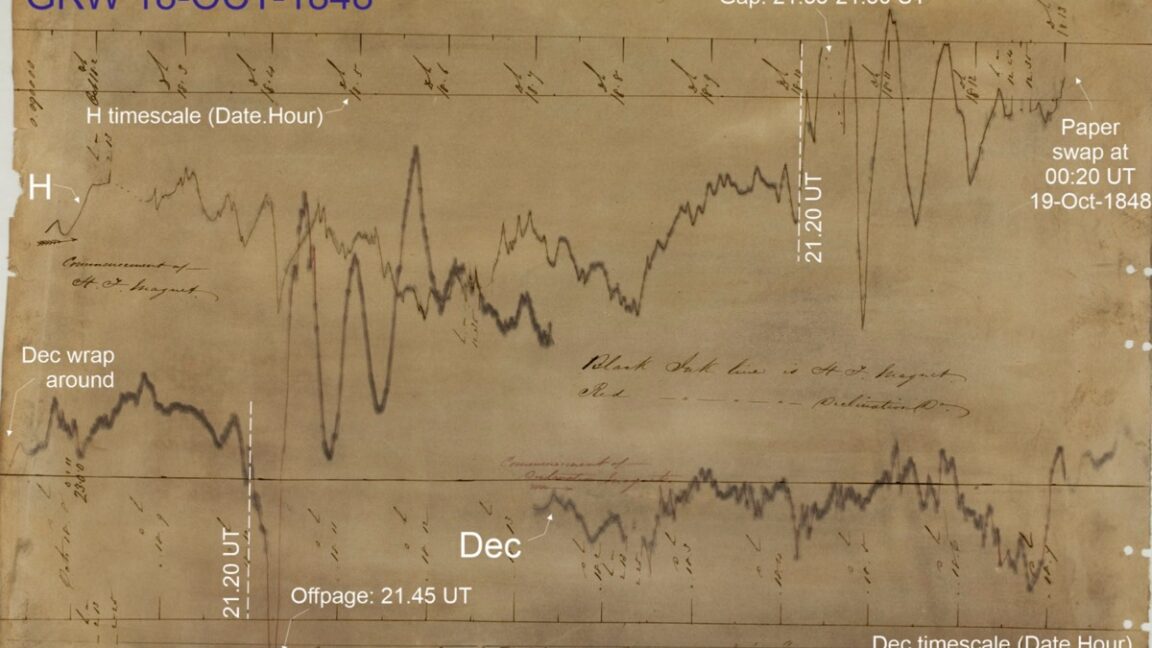
The researchers next examined archived scientific records, including some of the earliest magnetic observations from the Greenwich Magnetic Observatory in London. Although records of “unusual” magnetic observations—and therefore potentially strong geomagnetic storms—extend back to 1840, there was no report of unusual aurora-like activity in Britain on October 18, 1841.
Evidence Points to a Geomagnetic Storm in October 1848
By contrast, strong geomagnetic activity around October 18, 1848, was confirmed by contemporary newspaper reports. British astronomer Temple Chevalier also recorded sunspot observations on October 19, 1848.
Wilde and his colleagues then reviewed railway timetables from the period. They found references to express trains leaving Exeter at 10:05 p.m. between March 11, 1848, and July 26, 1849. This evidence led them to suggest that the 1841 date published in Nature was likely a typographical error and that the event occurred in the wrong year.
Space Weather and the Midland Railway Telegraph
Once the 1841 account is excluded, the earliest documented example of space weather affecting technology may be an incident from March 1847. During that event, a “brilliant aurora borealis” appeared over the British Isles and generated a “natural current” in the Midland Railway’s telegraph system.
The findings highlight how historical space weather research can depend on comparing scientific observations with newspapers, railway schedules, and other contemporary records.
Space Weather, 2026. DOI: 10.1029/2026SW005239
Source: arstechnica.com