


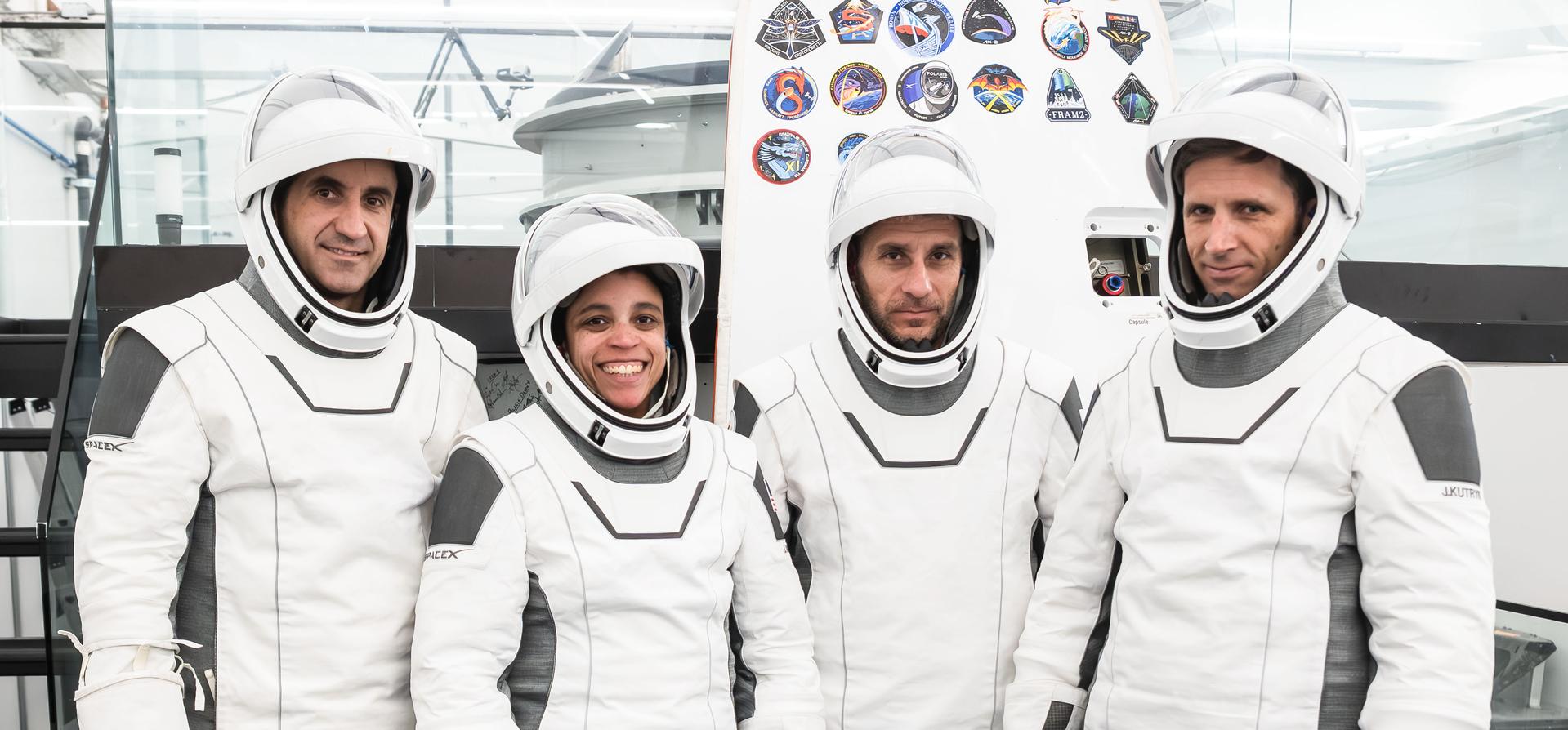
NASA’s SpaceX Crew-13 Mission to Launch Four Astronauts to the International Space Station
NASA’s SpaceX Crew-13 mission will launch four crew members to the International Space Station (ISS) to conduct scientific research, technology demonstrations and maintenance aboard the orbiting laboratory.
SpaceX Crew-13 Launch and Mission Overview
NASA astronauts Jessica Watkins and Luke Delaney will serve as the spacecraft commander and pilot, respectively. They will be joined by Canadian Space Agency astronaut Joshua Kutlik and Roscosmos cosmonaut Sergei Tetelyatnikov, who will serve as mission specialists.
Crew-13 is scheduled to launch from Space Launch Complex 40 at Cape Canaveral Space Force Station in Florida by 11:10 a.m. EDT on Thursday, October 1. The crew will join the International Space Station’s Expedition 75 crew and support a long-duration mission focused on research, technology development and station operations.
During the mission, the crew will advance research and technology intended to support future missions to the Moon and Mars while conducting scientific experiments designed to improve life on Earth.
“During the mission, the crew will help researchers treat heart disease and Parkinson’s disease by studying tissue derived from human stem cells that will help improve medicine, disease modeling and drug testing,” said Dana Weigel, NASA’s Low Earth Orbit Program Manager at NASA’s Johnson Space Center in Houston. “They will also investigate the production of crops important for long-duration spaceflight missions, help better understand blood flow abnormalities seen in space, and test new diagnostic medical equipment to monitor crew health.”
This flight will be SpaceX’s 13th crew-rotation mission to the space station through NASA’s Commercial Crew Office.
Falcon 9 and Dragon Pre-Launch Preparations
Support teams are continuing to advance Crew-13’s Dragon pre-flight milestones and prepare the SpaceX Falcon 9 rocket booster for its third flight. In orbit, NASA’s SpaceX Crew-12 is preparing to return to Earth after a brief handover period following Crew-13’s arrival.
After all rocket and spacecraft systems are checked and certified, teams will combine the Dragon spacecraft and Falcon 9 inside SpaceX’s hangar at the launch site. The integrated vehicle will then be transported to the launch pad, raised into a vertical position and put through a dry dress rehearsal with the crew. A comprehensive static-fire test will also take place before launch.
The four-person crew will fly aboard a SpaceX Dragon spacecraft named Grace. The spacecraft previously flew in summer 2025 in support of the civilian astronaut mission Axiom Mission 4.
Meet the SpaceX Crew-13 Astronauts
NASA Astronaut Jessica Watkins
This will be Jessica Watkins’ second flight to the space station since she was selected as a NASA astronaut in 2017. She grew up in Lafayette, Colorado, and earned a bachelor’s degree in geological and environmental science from Stanford University and a doctorate in geology from the University of California, Los Angeles.
As a geologist, Watkins studied the surface of Mars and served on the science team for NASA’s Curiosity rover at the Jet Propulsion Laboratory in Southern California. She first launched to the space station aboard NASA’s SpaceX Crew-4 mission and spent a total of 170 days in space during Expeditions 67 and 68 in 2022.
Watkins will become the first NASA astronaut to launch twice aboard the SpaceX Dragon spacecraft. Follow Jessica Watkins on X and Instagram.
NASA Astronaut Luke Delaney
Luke Delaney was selected as a NASA astronaut in 2021. He earned a bachelor’s degree in mechanical engineering from the University of North Florida and a master’s degree in aerospace engineering from the Naval Postgraduate School.
The Florida native is a distinguished naval aviator who participated in exercises throughout the Asia-Pacific region and flew missions in support of Operation Enduring Freedom. As a test pilot, Delaney evaluated aircraft systems under development and served as an instructor for test pilots.
He also worked as a research pilot at NASA’s Langley Research Center in Hampton, Virginia, supporting airborne science missions. Crew-13 will be Delaney’s first spaceflight.
Canadian Space Agency Astronaut Joshua Kutlik
The Crew-13 mission will be Joshua Kutlik’s first spaceflight. Before being selected as a Canadian Space Agency astronaut in 2017, he flew missions as a CF-18 fighter pilot in support of Canada’s NATO, United Nations and North American Aerospace Defense Command missions.
A native of Fort Saskatchewan, Alberta, Kutlik worked as an experimental and operational test pilot at the Aerospace Engineering Test Facility in Cold Lake, Alberta. He earned a bachelor’s degree in mechanical engineering from the Royal Canadian Military College in Kingston, Ontario, and graduated with honors from the United States Air Force Test Pilot School in Edwards, California.
Kutlik holds master’s degrees in space research, flight test engineering and defense studies. Follow Josh Kutlik on X and Instagram.
Roscosmos Cosmonaut Sergei Tetelyatnikov
This mission will be Sergei Tetelyatnikov’s first visit to an orbiting laboratory. He graduated from the Naval Academy in St. Petersburg, Russia, in 2011 as an engineer specializing in marine power plant operations.
Before being selected as a test cosmonaut, Tetelyatnikov served in various naval engineering roles, including operating underwater vessels and special engine rooms. He was selected to join the cosmonaut corps of the Gagarin Research and Test Cosmonaut Training Center in 2021 and has been a test cosmonaut since 2023.
Dragon’s Journey to the International Space Station
After liftoff, the Falcon 9 will accelerate the Dragon spacecraft to approximately 17,500 miles per hour. Once in orbit, the crew, NASA and SpaceX Mission Control will oversee a series of maneuvers guiding Dragon to the forward port of the station’s Harmony module.
The spacecraft is designed to dock autonomously, but the crew can manually control Dragon if necessary.
After docking, Crew-13 will be welcomed aboard the space station by a seven-person extended mission crew. The group includes NASA astronauts Jessica Meir, Anil Menon and Jack Hathaway; European Space Agency astronaut Sophie Adenot; and Roscosmos cosmonauts Pyotr Dubrov, Andrei Fezyaev and Anna Kikina.
Following a short handover period, the crew will say goodbye to the Dragon spacecraft that carried NASA’s SpaceX Crew-12 crew of Meir, Hathaway, Adenot and Fezyaev.
Future Space Station Research and Resupply Missions
During their time aboard the orbiting laboratory, Crew-13 will support NASA’s SpaceX 35th commercial resupply mission, scheduled for the fall. The mission will resupply the station and deliver the International Space Station Rollout Solar Array.
The crew will also welcome NASA’s Northrop Grumman Commercial Supply Service-25 mission later in the year.
For more than 25 years, people have lived and worked continuously aboard the International Space Station. The station has enabled scientific research and technological advances that would not be possible on Earth.
Research aboard the space station helps NASA understand and overcome the challenges of human spaceflight, expand commercial opportunities in low Earth orbit and build the foundation for long-duration missions to the Moon and Mars through the Artemis program.
For more information about the space station, its research and its crew, visit NASA’s official International Space Station resources.
Source: www.nasa.gov