


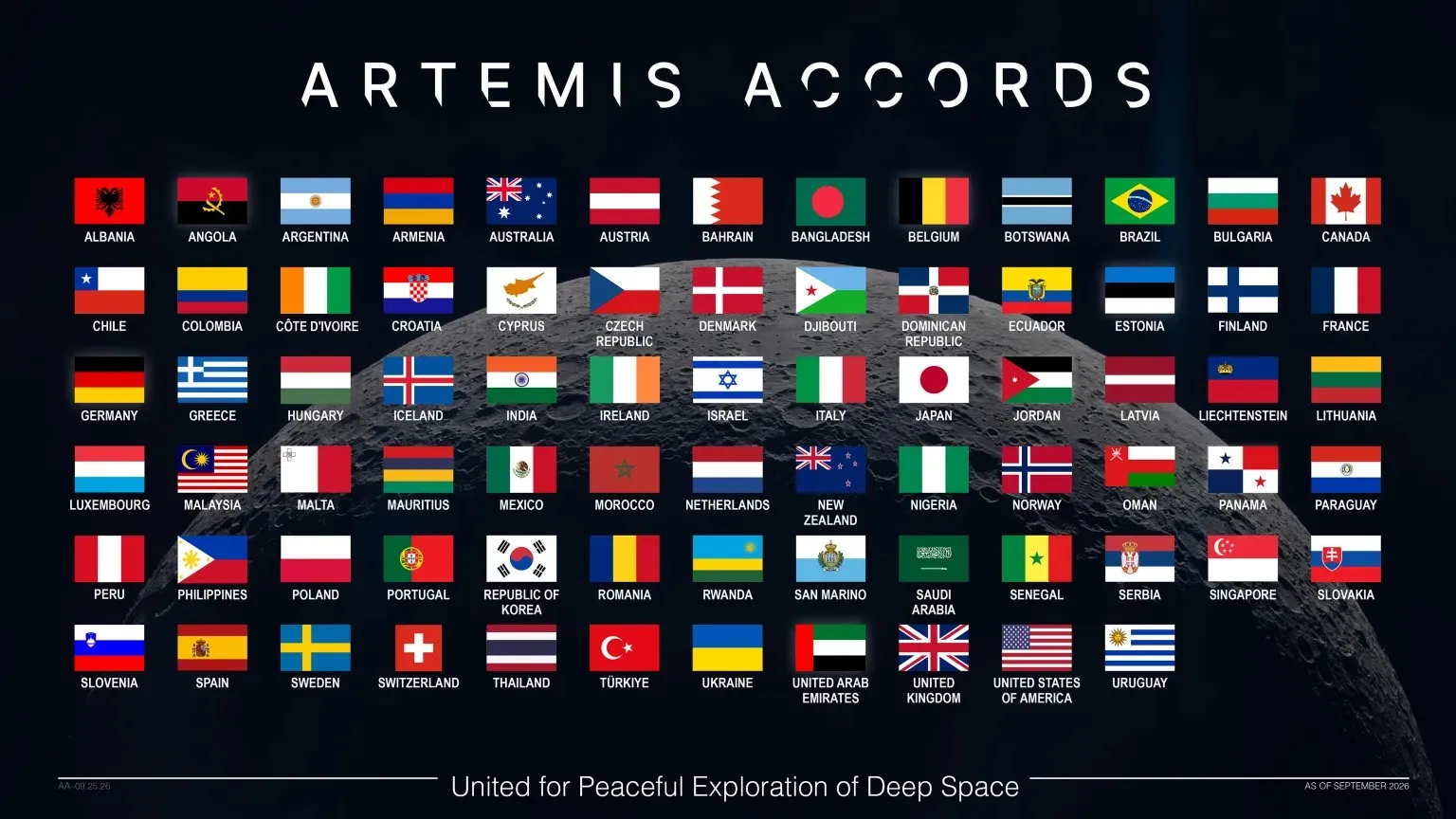
Artemis Accords Reach 76 Signatories as Albania, Croatia, Ivory Coast and San Marino Join
NASA has welcomed Albania, Croatia, Ivory Coast and San Marino as the newest signatories to the Artemis Accords, bringing the total number of participating countries to 76.
“Our momentum reflects a growing commitment to peaceful and responsible exploration and a shared understanding that the future of space will be shaped by motivated people,” said NASA Administrator Jared Isaacman. “Nearly one-third of all signatories have joined since the beginning of President Trump’s second term. As the president directs NASA to return Americans to the Moon and lay the foundations for Mars, we are strengthening a coalition of partners who share our values and are ready to help shape the future of exploration.”
Global Support for Peaceful Space Exploration Grows
The recent expansion represents one of the fastest periods of growth in international cooperation in civil space history. Nearly 40% of the world’s countries now work with NASA to promote a transparent, peaceful, responsible and safe approach to space exploration.
Nearly two-thirds of the countries that signed the 1967 Basic Outer Space Treaty have also signed the Artemis Accords.
What began as an informal partnership among a small group of countries has developed into a large, structured community. Its work is guided by the signatory group’s operating framework, adopted in 2024.
Under this framework, participating countries meet twice a year: once for a technical workshop and once for a principals’ meeting held during the International Astronautical Congress (IAC). Additional virtual sessions take place throughout the year to support implementation.
Artemis Accords Advance Lunar Cooperation
Participating countries have advanced shared recommendations covering non-interference, interoperability, scientific data sharing and registration practices.
Two major workshops were held this year to strengthen technical collaboration. Signatories reviewed planned lunar landings and orbital missions and took part in practical sessions focused on open science and tools for sharing lunar data.
Experts from dozens of countries worked on ways to make mission information easier to find, use and share. Their efforts included publishing lunar science data and adopting common standards to reduce interference between missions.
Upcoming Artemis Accords Principals Conference
This year’s Artemis Accords Principals Conference will be held at the IAC in Antalya, Turkiye, starting Monday, October 5. The conference will be co-chaired by NASA Deputy Administrator Matt Anderson and Peruvian Space Agency (CONIDA) Director General Roberto Melgar Sheen.
Participants will explore ways to support emerging space nations and share recommendations for lunar debris mitigation.
NASA Invites Signatories to Support the Return to the Moon
NASA continues to put the principles of the Artemis Accords into practice. With the creation of the lunar base, NASA invited all Artemis Accords signatories to support the return to the Moon through scientific payloads, technology demonstrations, CubeSats and other capabilities.
What Are the Artemis Accords?
The United States and seven other countries, led by NASA and the U.S. State Department, launched the Artemis Accords in 2020 to channel growing global interest in lunar activity.
The agreement established practical principles to improve safety and coordination as countries explore destinations such as the Moon and Mars. Signatories commit to:
- Exploring peacefully and transparently
- Providing aid to those in need
- Enabling access to scientific data
- Ensuring that space activities do not interfere with others
- Developing best practices to preserve historically significant sites and artifacts
More countries are expected to join the Artemis Accords in the coming months and years as NASA continues working with partners around the world to support a safe, peaceful and prosperous future in space.
For more information on the Artemis Accords, please see below.
-end-
Camille Gallo / Elizabeth Shaw
Headquarters, Washington
202-358-1600
[email protected] / [email protected]
Source: www.nasa.gov