


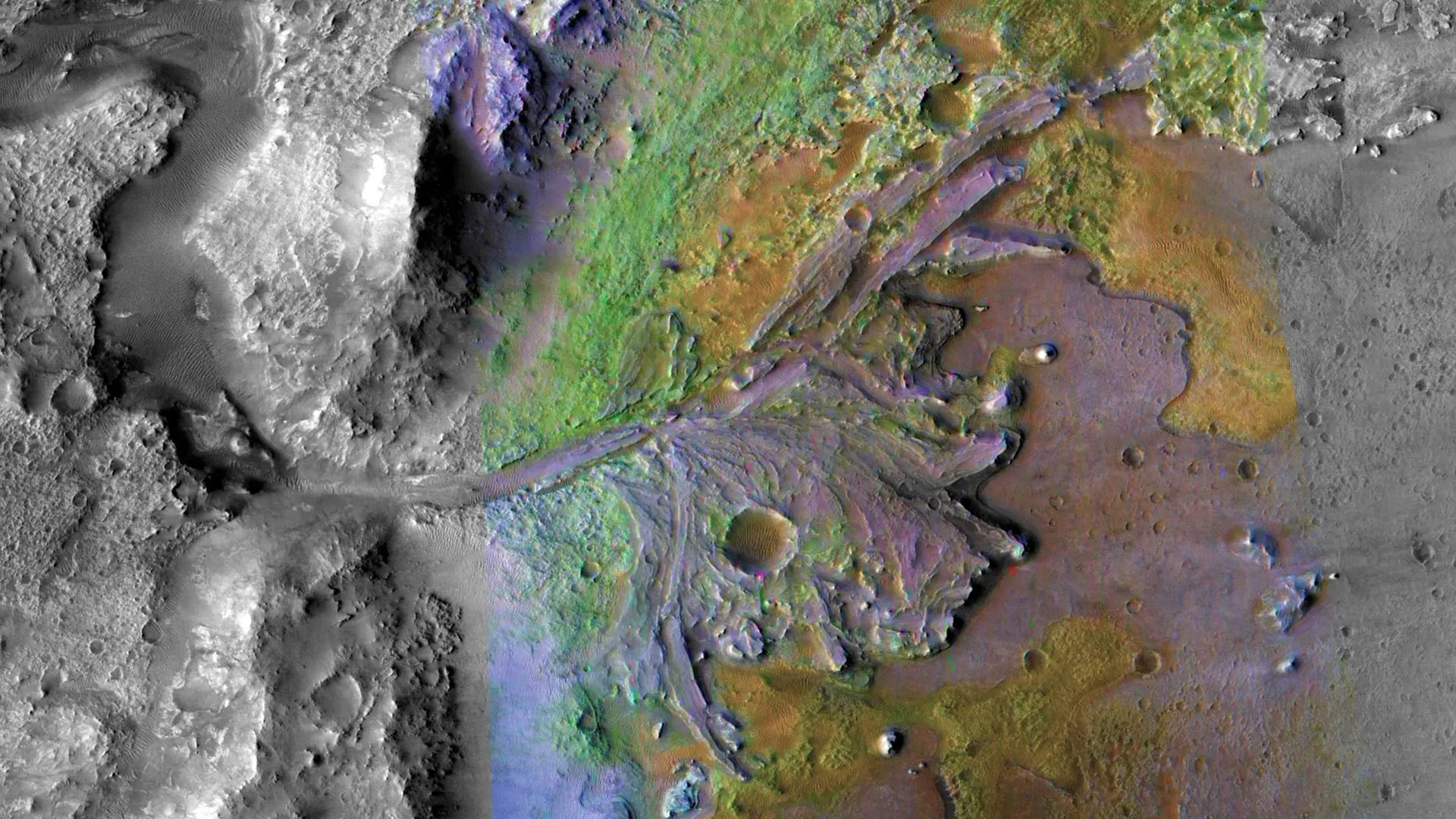
Perseverance Finds Jezero Crater Had a Complex History of Lakes, Groundwater and Hot Water
A new study suggests that Mars’ Jezero Crater margin unit records a far more complex water history than scientists expected, including ancient lakes, groundwater and later hydrothermal activity.
When NASA’s Perseverance rover reached the inner rim of Jezero Crater in September 2023, researchers expected to find sedimentary rocks along the shoreline of what was once a Martian lake. These rocks form as layers of material accumulate over long periods. On Earth, sedimentary rocks made of clay and silt are especially valuable because they can preserve evidence of ancient microbial life.
The region was also a scientific priority because Mars orbiters had detected strong signatures of carbonate minerals. On Earth, carbonates commonly form in shallow lakes and oceans, including environments that may support life.
Instead of the expected sedimentary deposits, Perseverance encountered igneous rocks. These rocks form when magma cools underground or volcanic material hardens at the surface. Their minerals can preserve detailed information about the conditions in which the rocks formed.
Those rocks revealed that Jezero Crater’s margin unit experienced an unexpectedly complicated history. Evidence indicates that water interacted with the rocks on at least three separate occasions, changing their chemistry and physical appearance in different ways each time. The findings were published in the journal Communications Earth & Environment.
SuperCam reveals Mars’ hidden water history
Much of the evidence came from SuperCam, an instrument mounted on Perseverance’s mast. SuperCam can identify the mineral composition of geological formations by analyzing reflected light.
After mission scientists identify a promising target, they can direct SuperCam to fire a laser from about 6.5 meters (21 feet) away. The laser produces small bursts of plasma, and the resulting spectra reveal the chemical composition of the rock. Using this technique, Perseverance studied more than 185 rock targets across the margin unit.
“Until we arrived at the Margin Unit, the main hypothesis derived from orbital observations was that the carbonates seen from orbit formed through interaction with the lakes present in Jezero Crater,” said Candace Bedford, a research scientist at Purdue University in West Lafayette, Indiana, and lead author of the study.
“But we now know that this site was a kind of crossroads for water systems. The discovery of the Margin Unit is important because Jezero Crater lies within one of the most exposed carbonates on Mars, so what we learn here extends far beyond the crater.”
Ancient magma lies beneath Jezero Crater
Perseverance surveyed the margin unit across an elevation range of approximately 870 feet (265 meters). In the region’s highlands, the rover encountered coarse-grained crystalline rocks rich in olivine. These rocks showed little evidence of alteration by water.
Olivine contains magnesium and iron. Researchers concluded that the olivine-rich unit originally formed inside a large mass of magma deep beneath Mars’ surface. The magma cooled slowly enough for large mineral grains to develop. Much later, erosion removed the overlying material and exposed the rocks.
Farther downstream in the margin unit, closer to the ancient lake bed, the rocks showed a very different history. The olivine had undergone substantial alteration: its particles were broken apart, and silica filled the spaces between them.
Carbonates and silica are especially important to scientists searching for evidence of ancient habitability. On Earth, when water reacts with olivine, the process produces hydrogen that some microorganisms can use as an energy source. The reaction also produces carbonate and silica, minerals that can preserve traces of past microbial activity.
Jezero Crater rocks record at least three water episodes
Researchers can reconstruct the order in which water altered the margin unit, but they cannot yet determine exactly when each episode took place.
The first known episode involved carbon dioxide-rich groundwater. As the water moved through the rocks, it reacted with olivine and created carbonates inside cracks at lower elevations. Over time, erosion removed some of the surrounding softer material, leaving the harder carbonate-filled cracks exposed as ridges.
The second phase of water activity may have been connected to an ancient lake that once filled Jezero Crater.
“Some of the rocks in the Margin Unit also contain silica,” said Eleni Lavanis, a planetary scientist at the University of Hawaii at Manoa and co-author of the study. “Converting olivine to carbonate can leave behind silica, which is often found in rocks below the waterline.”
Hot groundwater altered the rocks later
The third and subsequent episodes appear to have involved heated water circulating underground.
Perseverance discovered a vein approximately 10 inches (25 centimeters) thick in the eastern margin unit. The vein contains minerals including calcium sulfate and fluorite.
Fluorite provides important clues about the conditions in which the vein formed. The mineral typically develops when hot water circulates through volcanic rocks. Its presence indicates that Jezero Crater experienced late-stage heated groundwater activity after the earlier interactions between groundwater, rocks and the ancient lake.
A crossroads of water systems on ancient Mars
Taken together, the observations show that the margin unit did not form in a single lake environment. Instead, several different water systems modified the same rocks at different stages of Mars’ history.
“If there’s one thing I’ve learned from working with Mars rovers for 10 years, it’s that Mars never ceases to amaze me,” Bedford said. “It’s very rare that things turn out exactly as we expect from orbital data. We hope this work will help scientists reconstruct how they view the history of water in Jezero Crater and Mars as a whole. Ultimately, we hope it will help planetary scientists reconstruct the changing climate and habitability of early Mars.”
Source: www.sciencedaily.com