


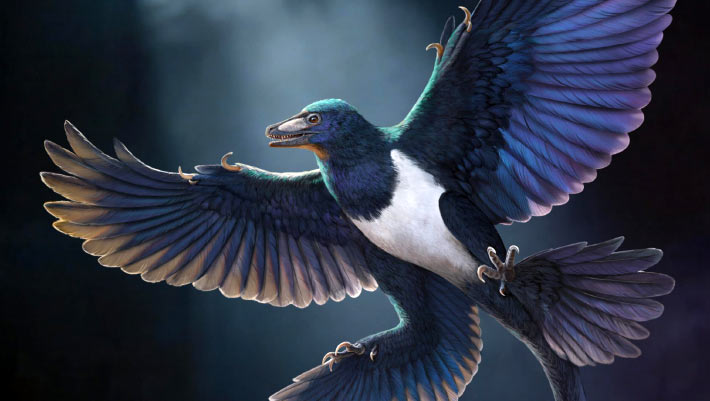
Norellaptor barsboldi: New Microraptor Dinosaur Challenges the Origins of Flight
A newly identified species of small, feathered microraptian dinosaur discovered in 120-million-year-old rock in China’s Liaoning Province is challenging the idea that early fliers evolved from a single shared flight blueprint.
A new microraptian dinosaur from China
Norellaptor barsboldi belongs to Microraptoridae, a group of small, bird-like predatory dinosaurs.
Microraptors combined wing-like arms with feathered legs. Some researchers have proposed that these dinosaurs were capable of gliding and may even have been able to fly under their own power.
The nearly complete skeleton of Norellaptor barsboldi measures about 57 centimeters (22 inches) long and includes traces of feathers. It was discovered in the Jiufodang Formation near the town of Ramadong in Liaoning Province, China.
What microraptors reveal about the evolution of flight
Microraptors have long been used to study how flight evolved. One hypothesis suggests that a rudimentary form of flight developed in the common ancestor of birds and their close relatives, the parabirds, before being elaborated in some lineages and lost in others.
A competing hypothesis proposes that flight-related traits evolved independently at least twice.
“Microraptoridae is a clade of small theropod dinosaurs known primarily from the Late Cretaceous,” said Dr. Qiang Ji of Hebei Geographical University, Dr. Andrea Cau of the OPHIS Museum of Paleontology, and their colleagues.
Exceptional microraptid fossils have preserved feather-like integumentary structures, true pennaceous plumage, and remnants of intestinal contents. These discoveries have provided unusual insights into the anatomy and ecology of the group.
As members of Paraves and some of the closest relatives of birds, microraptids display a distinctive combination of limb and feather characteristics. These features suggest that at least some members of the clade developed adaptations related to aerial movement.
Flight features evolved in a different sequence
The paleontologists conducted an evolutionary analysis of the fossil, identifying 194 anatomical changes along the microraptian branch of the family tree. Approximately 30% of those changes—57 traits—also appear along the lineage leading to birds.
However, the researchers found that the traits emerged in a different order in microraptors and birds.
For example, the finger bones of microraptors became shortened early in their evolution, while features such as the fusion of the wrist and hand bones developed later.
“This discovery challenges the idea that microraptors and birds inherited a common flight apparatus or a common developmental process that drove their evolution,” the researchers said.
“Different selective pressures likely shaped the flight-related traits of each lineage.”
The team’s study was published in Nature Communications.
_____
Ji, Q., Cau, A., et al. 2026. Independent assembly of flight apparatus in nonavian dinosaur clades. Nature Communications 17, 10074. doi: 10.1038/s41467-026-77804-6
Source: www.sci.news