


NASA Tests Glow-in-the-Dark Paint to Reveal Airflow Around Aircraft Wings
A groundbreaking test at NASA’s Langley Research Center in Hampton, Virginia, is helping advance wind tunnel technology for the design of future aircraft.
Pressure-Sensitive Paint Maps Airflow in Real Time
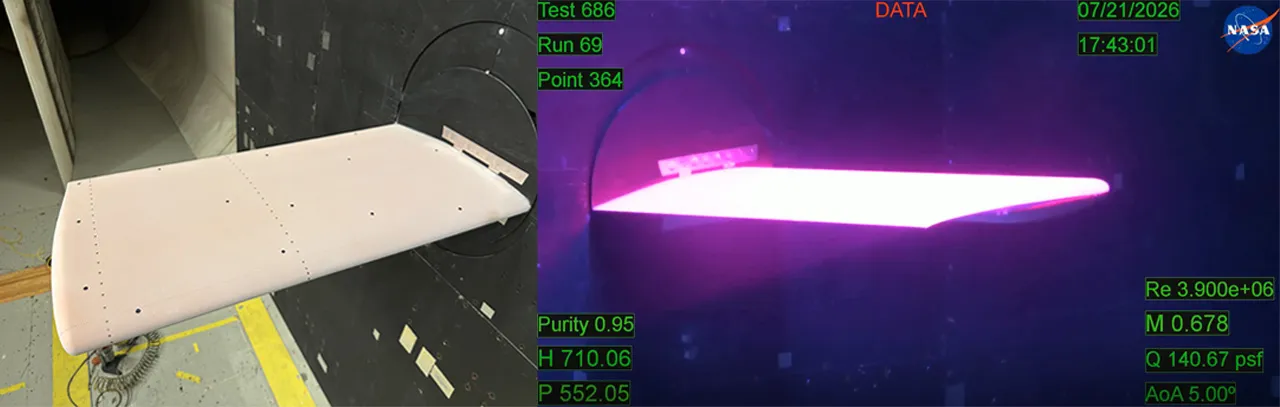
In the first test of its kind, researchers at NASA Langley’s Transonic Dynamics Tunnel used unsteady pressure-sensitive paint to study airflow around a standard wind tunnel model called a benchmark supercritical wing.
When exposed to ultraviolet light, a special feature of the paint caused the model’s wings to glow pink and purple. High-speed cameras captured the changes in brightness, allowing researchers to measure how air pressure moved across the wing.
A Universal Model for Aircraft Research
NASA’s benchmark wing does not represent one specific aircraft. Instead, it serves as a universal model that helps researchers improve computer simulations by comparing them with wind tunnel data.
Transient pressure-sensitive paint changes brightness in response to airflow pressure on the wing. High-speed cameras record those changes and generate data that can be used to improve computer models.
Researchers at NASA’s Langley Research Center and NASA’s Ames Research Center in California’s Silicon Valley have worked for years to incorporate the technology into wind tunnel tests involving aircraft and rockets. NASA researchers expect the paint to support many more wind tunnel applications in the future.
First Large-Scale Test in a Hypoxic Environment
This test marked the first time the technology was used on a large-scale model moving freely in a hypoxic environment. The achievement was made possible by the unique testing capabilities of NASA’s Transonic Dynamics Tunnel.
Advancing the Future of Flight
The milestone opens the door to future tests involving flexible aircraft models designed to bend and adapt during flight to improve efficiency. It also lays the foundation for more accurate simulations and improved aircraft design as NASA advances the future of flight.
Source: www.nasa.gov