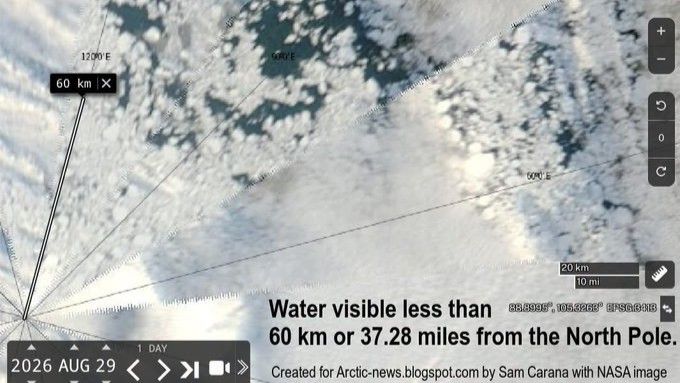
NASA Satellite Image Shows Open Water Just 37 Miles From the North Pole
A NASA satellite image captured on August 29 shows a large area of open water just 37 miles (60 kilometers) from the North Pole. Although the image does not prove that Arctic sea ice conditions are worse this year than during previous record-setting seasons, it highlights how dramatically the region is changing as a result of climate change.
The image was viewed through NASA’s Worldview satellite imagery platform and later shared by Arctic News. The striking areas of open ocean are unusual in their scale, although similar breaks in the ice have appeared in the Arctic before.
Julienne Stroeve, a professor of polar observation and modeling at University College London, said open water can occasionally be seen in the central Arctic. However, she noted that the extent shown in the recent satellite imagery is particularly notable.
“You can sometimes see open ocean in the Arctic, but I don’t think it’s ever been this widespread,” Stroeve told Live Science in an email. One example occurred in early September 2016, when an imaginary line through the central Arctic Ocean and areas north of 80 degrees north latitude—including Ellesmere Island in Canada and Spitsbergen in Norway—was highly fragmented.
From the Latest VideosLive Science
Why Is There Open Water Near the North Pole?
Late summer is one of the most dynamic periods for Arctic sea ice. By this time of year, the ice pack is typically thinner, more fragmented and surrounded by larger areas of open water.
Local weather and ocean currents can quickly change the appearance of the ice. Strong winds may push ice floes apart, creating large stretches of open ocean, or compress them into a tighter formation within a matter of hours or days.
“Individual satellite images from around the North Pole in just the past two weeks show dramatic changes in the amount and location of visible open ocean,” climate scientist Zachary Labe said.
The overall extent of Arctic sea ice is not currently among the smallest ever recorded. However, the ice is highly variable because of shifting winds and uneven distribution across the Arctic Ocean. A change in wind direction could compress the ice into a denser pack and reduce the amount of open water visible in satellite images.
Arctic Sea Ice Is Becoming Thinner and More Fragile
There is no fixed distance from the North Pole where open water should disappear. Arctic conditions vary considerably from one year to the next. However, summer sea ice has become thinner and more fragile, allowing open water to appear closer to the pole more frequently than in the past.
The recent image may not show that this summer is dramatically worse than every recent year. Instead, it offers a vivid snapshot of an Arctic Ocean that looks very different from the one observed several decades ago and continues to change rapidly.
The Arctic is warming nearly four times faster than the global average. Areas that once held thick, persistent sea ice late into the summer are increasingly dominated by younger, thinner ice floes.
More open water in the Arctic can affect local weather patterns, ocean conditions and marine ecosystems. It may also increase coastal erosion, flooding risks and other hazards for Arctic communities.
Scientists expect Arctic sea ice to begin refreezing by mid-to-late September, which should close at least some of the gaps. Even so, the broader trend toward thinner, less stable summer sea ice remains an important indicator of ongoing Arctic warming.