


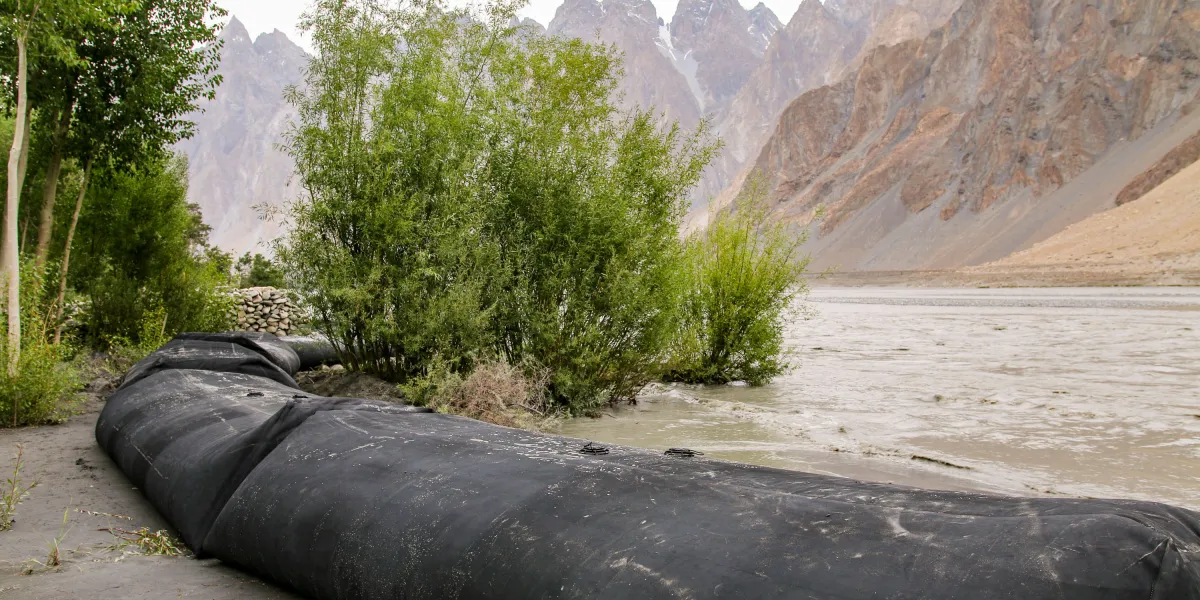
How SlamDam’s Mobile Flood Barriers Help Protect Communities From Rising Flood Risk
Developed in the Netherlands in 2013, SlamDam was first tested by the country’s local water authorities and is still used there today. WaveSave has since expanded into Africa and Southeast Asia, with customers deploying SlamDam in at least 12 countries.
WaveSave and SlamDam: Key Facts
- Industry: Seawalls and mobile flood protection
- Year of company establishment: 2017
- Headquarters: Eindhoven, Netherlands
- Notable project: WaveSave is demonstrating SlamDam on Governors Island in New York City after being selected as one of seven winners in the island’s climate adaptation challenge. The project uses breakwaters in areas where high tides and waves from passing ferries frequently wash onto the shore.
The Potential Impact of Mobile Flood Barriers
Climate change and population growth could expose nearly 2 billion people to flooding by 2100—an increase of 300 million people compared with 2020, according to some estimates.
Mobile flood barriers such as SlamDam are designed to protect agricultural land, private property and critical facilities, including hospitals and water treatment plants. In the short term, they can cost less than permanent adaptations such as constructing embankments or rebuilding facilities on higher ground. Because they are temporary, the barriers can be deployed when needed and stored between floods.
Local installers can fill SlamDam barriers using portable, hand-held water pumps. The seawall system has a service life of more than 40 years and can be used repeatedly.
The system may offer another important benefit during freshwater floods. In the weeks and months after a flood, residents can pump water stored in the mobile barriers to irrigate crops. This can be especially valuable during dry seasons or in drought-prone areas.
In the rural Mpanda commune of Burundi, East Africa, a SlamDam system was installed during the 2022 flood season. Farmers who had access to the stored water produced more crops that year and doubled their incomes, according to a UN report.
Challenges and Precautions
Companies including AquaFence, MegaSecur and NOAQ Flood Protection also manufacture mobile flood walls. WaveSave differentiates SlamDam through its focus on rapid emergency deployment in developing countries and its emphasis on storing water for later use.
However, research into the use of mobile flood barriers in Kenya identified several challenges, including gaining community acceptance. Communities must also determine who will own, maintain and deploy the barriers.
Initial cost is another challenge. SlamDam is already as affordable as, or more affordable than, many alternatives. Prices range from €1,000 to €3,000—approximately $1,140 to $3,400—for each 5-meter section, depending on height.
Protecting a single entrance to a home or facility may require only 10 meters of barriers. Enclosing a facility such as a hospital, or protecting a farm or neighborhood, may require 200 to 300 meters. For many communities and farmers, however, the total cost remains too high.
WaveSave managing director Omar Saleh said the company is considering offering SlamDam as a service. Under this model, the barriers could be deployed on demand, potentially making flood protection more affordable for communities that cannot purchase the system outright.
Source: www.technologyreview.com