


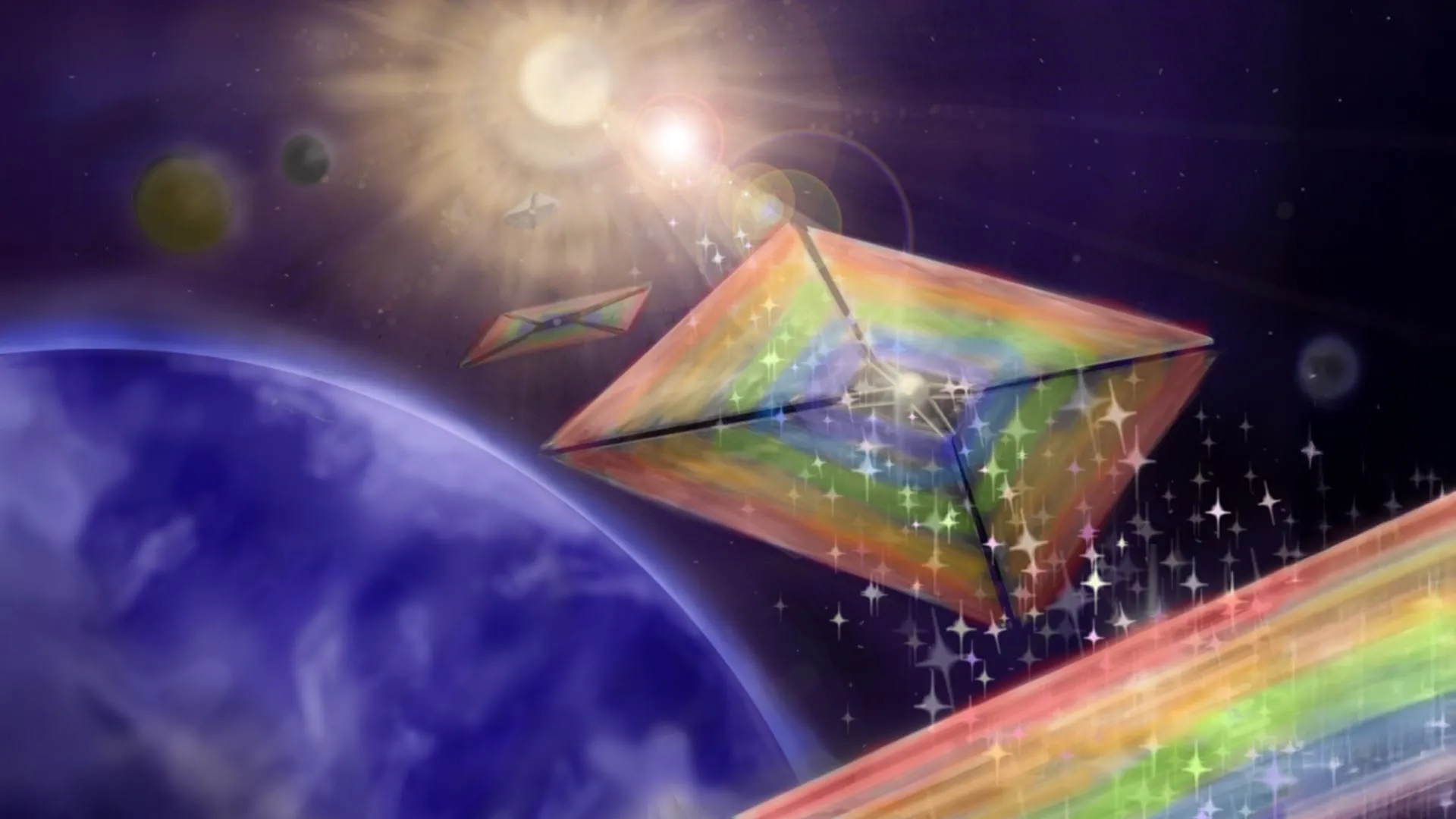
Reaching another star in a practical timeframe will require propulsion technology far more powerful than today’s chemical rockets. One promising concept is the laser-propelled solar sail—a huge reflective structure that uses photon pressure to generate thrust. A powerful laser aimed at the sail could accelerate a spacecraft to a significant fraction of the speed of light, potentially making interstellar travel more achievable.
However, a lightsail traveling at relativistic speeds could encounter unexpected challenges. According to a new paper published on arXiv by Chao Shen and Jiaze Li of the Harbin Institute of Technology, the same light that propels the sail may eventually create a form of radiation drag.
How a laser pushes a solar sail
Researchers generally divide the forces produced when photons strike a solar sail into three components.
The largest contribution comes from incident light, which refers to the raw momentum carried by photons as they hit the sail. The second effect is specular reflection, in which photons bounce directly off the reflective surface and transfer momentum to the spacecraft. The smallest contribution comes from diffuse scattering, when photons are absorbed and later re-emitted in random directions.
At relatively low speeds, all three effects help propel the sail forward. However, the physics becomes more complicated as the spacecraft approaches a substantial fraction of the speed of light.
The Doppler effect reduces laser-sail thrust
As a laser sail moves away from its light source, the Doppler effect becomes increasingly important. The frequency of the light reaching the sail decreases, reducing the energy and momentum transferred by the photons.
This causes the thrust generated by incident light, specular reflection and diffuse scattering to decline. As a result, continuous acceleration becomes less efficient. The faster the sail travels, the more difficult it becomes for the laser to increase its speed further.
The effect becomes even more significant when the lightsail reaches approximately 75% of the speed of light.
How scattered light can produce radiation drag
At these extreme velocities, relativistic optical aberration begins to play a major role. From the perspective of an observer on Earth, diffusely scattered photons can appear to be emitted in the forward direction—the same direction in which the sail is moving.
Because radiation carries momentum, light emitted forward produces an opposing reaction force on the sail. Consequently, once the spacecraft exceeds roughly 75% of the speed of light, diffuse scattering—the weakest of the three photon interactions—can begin to act as a drag force.
The laser would still provide a net forward push, so the total force would not become negative. Nevertheless, the efficiency of the laser-sail propulsion system would be significantly reduced.
Real solar sails face additional challenges
The study focuses on radiation dynamics and does not include several other hazards that an interstellar solar sail would encounter. For example, collisions with interstellar gas and dust could create additional drag or damage the spacecraft at high speed.
The research also does not fully address the thermal limits of real sail materials. A sail exposed to an extremely powerful laser could absorb enough energy to overheat, deform or melt.
For simplicity, the researchers modeled the lightsail as an ideal mirror. Actual spacecraft would likely require advanced materials capable of reflecting specific laser wavelengths while minimizing heat absorption.
Engineers are already studying metamaterials and photonic crystals for next-generation laser sails. These engineered surfaces could potentially be designed to manage relativistic optical effects, automatically adjust the sail’s orientation and help keep the spacecraft centered in the laser beam.
The long-term challenge of interstellar travel
A fully operational interstellar solar sail remains many years away. Traveling between stars presents numerous additional challenges, including navigation, spacecraft stability, radiation exposure and interactions with interstellar matter. The paper also simplifies certain aspects of the journey, including the effects of spacetime curvature.
Even so, understanding how light behaves at relativistic speeds is essential for designing future laser-propelled spacecraft. If humanity eventually sends probes to neighboring star systems, engineers will need to account for every force that could influence their trajectory—including the possibility that scattered light may transform from a source of propulsion into a source of drag.
Source: www.sciencedaily.com