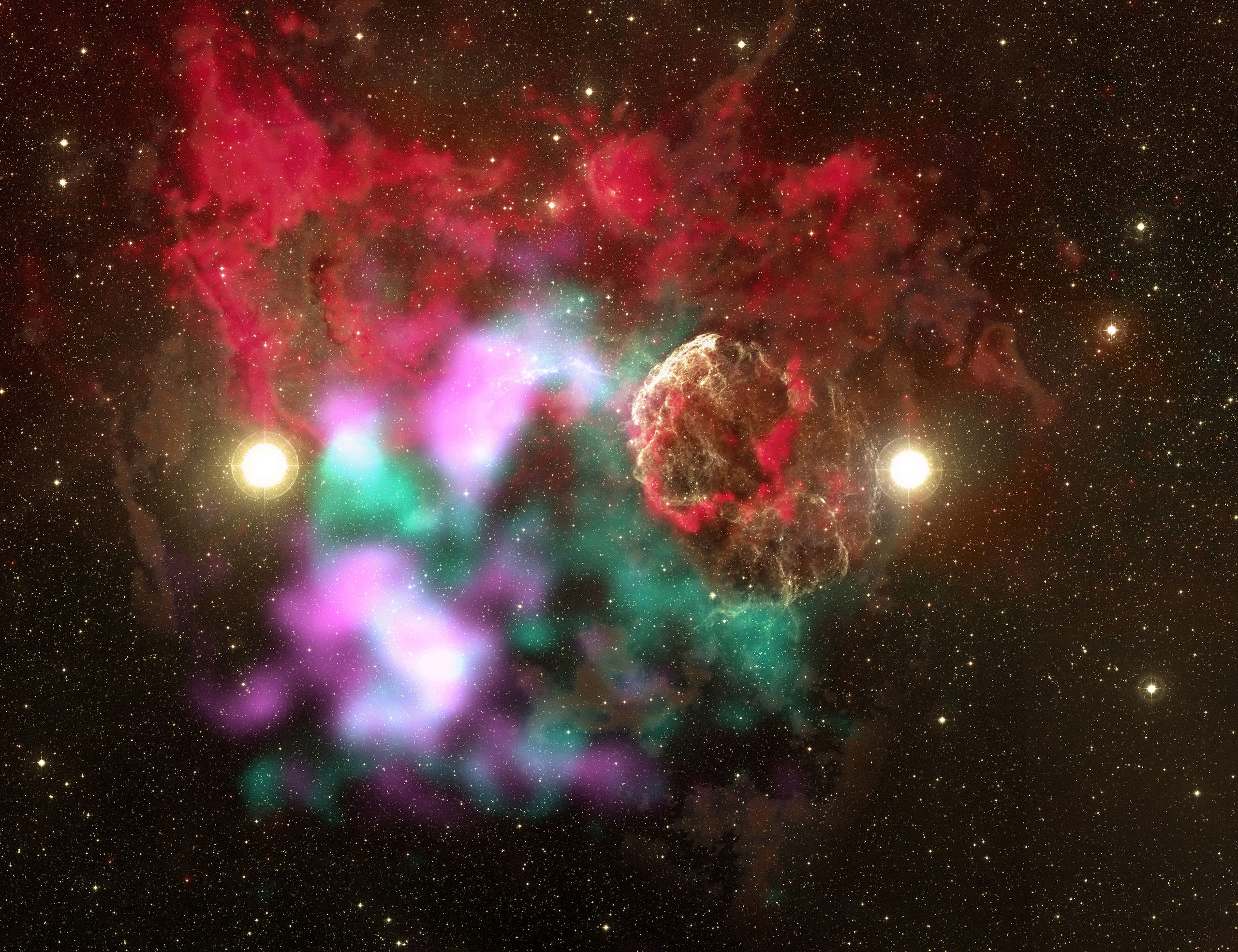
Astronomers may have identified the first known pair of supernova remnants created by the same binary star system. The two stars likely spent millions of years orbiting one another before exploding separately and leaving behind neighboring clouds of cosmic debris in the Milky Way.
Using 16 years of observations from NASA’s Fermi Gamma-ray Space Telescope, researchers detected high-energy gamma rays from a faint and previously overlooked supernova remnant known as G189.6+3.3. The remnant lies next to the much brighter and extensively studied IC 443, also called the Jellyfish Nebula.
The new analysis suggests the two supernova remnants are more than coincidental neighbors. Instead, they may be the remains of a binary star system in which both massive stars eventually exploded. If confirmed, the system would represent the first known example of two supernova remnants linked to the same stellar pair.
“We weren’t really looking for a binary supernova remnant,” study first author Miltiadis Michailidis, an astrophysicist and postdoctoral fellow at Stanford University, told Live Science.
The researchers initially set out to study G189.6+3.3, a supernova remnant that had been largely overlooked because of its brighter neighbor. IC 443 is one of the best-studied supernova remnants in the Milky Way and was among the first confirmed remnants capable of accelerating protons — a process linked to the production of cosmic rays, the high-energy particles that constantly bombard Earth’s atmosphere.
By combining Fermi’s gamma-ray observations with X-ray, radio, ultraviolet and optical data, the team isolated the faint signal from G189.6+3.3. The observations revealed an unusual internal structure: accelerated protons dominated the remnant’s northern half, while electrons were more prominent in the south. It is the first time astronomers have identified such a clear division within a single supernova remnant.
The researchers traced this difference to the surrounding environment. The northern edge of G189.6+3.3 is colliding with a dense cloud of hydrogen gas. When fast-moving protons strike the cloud, they generate gamma rays, Michailidis said. The southern region contains less dense material, allowing an electron-driven process to dominate.
Ultraviolet observations provided additional support for this explanation. They showed that the northern shock wave had slowed as it crashed into the hydrogen cloud, indicating that the remnant is interacting with dense gas.
A dense hydrogen cloud helped astronomers uncover evidence that two neighboring supernova remnants may have formed from the same binary star system.
(Image credit: M. Michailidis et al. 2026)
Earlier research showed that IC 443 also interacts with the same hydrogen cloud. This indicates that the two remnants are located at approximately the same distance from Earth.
To determine whether the alignment could be accidental, the researchers simulated 1 million hypothetical binary star systems. They calculated how often two unrelated supernova remnants would appear this close together by chance. Depending on the statistical method, the probability ranged from roughly 1 in 1,000 to 1 in 100. The results suggest that G189.6+3.3 and IC 443 are highly likely to be physically related.
Get the world’s most fascinating discoveries delivered straight to your inbox.
The team also estimated the timing of the two stellar explosions. Their calculations indicate that the supernovas likely occurred tens of thousands of years apart — a sequence consistent with a binary system in which one massive star exploded first and its companion went supernova much later.
This possible binary supernova remnant system gives astronomers a rare natural laboratory for testing theories about how massive binary stars evolve, exchange material and ultimately explode.
Michailidis said the researchers’ next step is to search for other pairs of supernova remnants that may have originated from binary star systems. Finding additional examples could help explain why this system appears to be unique.
The discovery could also help scientists better measure the energy released by supernovas. By determining the distance between the centers of two explosions, astronomers may be able to estimate how much each blast expanded and how much energy it produced — a value that has traditionally been inferred mainly from theoretical models. “Now we can actually test it,” Michailidis said.
Michailidis, M., Lemoine-Goumard, M., Willcox, R., Gabici, S., Di Lalla, N., & Omodei, N. (2026). Shared cloud interactions unveil a candidate binary-system supernova pair with no known analogue. Nature Communications, 17(1).