


James Webb Space Telescope Identifies the Host Galaxy of the Most Distant Fast Radio Burst
Astronomers using NASA’s James Webb Space Telescope have precisely identified the host galaxy of the most distant fast radio burst (FRB) ever observed. The discovery could help reveal which extreme cosmic events produce these mysterious millisecond-long flashes of radio energy.
First discovered in 2007, fast radio bursts originate billions of light-years away. Most are detected only once, leaving scientists uncertain about their sources. “What’s interesting about fast radio bursts is that we don’t know what causes them. There are theories about what objects might produce them, but no conclusive evidence,” said Manisha Caleb of the University of Sydney, lead author of the study published in Science.
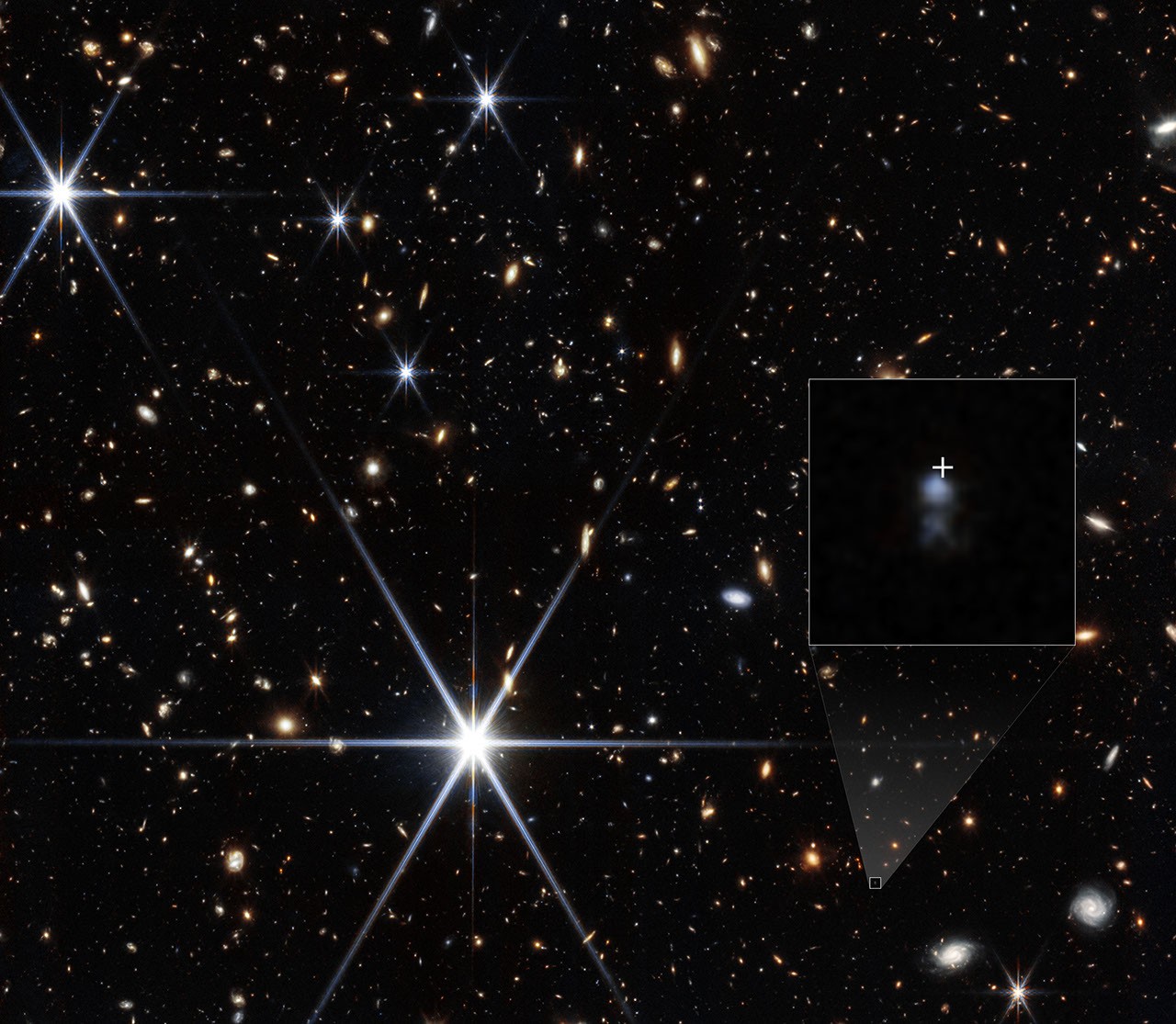
Webb Pinpoints a Distant Fast Radio Burst’s Galaxy
The MeerTRAP team detected the March 4, 2024, outburst with the MeerKAT radio telescope. Designated FRB 20240304B, the event appeared to be extremely distant and could be the most distant fast radio burst ever observed.
Radio observations pinpointed the burst’s location with exceptional precision. However, even the world’s largest ground-based telescope could not detect a galaxy at that position. The team therefore turned to NASA’s James Webb Space Telescope.
NASA’s James Webb Space Telescope detected the host galaxy of FRB 20240304B with its NIRCam instrument. The galaxy is a small dwarf galaxy that is actively forming stars.
Images: NASA, ESA, CSA, STScI, Temia Nanayakkara (USYD); Image processing: Joseph DePasquale (STScI)
Webb’s Near Infrared Camera (NIRCam) detected a galaxy at the correct location. Webb’s Near Infrared Spectrometer (NIRSpec) then measured the galaxy’s redshift at 2.148. This means the galaxy existed only about 3 billion years after the Big Bang.
A Surprisingly Small, Star-Forming Dwarf Galaxy
The host galaxy of FRB 20240304B is unlike most other galaxies known to contain fast radio bursts. Many FRB host galaxies are massive and actively forming stars. By contrast, this host is a small dwarf galaxy—about 1,000 times smaller than expected.
“We thought it was a large, well-formed galaxy full of stars, actively forming stars, but instead it was a small dwarf galaxy,” Caleb said.
“The host stands out in the overall sample of galaxies we have, and it definitely wasn’t what we expected,” said study co-author Ben Stappers of the University of Manchester in the United Kingdom. “This combination of discovering and locating these distant bursts using the MeerTRAP project on the MeerKAT telescope and studying their hosts using Webb is very exciting.”
The galaxy existed during the height of cosmic star formation, sometimes described as the “noon” of the universe. Its star formation rate suggests that most of its stars may have formed within only 30 million years.
What the Discovery Reveals About the Origins of FRBs
The properties of this young dwarf galaxy offer important clues about the possible origins of fast radio bursts.
One theory proposes that an FRB is produced when two neutron stars merge. Because neutron stars are expected to take billions of years to gradually spiral toward each other before colliding, this scenario predicts that FRBs should be associated with older galaxies containing more evolved stellar populations.
Another theory suggests that FRBs come from a single young, highly magnetic neutron star called a magnetar. In this scenario, a massive star could explode as a supernova and leave behind a magnetar capable of producing an FRB through a starquake-like mechanism. That process could happen relatively quickly, making FRBs possible in young galaxies like the host of FRB 20240304B.
“Our research suggests that it is highly unlikely that this FRB resulted from a merger,” Caleb said.
“Our findings further demonstrate Webb’s remarkable ability to push boundaries beyond what was previously possible,” said co-author Temia Nanayakkara of the University of Sydney in Australia.
Fast Radio Bursts Map the Cosmic Web
Beyond setting a distance record, FRB 20240304B allowed researchers to study the billions of light-years of apparently empty space between the burst and Earth.
“Fast radio bursts are like cosmic flashlights, illuminating everything along their path. They leave a trail of everything they pass, so they can be used to track the ‘cosmic web’ of invisible matter and structures they encounter along the way,” said co-author J. Xavier Prochaska of the University of California, Santa Cruz.
The team identified traces of two cosmic structures in the FRB’s signal. One is a previously unknown galaxy cluster at a redshift of 0.3, about 3.5 billion light-years from Earth. The other is the nearby Virgo Cluster, approximately 54 million light-years away.
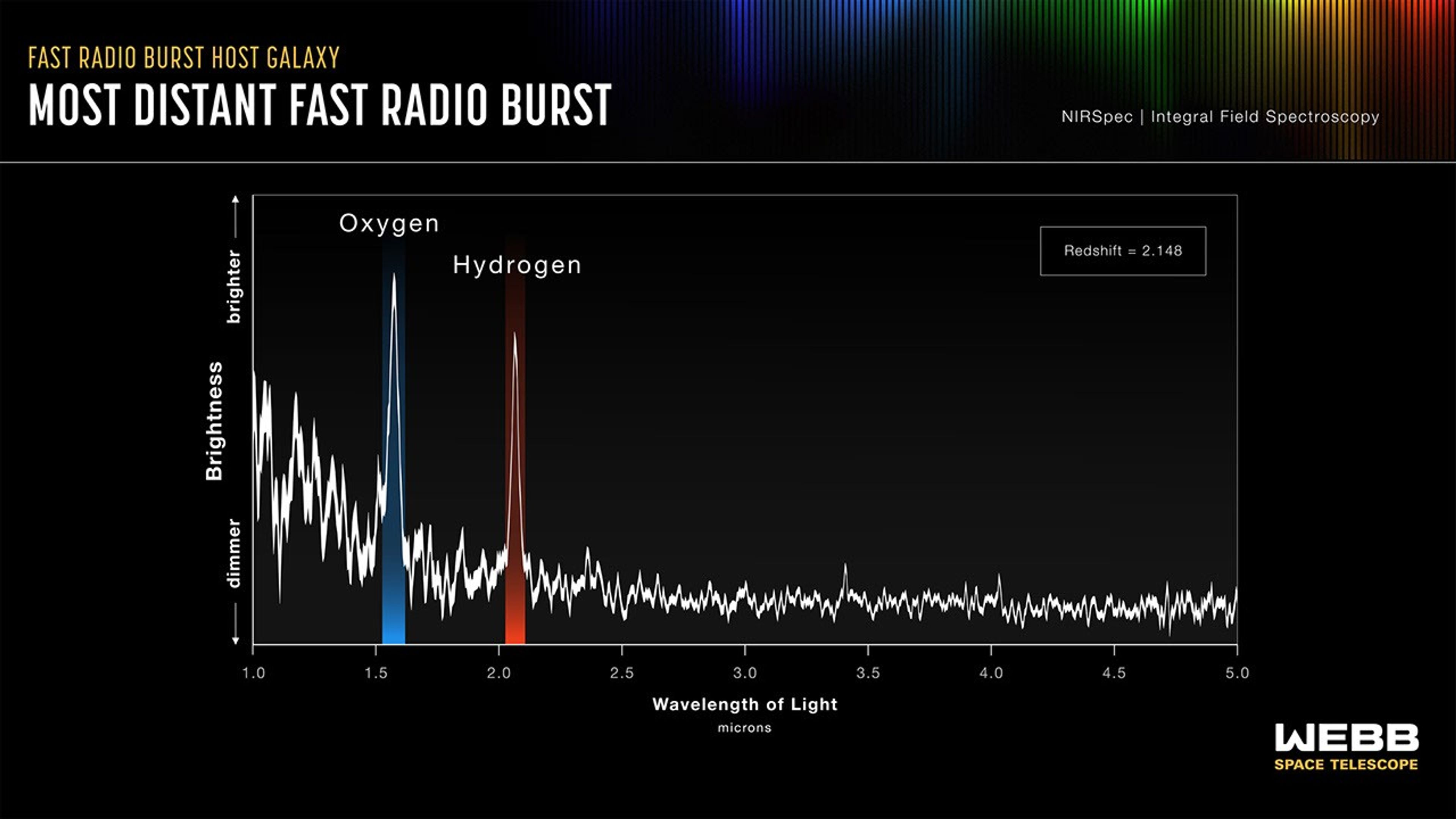
Astronomers used Webb to study the host galaxy of the most distant known fast radio burst. They measured a cosmological redshift of 2.148, showing that the FRB occurred when the universe was about 3 billion years old.
Illustrations: NASA, ESA, CSA, Joseph Olmsted (STScI); Science: Manisha Caleb (SIfA)
More Distant FRBs Could Be Discovered
The research team expects to find more distant fast radio bursts in the future. They estimate that MeerKAT could detect and precisely locate several FRBs each year at redshifts greater than 1.0. New radio telescope facilities and instruments are expected to accelerate the pace of discovery, while Webb will be essential for revealing the properties of the distant galaxies that host these bursts.
The James Webb Space Telescope is the world’s premier space science observatory. Webb studies our solar system, investigates distant worlds around other stars, and explores the structure and origins of the universe. It is an international program led by NASA and its partners, the European Space Agency and the Canadian Space Agency.
Source: science.nasa.gov