


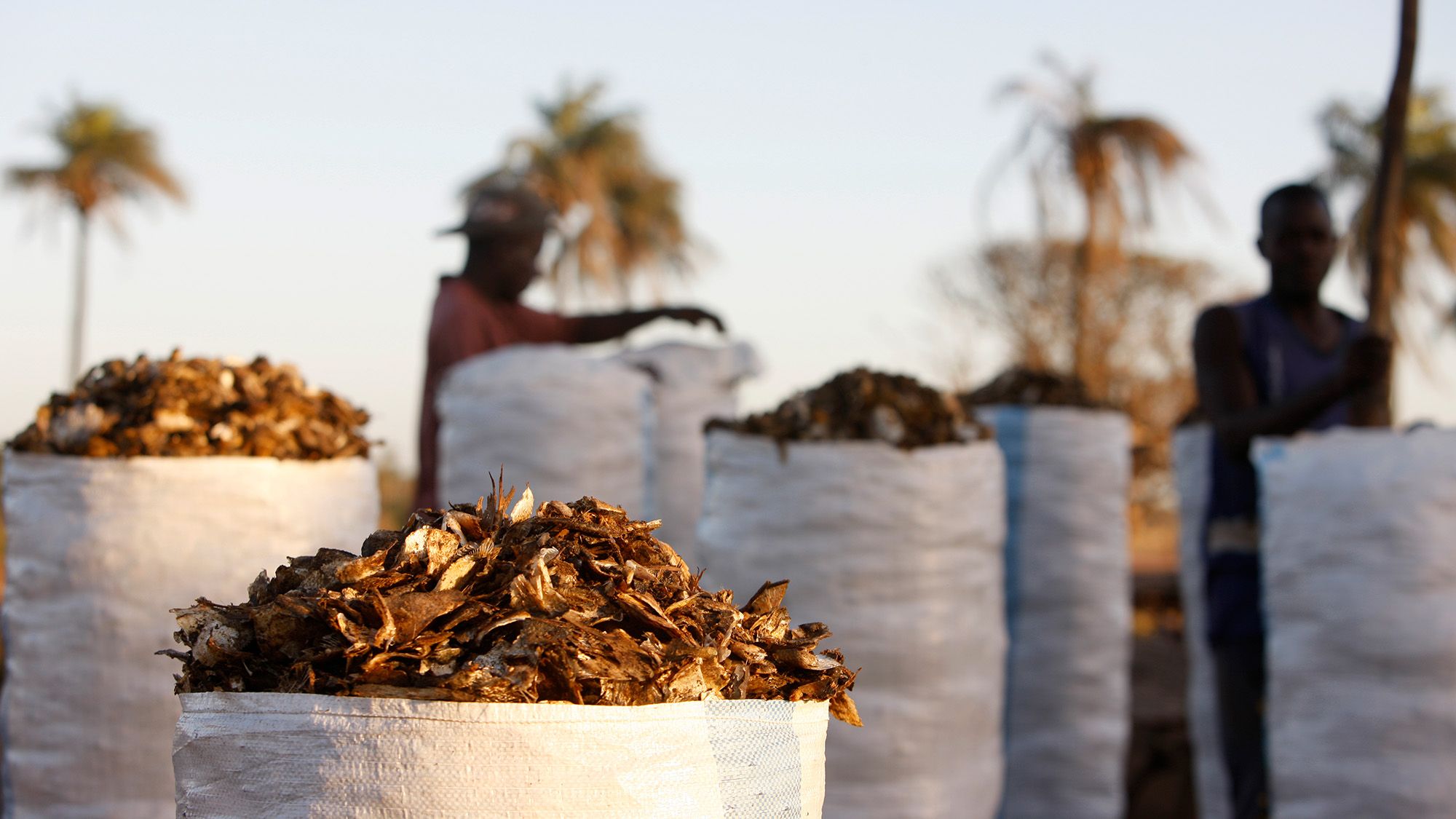
How Fishmeal Is Fueling a Global Industry at West Africa’s Expense
Fishmeal is a protein-rich commercial product made from raw fish and fish byproducts, including heads and bones. Small fish such as anchovies, sardines and herring are cooked, dried and ground into powder for use as feed for livestock, farmed fish and pets.
But fishmeal is far more than a simple market. In this excerpt from Every Last Fish: A Deep Dive Into the World of Fish and Fishing (Granta Books, 2025), journalist and author Rose George examines how large quantities of staple fish are harvested off the coast of West Africa. Rather than reaching African consumers, much of the catch is processed into fishmeal and fish oil for aquaculture in Europe and China.
Every Last Fish was shortlisted for the 2026 Royal Society Trivedi Scientific Book Award.
Rose George interview: “If you want to be a criminal, there’s no better place to be.” Dive into the darkness of the fishing industry
“Please take the fish. Eat that meat if you want. But don’t discount the rest. You can always use it in some way, whether it’s fishmeal or face cream.”
Fish is used in far more products than food
Fish-based products appear in everyday items. Guanine, an ingredient made from fish scales, is used in bath foams, perfumes, nail products, shampoos, skin-care products and lipsticks. Fish can also be processed into gelatin, glue and squalene. Fish-derived ingredients may be found in dietary supplements and wine.
Isinglass, extracted from dried fish swim bladders, is used in winemaking. These products are part of a vast and largely overlooked industry built around fish byproducts.
Futuristic fish transplants may seem irrelevant to most people in Senegal, but communities there still have to contend with the fish-byproduct industry. Fish that local people could eat is being turned into one of the most common and lucrative fish products and shipped overseas.
What is fishmeal?
Fishmeal is a gritty, dirty meal worth billions. Mink, pigs, cows, farmed fish and pets may all consume it. It is also used as a raw material for fertilizer and pet food.
Fishmeal is part of the larger fish-byproduct industry formerly known as FMFO, or fishmeal and fish oil. Industry bodies now often refer to these products as “fish ingredients,” an ambiguous term covering a wide range of fish-based products that receive little public attention.
The Food and Agriculture Organization defines fishmeal as “a clean, ground, dry tissue of undigested whole fish and/or fish fillets from which some of the oil has not been extracted.”
Fishmeal is supposed to use waste—but often does not
American pets may also eat fish liver or glandular powder made from dried whole-fish entrails. Other fish byproducts include “unrendered, clean, undecomposed parts of fish, including, but not limited to, heads, fins, tails, ends, skin, bones, and internal organs.” Another product is condensed fish protein digest, made by enzymatically breaking down clean, undigested whole fish or fish fillets.
The word “undecomposed” is significant. Unless fish is caught on a boat with freezer capabilities—which artisanal fishermen generally do not have—it can rot over several days.
In theory, fishmeal can be sustainable when it is made from discarded fish parts. That idea helped give rise to the term “reduced fishing”: use the meat and repurpose the rest. But that is not what is happening in West Africa.
How West African fish reaches Europe and China
Every year, 500,000 tonnes of wild fish are caught in African waters and sent to Europe to feed animals, even though the same fish could have fed 33 million Africans. That population is larger than the combined populations of Senegal, Mauritania and The Gambia.
Globally, one-fifth of wild fish is turned into fishmeal or fish oil, even though 90% of the fish used for fishmeal is suitable for human consumption.
China uses almost half of all FMFO, while Europe is also importing large quantities. Spain imports the most fish oil from Senegal, and France imports 70% of Mauritania’s fish oil.
A 2019 report from the Changing Markets Foundation documented the fishmeal industry in Senegal, Mauritania, India, Vietnam and The Gambia. Across these countries, the pattern was similar: foreign factories arrived, fish was taken away, the environment was polluted and fishermen reported that they were running out of fish.

A lack of traceability in farmed seafood
The Changing Markets Foundation linked trusted European retailers to FMFO supply chains that may use fish from West Africa. The report noted “an alarming lack of traceability and transparency regarding the origin and supply chain of farmed seafood products.”
Examples included Sainsbury’s, ALDI, Lidl and Marks & Spencer in the United Kingdom; Auchan, Groupe Casino, Monoprix and Système U in France; ALDI in Germany; and Mercadona in Spain. Sainsbury’s, Marks & Spencer and Mercadona say they do not use West African FMFO in their seafood products. The question is how they can verify the source.
European Union regulations on illegal, unreported and unregulated fishing require documents such as catch certificates to show that fish was legally caught. However, those rules do not apply to fishmeal.
In Mauritania, some Chinese-owned fishmeal factories have their own trawler fleets. Fish can go directly from the boats to the factories without passing through human mouths. Another tactic is to bid more than local seafood processors can afford.
Why local fishermen supply fishmeal factories
Seafood processors have said they cannot compete with the prices fishmeal factories pay for sardinella. Unlike Chinese seafood companies, they do not receive government subsidies. In The Gambia, one fishmeal factory used 40% of the country’s total catch in a single year.
The situation is not simply a story of foreign companies taking fish from local communities. In Senegal, The Gambia and Mauritania, local fishermen also supply fishmeal factories because the factories pay more. In Senegal, fishermen’s cooperative officials say there are too many pirogues—traditional fishing boats—and that fishermen are chasing smaller and smaller fish to sell to factories.
That is unsustainable.
The website of IFFO, formerly known as the International Fishmeal and Fish Oil Organization and now associated with the term Marine Ingredients Organisation, says marine ingredients “play a critical role in global food security.”
Francisco Mari of Bread for the World, speaking at a workshop organized by CAOPA, the African Confederation of Professional Organisations of Artisanal Fisheries, challenged that argument:
“This is only for shrimp and salmon. These are not essential foods. It’s a luxury. It’s not enough to have 10 to 15% of the fish that feeds salmon and shrimp. Indirectly, we’re eating your fish. It’s not essential to the nutrition of the United States or Japan. We’re taking your fish to feed a luxury product that we don’t need.”
Excerpted from Every Last Fish: A Deep Dive Into the World of Fish and Fishing, written by Rose George and published by Granta Books.
Source: www.livescience.com