


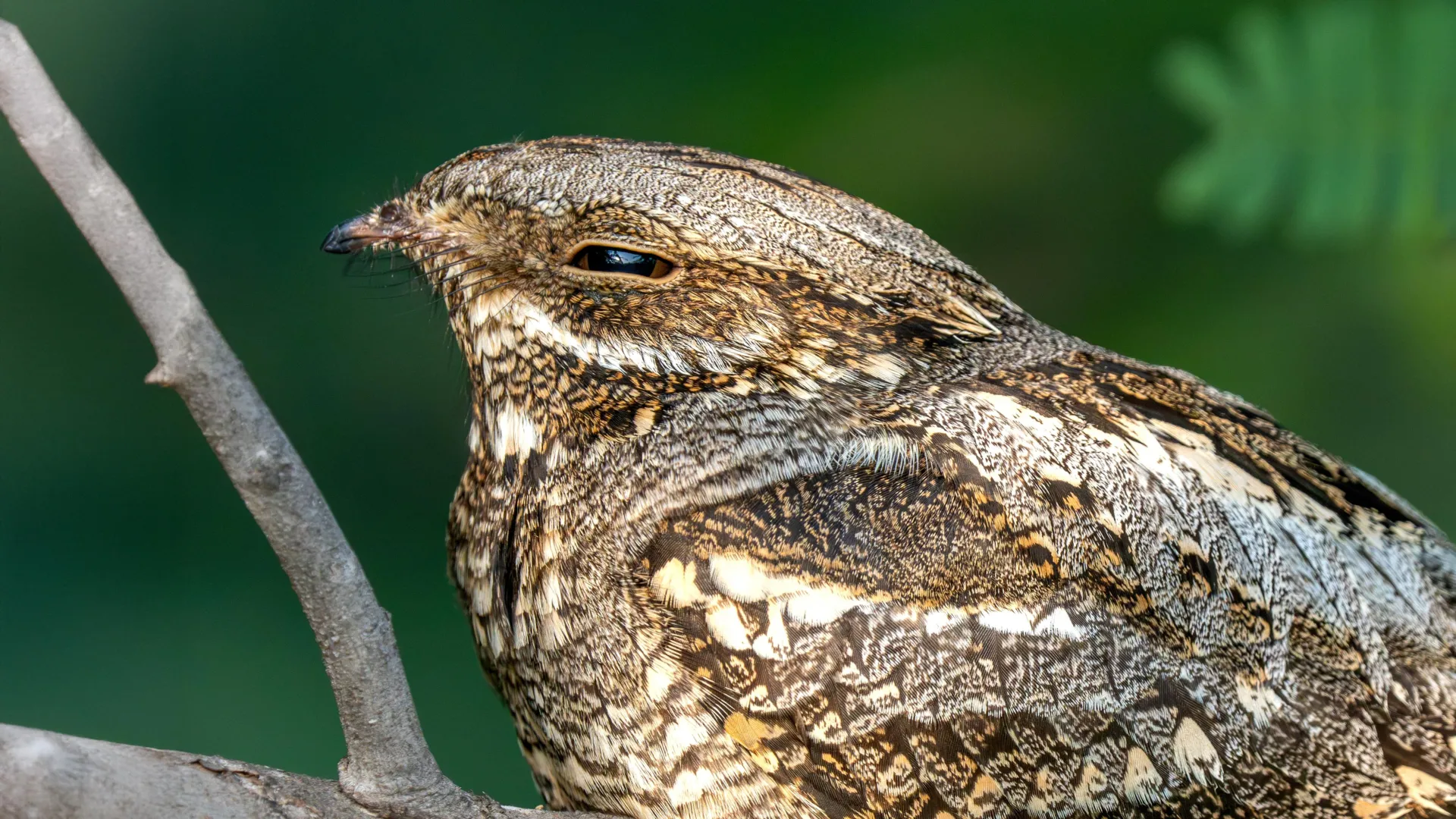
European Nightjars Use a Surprising Wingbeat Trick to Stay Agile in Flight
European nightjars that migrate thousands of miles have revealed surprising secrets about how bird wings work. Scientists have discovered that the nocturnal hunters sacrifice some flight efficiency for agility and use an unexpected flapping technique previously associated mainly with bats and insects.
The European nightjar (Caprimulgus europaeus) is a nocturnal bird that migrates annually between Europe and southern Africa. Its wings must perform two very different jobs: carrying the bird over long distances and helping it catch insects while flying slowly or making sharp turns.
Scientists at Lund University found that these competing demands create significant aerodynamic trade-offs. Although nightjars are capable of long-distance migration, their wings are not fully optimized for efficient flight at high speeds.
Why European nightjar wings trade efficiency for agility
To understand how nightjars fly, researchers studied the birds in wind tunnels. They recorded their movements at different speeds and measured the patterns of airflow that remained behind their wings.
The experiments showed that the nightjar’s wide wingtips may help it maneuver at low speeds, which is useful when hunting insects. However, the same wing shape becomes a disadvantage during faster flight because the lift produced by the wings becomes less efficient. Lift is the aerodynamic force that helps keep a bird airborne.
The finding challenges the assumption that birds capable of long-distance migration must have wings designed primarily for highly efficient flight.
“This goes against the intuitive image of long-distance migratory birds as fully optimized flying machines. Instead, the nightjar’s wings appear to be a compromise between several different requirements. The bird can fly slowly and maneuver while hunting, but at the cost of being less efficient at generating lift at high speeds,” says Associate Professor Christopher Johansson from Lund University.
Nightjars generate thrust during the upstroke
Researchers also identified another unusual feature of nightjar flight. As the birds raise their wings during the upward part of each flap, they continue to generate propulsion—the force that moves them forward.
This is unusual because vigorous upward wing movements, known as upstrokes, have previously been associated mainly with the flight mechanics of bats and insects rather than birds.
The discovery suggests that animals with very different evolutionary histories may have developed similar aerodynamic solutions to the challenges of powered flight.
“What is interesting is that the same type of aerodynamic solution seems to be found in completely different animals. This suggests that the upstroke need not be just a passive or lift-generating part of flapping; it can be actively used to generate propulsion when the wings cannot be folded very much,” says Christopher Johansson.
What nightjar flight reveals about evolution and flying robots
The results offer broader insight into how evolution shapes animals that use the same body structures for multiple activities.
Rather than producing a wing perfectly suited to a single purpose, evolution may favor designs that balance several competing needs. For nightjars, this means combining the ability to migrate between continents with the agility required to hunt insects at low speeds.
Understanding these aerodynamic trade-offs could also contribute to advances in aviation technology, including drones and other robotic aircraft that use flapping wings.
Like birds, these machines may face mechanical limits on how far their wings can fold during each flap. Learning how nightjars generate thrust during the ascent stroke could help engineers develop more effective ways for flapping aircraft to move through the air.
Researchers now hope to determine whether this unusual flight mechanism is common among other birds and flying animals or represents a more specialized adaptation of nightjars.
“We now want to investigate how common this method of force generation is among other birds and flying animals. This could help us understand which aerodynamic principles are unique to nightjars and which are more general. This knowledge could also provide inspiration for the development of new types of flapping aircraft,” concludes Christopher Johansson.
Source: www.sciencedaily.com