


Germany and NVIDIA Partner to Accelerate Industrial AI and Manufacturing
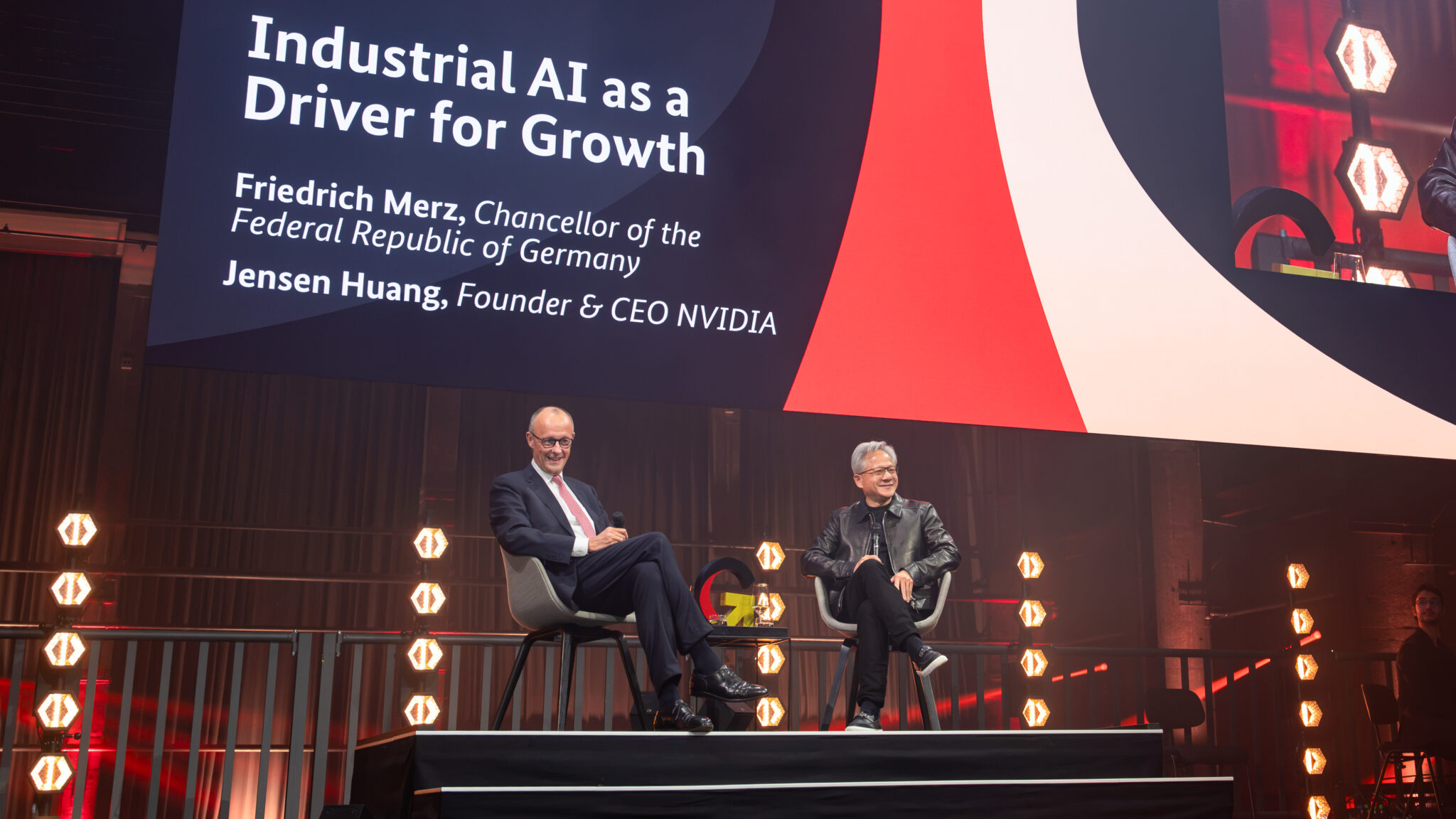
At Berlin’s Kraftwerk, a former power plant, German Chancellor Friedrich Merz and NVIDIA founder and CEO Jensen Huang discussed Germany’s AI roadmap, with a focus on industrial applications, manufacturing and the country’s small and medium-sized businesses.
Huang highlighted NVIDIA’s long-standing relationship with German industry, from gaming systems, workstations and automotive design in the early 2000s to current partnerships in self-driving vehicles and digital twins for manufacturing.
The discussion centered on how Germany can use its strengths in engineering, manufacturing and automotive technology to accelerate AI adoption across its Mittelstand—the country’s network of small and medium-sized businesses.
Germany and NVIDIA formalize industrial AI collaboration
Earlier in the day, as part of the German Investment Summit, Chancellor Merz, the Federal Ministry for Economic Affairs and Energy, and the Federal Ministry for Research, Technology and Space signed a joint declaration of intent with NVIDIA.
The German government aims to combine the country’s traditional engineering and manufacturing expertise with advanced research and AI technology. The declaration includes joint initiatives with NVIDIA to advance AI models for physical AI.
The agreement also formalizes and expands cooperation between NVIDIA and the Industry 4.0 Platform, which includes the German federal government and representatives from politics, industry, research and trade associations.
The collaboration supports the government’s goal of “systematically disseminating industrial AI and establishing a cutting-edge industrial AI ecosystem in Europe.”
How Germany plans to integrate AI into industry
Merz and Huang discussed how industrial AI could help Germany strengthen its economy and maintain its position as a global manufacturing leader.
“We are committed to being one of the most advanced places in the world to work with AI and integrate AI into industry, not just in the European Union but around the world,” Merz said.
Merz said Germany has an opportunity to become a global leader in AI adoption across manufacturing, machinery, the automotive industry and automotive suppliers.
“The biggest advantage in Germany is the so-called Mittelstand,” Merz said. “Open the door for AI to leverage your data. This is the real secret and a huge advantage for Germany to leverage all the data already available within companies.”
Huang praised Germany’s world-class manufacturing expertise, including its network of large and small businesses, as well as the country’s strengths in mathematics and science. He said this national expertise and knowledge gives the German economy a distinct advantage that AI can amplify.
“That knowledge is yours,” Huang said. “You can’t replace it. AI only enhances your capabilities, not replaces them. Leverage technology. It’s a new tool.”
Huang and Merz also discussed Germany’s expertise in physics and how incorporating AI could accelerate economic growth.
“If we succeed in integrating these two aspects and parts of our future business, I am very optimistic that Germany can become one of the most successful economies in the world,” Merz said.
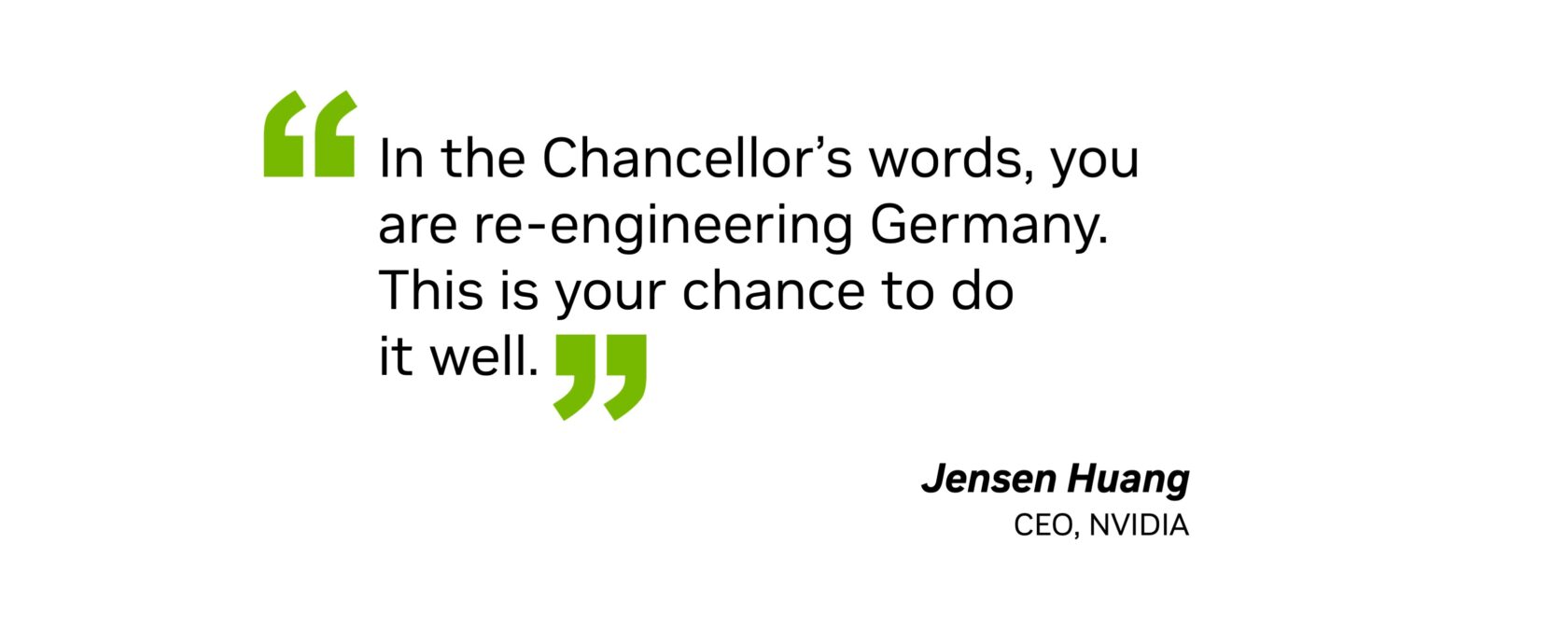
“This industrial revolution is very strong and powerful,” Huang said. “In the Chancellor’s words, you are rebuilding Germany, and this is your chance to do it well.”
Merz said he would like to meet with Huang regularly, at least once a year, to assess Germany’s progress in AI and its position as an investment destination.
“I would like to meet with him on a regular basis, at least once a year, to discuss our progress,” Merz said. “And I would like to see the man sitting in my office very happy with Germany as an investment destination.”
NVIDIA announces investments in four German startups
Huang also announced new investments in four German startups as part of NVIDIA’s approximately $10 billion commitment to support businesses, universities, research institutes and other organizations across Europe.
NVIDIA has already invested across Germany’s startup ecosystem and supported technology companies including n8n, Neural Robotics and Black Forest Research Institute.
Agile Robots
Munich-based Agile Robots develops AI-powered robots for manufacturing, logistics and healthcare. Its products include robotic arms and the Agile ONE humanoid.
Avelios Medical
Avelios Medical is a Munich-based healthcare technology startup that has developed an AI-native hospital information system. The platform serves as a core system of record for clinical and administrative workflows, integrating AI into hospital operations to reduce the burden on doctors and nurses and support patient care.
Mirelo
German startup Mirelo develops AI models that generate sound effects, audio and music for videos. The technology is designed to help creators and production teams produce audio that matches the visuals on screen.
Reflex Aerospace
Berlin-based space scale-up Reflex Aerospace designs and builds high-performance satellites that can be launched in about 12 months instead of years.
Siemens and NVIDIA advance autonomous manufacturing
Earlier in the day, Siemens announced a partnership with NVIDIA to power AI-driven autonomous factories.
At its Erlangen plant, Siemens showcased new AI solutions and promoted the facility as a global blueprint for automated manufacturing. Fully virtual production ramp-up can reduce engineering effort by up to 85%, while agent-based production planning enables more adaptive manufacturing and cost savings of up to 20%.
NVIDIA conducts record-breaking quantum computing simulation
NVIDIA researchers are using JUPITER, Europe’s largest supercomputer at the Jülich Supercomputing Center, to conduct a record-breaking simulation of a fault-tolerant quantum computer.
The 104-qubit simulation is described as the largest and most detailed of its kind to date.
Source: blogs.nvidia.com