


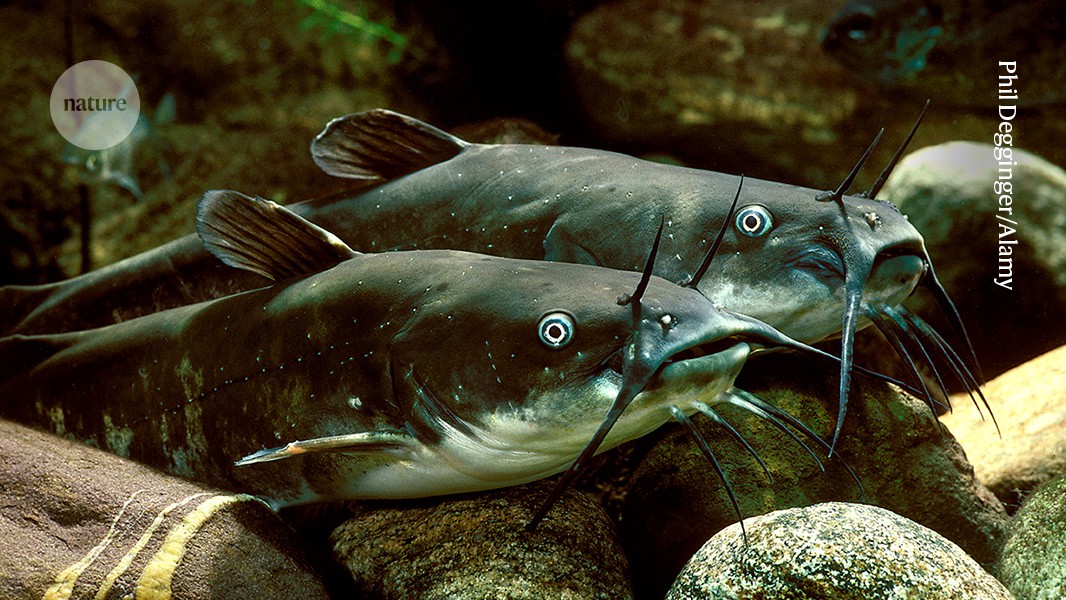
Shocking discovery: Contagious cancer identified in brown bullhead catfish (Ameiurus nebulosus). The infection observed in Lake Memphremagog, Canada, was revealed to be a transmissible form of melanoma.
Credit: Phil Degginger/Alamy
Recent research has unveiled a contagious cancer affecting catfish, marking one of the rare instances of tumor cells transmitting naturally between animals.
This discovery joins a list that includes a sexually transmitted tumor in dogs, two distinct cancer strains impacting Tasmanian devils (Sarcophilus harrisii), and various tumor lineages affecting bivalves like clams and mussels.
The latest findings explain the enigmatic appearance of black skin lesions in brown bullhead catfish (Ameiurus nebulosus), with observations dating back to the 19th century in lakes along the Canada-U.S. border.
Anglers and wildlife biologists first reported seeing these tumors in Lake Memphremagog, which stretches from Newport, Vermont, to Magog, Canada, in 2012. Research later indicated that approximately one-third of the lake’s brown bullhead catfish were affected by these tumors.1
These skin lesions, a type of melanoma, appear pitch-black and sometimes crusty. Some fish exhibit multiple tumors, which can metastasize to the brain, liver, and other organs. Julie Dragon, a data scientist at the University of Vermont and lead author of a today published study in Nature, noted that both young and old fish display these tumors, leaving their health implications uncertain. “There is no significant age discrepancy to suggest a mass die-off,” Dragon adds.
Initially, contamination and viral infection were suspected causes. Dragon and biologists from Vermont found no evidence of viral transmission. Consequently, they expanded their investigation to analyze individual fish genomes for potential cancer-causing DNA mutations, which are prevalent in the lake’s Danube catfish.
Instead of finding mutations, researchers uncovered traits of a contagious tumor. Tumor cells from various fish shared hundreds of thousands of genetic mutations, forming a unique genetic lineage separate from healthy cells in the same individuals. “I never imagined this could happen,” Dragon remarked. “It’s truly astonishing.”

A visibly pitch-black tumor located near the tail of this brown bullhead catfish (Ameiurus nebulosus).
Credit: Vicki S. Blazer/USGS
The Story of the Fish Wives
Biologist Michael Metzger from the Pacific Northwest Research Institute in Seattle expressed his surprise at the discovery of contagious cancer within a freshwater species. His team previously found infectious tumor cells in marine bivalves that survive days in salt water, lending credence to theories of transmission via planktonic cells. However, these cells die immediately in freshwater.3 Metzger speculates that catfish tumors, like those in dogs and Tasmanian devils, could be transmitted through direct contact.
Source: www.nature.com