


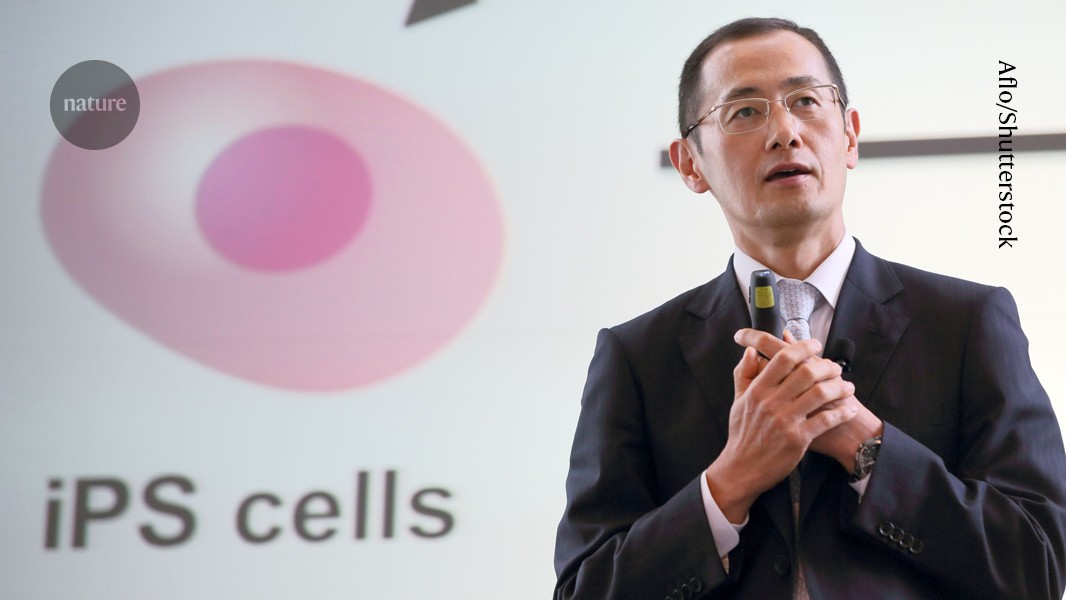
In 2012, Shinya Yamanaka won a share of the Nobel Prize for his work on iPS cells.Credit: Afro/Shutterstock
Shinya Yamanaka does not consider himself a celebrity. Yet when the renowned stem cell researcher runs through Kyoto, Japan, often while training for a marathon, people regularly recognize him.
Many offer words of encouragement and express hope that his research will lead to treatments for families living with serious diseases. “I am very humbled and grateful,” says Professor Yamanaka, who divides his time between Kyoto University and the Gladstone Institute in San Francisco, California.
No need to rush promising stem cell therapies
Some promising stem cell treatments could now be approaching clinical reality. It has been 20 years since the publication of the landmark paper that transformed biomedical research.1 In that study, Yamanaka and his Kyoto University colleague Kazutoshi Takahashi demonstrated how four genes could rewind adult mouse cells to a fetal-like state, erase their specialized identity and reprogram them into induced pluripotent stem cells, commonly known as iPS cells.
The discovery created new possibilities for regenerative medicine. Because iPS cells can potentially be guided into different cell types, they could provide healthy tissue derived from a patient’s own cells to repair damaged or diseased organs. Earlier this year, two iPS cell-based treatments—one for Parkinson’s disease and another for heart failure—received conditional approval in Japan.2 Clinical trials investigating iPS cell therapies are also under way in countries around the world.
The stem cell field is entering a critical phase. As more potential treatments move toward patients, researchers, biotechnology companies and regulators must ensure that iPS cell therapies are tested rigorously, manufactured safely and made available to the people who need them.

Japan’s big bet on stem cell therapy may soon pay off with medical advances
Before the landmark 2006 Cell paper was published, some of Yamanaka’s colleagues questioned his research direction. They suggested that the mouse cells might be interesting but encouraged him to focus on work more directly connected to human disease and medicine, Yamanaka recalled in his Nobel Prize lecture.
Researchers soon replicated the discovery in human cells.3,4 The next challenge was learning how to direct iPS cells into specific cell types that could be used to study disease or develop new treatments.
Deepak Srivastava, a cardiologist and stem cell researcher at the Gladstone Institute, remembers the excitement of seeing his laboratory produce heart cells from iPS cells. At first, however, only about 1% of the cells successfully adopted the new identity. It could take many more years to reliably convert more than 90% of the stem cells into heart cells—enough to beat together and create visible waves in the culture medium.
Other medical applications soon emerged. By creating iPS cells from people with and without particular disorders, scientists have gained insight into the molecular mechanisms that drive disease. Researchers can also use iPS cells to grow organoids, or three-dimensional clusters of cells designed to model aspects of human organs. Pharmaceutical companies are using iPS cell technology to help identify and test treatments for conditions including motor neuron disease, also known as amyotrophic lateral sclerosis.
How have iPS cells changed the world?
Before iPS cell therapies could be tested in people, scientists had to address major safety concerns. Stem cells that have not fully acquired a specialized identity can potentially form tumors. Researchers therefore need to confirm that cells intended for treatment have been completely reprogrammed and that no undifferentiated cells remain. These safety requirements have contributed to the lengthy development timeline for iPS cell therapies, Srivastava says.
As these technical and safety challenges are addressed, researchers are moving ahead with clinical testing. Trials involving potential treatments for conditions such as macular degeneration and diabetes are expected to produce results over the next five years. Scientists are also continuing to monitor the two treatments that received conditional approval in Japan after initial clinical studies focused on safety.
This is an exciting but uncertain period for iPS cell research. The rapidly expanding field creates strong incentives to achieve scientific and clinical breakthroughs first. Although iPS cell therapies could eventually help large numbers of patients, development must remain evidence-based and responsible. Moving too quickly without robust safety standards could cause harm, while a serious incident in one clinical trial could undermine public confidence and delay progress across the entire field.
Clinical trial verifies the safety of stem cell therapy for Parkinson’s disease
Personalized iPS cell therapies made from a patient’s own cells can be too slow, costly and complex to provide at scale. Yamanaka and other researchers are therefore developing “off-the-shelf” approaches, in which iPS cells from a single donor could be used to treat multiple patients. Combined with advances in cell manufacturing, this strategy could lower costs, improve access to regenerative medicine and encourage more companies to develop iPS cell treatments.
After waiting two decades for promising discoveries to reach patients, it can be difficult to move slowly and carefully. But that is the reality of medical research. “Translational research is a marathon, not a sprint,” says Yamanaka, drawing on his experience both as a scientist and a long-distance runner. “Keeping patient interests as your north star will sustain you.”
Source: www.nature.com