


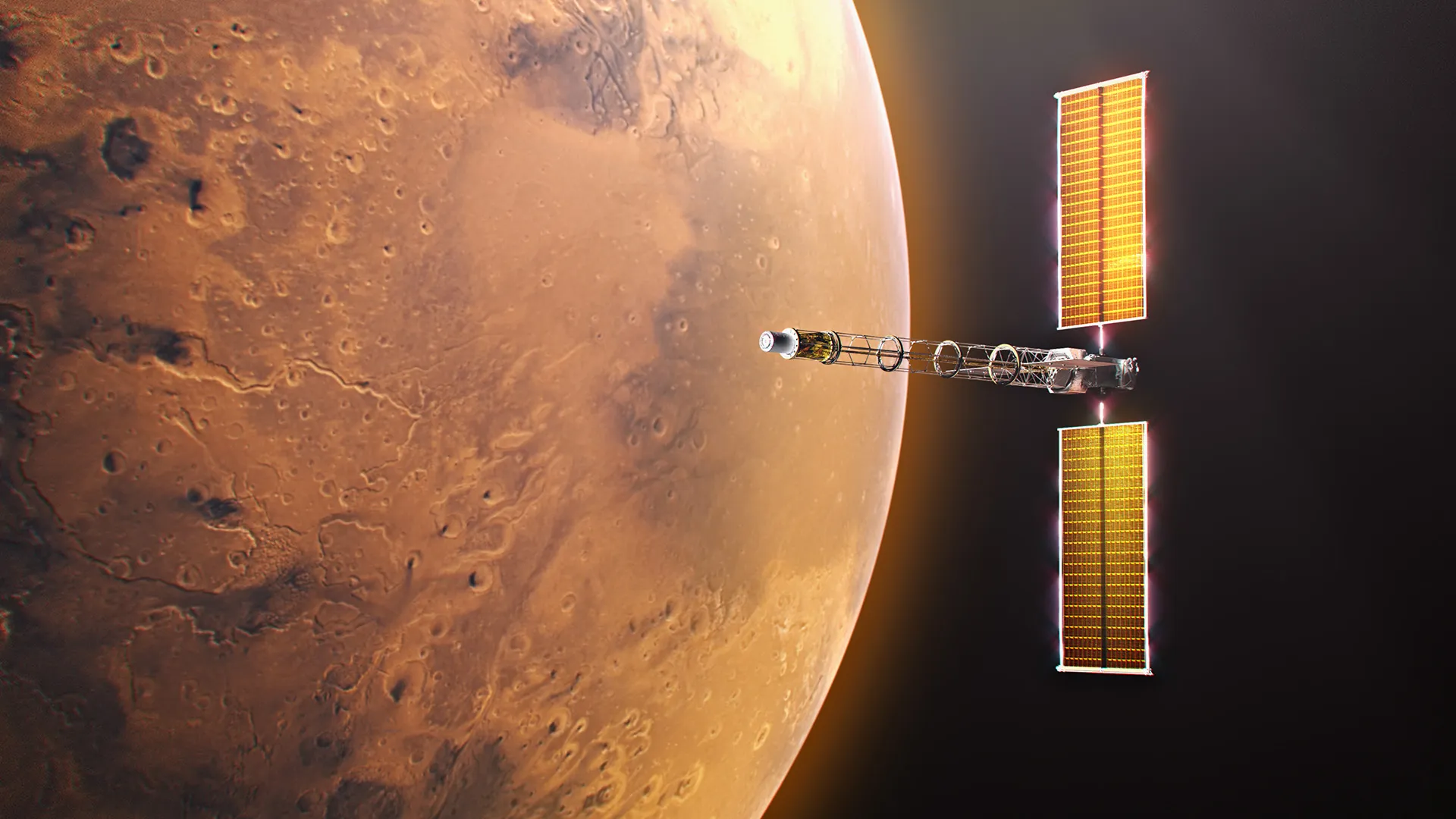
NASA’s SR-1 Freedom to Demonstrate Nuclear-Electric Propulsion Beyond Earth Orbit
NASA’s Space Reactor 1 (SR-1) Freedom is being developed for a mission to Mars and beyond. The spacecraft is expected to become humanity’s first fission-powered spacecraft to travel outside Earth’s orbit, demonstrating nuclear-electric propulsion in deep space.
Announced during NASA’s Ignition event, the mission is advancing with development of the spacecraft’s nuclear module. NASA and its partners have also agreed to significant contractual measures intended to accelerate development and support a planned 2028 launch.
SR-1 Freedom Targets a 2028 Launch
“These contractual actions not only help reduce technical risk and maintain momentum toward a 2028 launch, but also strengthen collaboration between our partners,” said Steve Sinacore, SR-1 Freedom program director. “These actions will ensure that SR-1 Freedom remains in orbit and builds the strongest possible foundation for NASA’s first fission-powered voyage beyond Earth orbit, while developing technology that can scale into a vibrant space nuclear future.”
How the Spacecraft’s Nuclear Power System Will Work
Sierra Robo will provide the nuclear module’s closed Brayton cycle power conversion system. The system will convert thermal energy from a nuclear fission reactor into the electricity required for the SR-1 Freedom nuclear propulsion demonstration.
The work will be performed under the Spaceflight Systems Development and Operations Contract III, awarded in 2024. The contract supports the design, development, testing and operation of spaceflight hardware at NASA’s Glenn Research Center in Cleveland.
The power conversion system will be integrated with a nuclear fission reactor designed and developed by the Department of Energy’s (DOE) Idaho National Laboratory. Together, these systems will form the SR-1 Freedom nuclear module.
NASA and DOE Plan Extensive Nuclear Safety Measures
NASA and DOE have incorporated extensive safety standards into the design and development of the SR-1 Freedom spacecraft. These measures include interagency safety reviews, ongoing oversight by the NASA Chief Safety Officer and a rigorous safety process focused on regulatory compliance, hazards, fault tolerance and nuclear safety.
The reactor portion of SR-1 Freedom will remain shut down until the spacecraft has left Earth orbit.
Mission Will Support Mars Exploration and Future Lunar Operations
SR-1 Freedom is scheduled for release in the second half of 2028. During the science mission, a team of three Mars helicopters evolved from Ingenuity’s design will collect scientific data, demonstrate exploration zones and identify potential water sources.
The mission is intended to advance deep-space exploration and support the next generation of nuclear fission power systems. These systems are designed to help keep NASA’s lunar base operating during periods of darkness and in locations where solar power alone is insufficient.
For more information on SR-1 Freedom, please see below.
Source: www.nasa.gov