


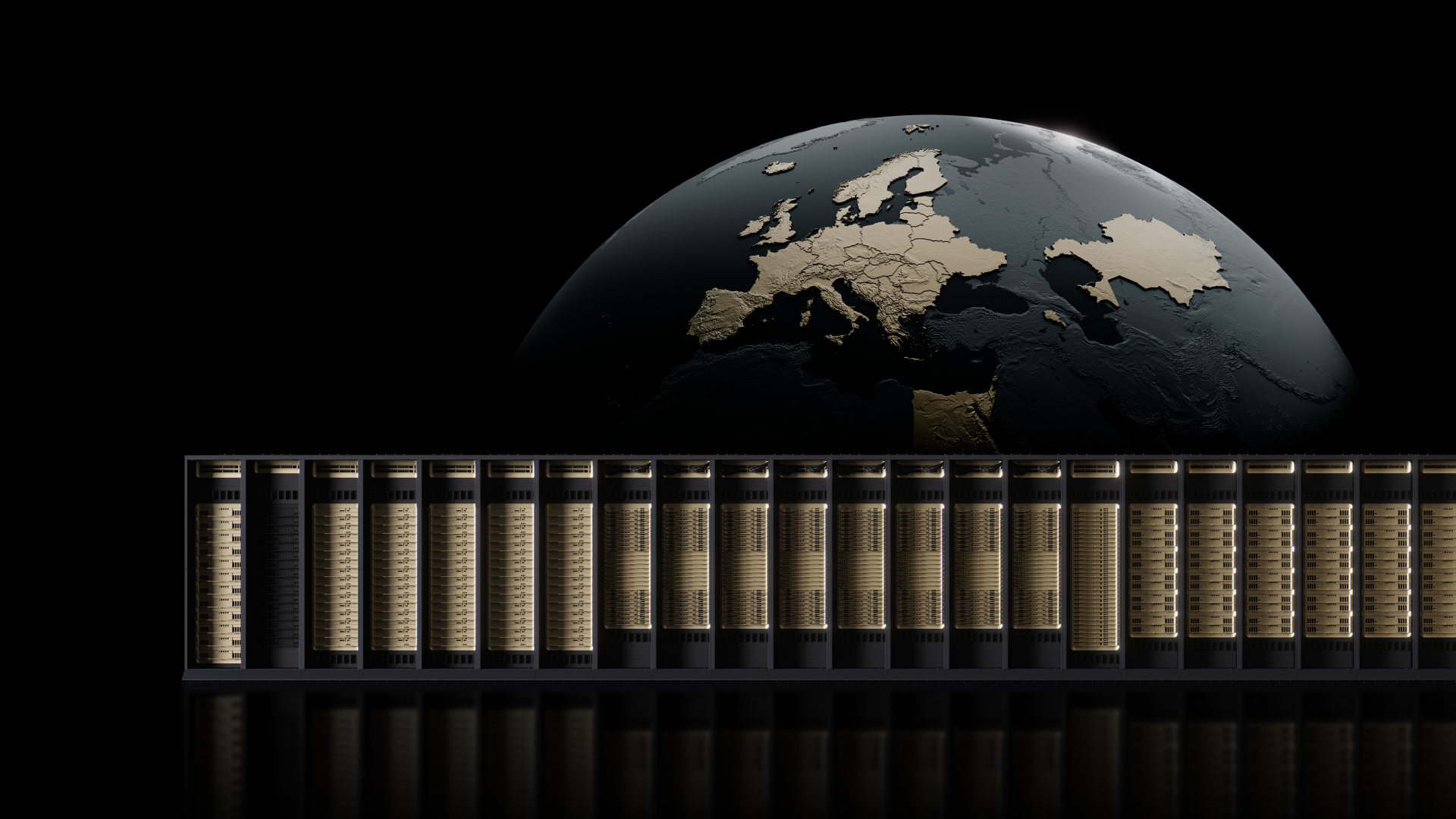
NVIDIA Expands Sovereign, Open and Secure AI Cloud Infrastructure Across Europe
Demand from AI-native companies is accelerating the European AI cloud ecosystem. Developers need compute close to their data, open models that can be customized and deployed at scale, and full-stack infrastructure designed with security in mind.
Through its NVIDIA Cloud Partner ecosystem, NVIDIA is expanding regional computing capacity across Europe, Northern Europe, Africa and Central Asia. The effort is helping developers build AI agents and physical AI applications while establishing clear boundaries around what agents can access and do.
Together, these efforts are turning Europe’s energy, data, research and industrial expertise into productive intelligence. They are supporting new models, applications, organizations and jobs while giving people greater control over where and how they develop and deploy AI.
Sovereign AI cloud infrastructure for Europe
Europe is home to world-class research, engineering talent, industrial expertise, data and next-generation AI models. Regional AI clouds provide the infrastructure foundation that model builders, businesses and industries need to grow while keeping computing close to the knowledge and data they rely on.
As AI factories scale, power is becoming a critical constraint. Improving efficiency and making every watt count can help operators produce more intelligence within existing power budgets.
Nscale improves AI inference efficiency with NVIDIA DSX
Nscale is using the NVIDIA DSX Platform to adjust power allocation to workload requirements. In testing with an NVIDIA GB300 NVL72 system, Nscale demonstrated that NVIDIA DSX MaxLPS enabled 37% more GPUs and nearly 50% higher total inference throughput within the same provisioned power budget.
Nscale also plans to deploy NVIDIA Vera Rubin infrastructure for frontier model training and production workloads. The vertically integrated platform will support leading model and application builders across five European markets.
Crusoe brings AI cloud capacity closer to European users
Crusoe is developing Spark, a water-cooled modular AI factory designed for the NVIDIA Vera Rubin platform. The system is intended to bring Crusoe Cloud capacity closer to users and support low-latency AI inference. Crusoe Cloud serves leading model and application builders across EMEA.
Across Europe, Northern Europe, Africa and Central Asia, NVIDIA-powered infrastructure is also being developed and scaled by Alleria, Cassava Technologies, Firebird, G42, Shining, SWI Computing and Bartol.
Regional AI cloud capacity combines the full-stack NVIDIA DSX AI Factory Platform, NVIDIA Vera Rubin infrastructure, NVIDIA BlueField and NVIDIA Spectrum-X Ethernet networking.
This approach gives customers greater choice and control over where their workloads and data reside. It also supports sovereign computing services and economic growth throughout the region.
Open AI models and libraries for training, customization and inference
NVIDIA is expanding AI cloud infrastructure and services to help developers build applications with open models and libraries. The new capabilities support model training, specialized task fine-tuning, large-scale inference and edge-deployed applications.
Nebius supports production reasoning and physical AI
For production reasoning, Nebius has employed NVIDIA Groq 3 LPX and integrated it with Vera Rubin NVL72 systems using Spectrum-X Ethernet networking. The resulting token factory is designed to accelerate token generation for latency-sensitive applications and AI agent systems through managed serverless and dedicated endpoints, along with familiar application programming interfaces.
For robotics and physical AI, Nebius offers purpose-built AI cloud solutions, including the full-stack Physical AI Workbench. The platform supports robotics companies such as Loader AI, Roboforce and Celeact. Nebius has also launched three NVIDIA retail agent blueprints covering inventory, store operations and fine-tuning, with early access to Nebius infrastructure.
Nebius is expanding its cloud services across the continent through its Physical AI Living Lab. In Germany, it is also a computer supplier to the Federal Agency for Breakthrough Innovation, SPRIND’s Next Frontier Challenge.
Baseten and CodeRabbit improve specialized AI performance
Baseten developed a model for code review routing using Nemotron 3.5 Lightning. Through supervised fine-tuning and reinforcement learning, CodeRabbit improved routing-match performance from 75.8% to 80.7%. The estimated inference cost for the evaluated workload was reduced by 50%.
The results demonstrate how AI developers can customize NVIDIA Open Models for specialized tasks while improving accuracy and inference efficiency.
Fireworks and Era4 expand open model access
Fireworks and Era4 have partnered to offer an open model to businesses across the UK and Europe. The collaboration combines Fireworks’ model training and inference platform with direct water cooling powered by NVIDIA Blackwell Ultra GPUs.
Era4’s facility in Chesterfield supports the development of enterprise AI solutions for financial services, insurance and life sciences.
Mistral expands NVIDIA-accelerated AI infrastructure
Mistral is expanding its NVIDIA-accelerated computing infrastructure for model training, customization and inference. The expansion includes NVIDIA Vera Rubin infrastructure, scheduled for availability in 2027.
Mistral Large 4, the company’s latest frontier multimodal model, was trained on 3,800 NVIDIA Grace Blackwell GPUs. The model advances capabilities in coding, agent workflows and multimodal understanding through Mistral’s European data centers.
Open-weight models and inference optimization
Belda plans to introduce NVIDIA Vera Rubin infrastructure while continuing to advance its open-weight model strategy. The company is also working with NVIDIA Nemotron and NVIDIA Cosmos.
Already in production, NVIDIA Dynamo is an open-source framework designed to optimize inference.
Secure AI agent deployment from silicon to software
As developers connect AI models to tools and business systems, they need stronger control over what agents can access and do. NVIDIA is addressing this requirement with a security architecture that spans infrastructure, runtime software and silicon-level enforcement.
Announced at GTC Berlin, the NVIDIA OpenShell Reference Architecture was developed with support from AI cloud ecosystem partners. It is built on NVIDIA OpenShell, a secure runtime software architecture designed to give organizations full-stack control when deploying AI agents.
The architecture establishes clear boundaries around what agents can access and do. NVIDIA Vera Rubin NVL72 provides model inference, while NVIDIA Vera CPU supports the system. OpenShell provides the agent harness and tooling, and an NVIDIA BlueField-4 DPU running NVIDIA Sentry enables in-silicon enforcement.
Each component has a distinct role in maintaining control. Together, they are designed to help agents achieve their intended goals without exceeding the boundaries established by the organization deploying them.
Partners supporting the OpenShell reference architecture include Alleria, Baseten, Cassava Technologies, CoreWeave, Crusoe, DigitalOcean, Firebird, Fireworks, Solid, G42, GMI Cloud, Airen, Lambda, Lightning AI, Nebius, Nscale, Radiant, Belda and Bartol.
Building Europe’s AI cloud ecosystem
The European AI cloud ecosystem combines regional infrastructure investment with the tools required to build and deploy AI. Expanding capacity gives developers more room to run demanding workloads. Model and inference services help them use that computing power, while agent controls help manage what applications can do in production.
Explore NVIDIA Cloud Partner infrastructure and services and the NVIDIA OpenShell Reference Architecture for secure AI agent deployment control.
Source: blogs.nvidia.com