


Herrerasaurid Dinosaur Fossil in Brazil Reveals Survival After Triassic Ecosystem Change
A single pubic bone discovered in southern Brazil suggests that herrerasaurids—among the earliest large carnivorous dinosaurs—survived even after major changes reshaped the surrounding Late Triassic fauna.
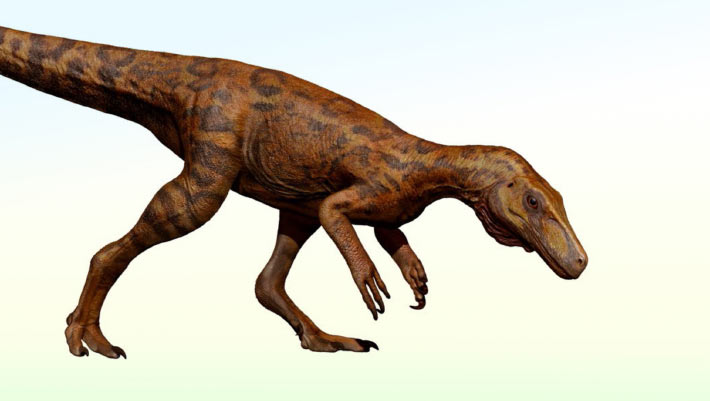
An artistic representation of a living herrerasaurid dinosaur. Image credit: Johnny Pauly V. Mingau.
Early carnivorous dinosaurs from the Late Triassic
Herrerasaurid dinosaurs lived during the Carnian period of the Late Triassic, approximately 230 million years ago.
They were bipedal predators equipped with serrated teeth and large claws. Some species grew to more than 5 m (16 ft) long.
The group is known only from South America, based on fossils discovered in Argentina and Brazil.
A fossil from a changing ecosystem
Until now, herrerasaurids from both countries had been found only in rock formations dominated by rhynchosaurs, stocky plant-eating reptiles.
In younger fossil assemblages, pig-sized traversodontid cynodonts—distant relatives of mammals—became more abundant, while rhynchosaurs declined. This change raised the possibility that herrerasaurids disappeared when the composition of the fauna changed.
“There are no records of herrerasaurids from geological formations characterized by abundant traversodontid cynodonts. It may reflect changes in the fauna that ultimately prevented the survival of the group,” said Dr. Rodrigo Temp Müller, a paleontologist at the Federal University of Santa Maria.
“For example, if herrerasaurids were ecologically specialized to prey on rhynchosaurs, the decline of these herbivores may have had a negative impact on their survival.”
However, rhynchosaurs were fewer in the younger communities but were not entirely absent. “Thus, this alone may not be sufficient to explain the apparent absence of herrerasaurids in these deposits,” the researcher said.
First herrerasaurid found in a cynodont-rich formation
For the study, Dr. Müller examined fragments of the pubic bone, part of the dinosaur’s hip, recovered near the town of Agudo in Rio Grande do Sul, Brazil.
Cataloged as CAPPA/UFSM 0539, the fossil represents the first herrerasaurid discovered in a rock formation where traversodontid cynodonts are abundant.
“The specimens were collected from the Várzea do Agudo fossil site in the municipality of Agudo, Rio Grande do Sul, Brazil,” Dr. Müller said.
“The fossil-bearing strata at this site belong to the Santa Maria Formation of the Paraná Basin.”
What the discovery reveals about herrerasaurid survival
The researchers suggest that herrerasaurids may have been adaptable enough to survive in ecosystems that differed from those where they were previously known. The dinosaurs may also have remained among the top predators in these environments.
The fossil could represent the youngest known herrerasaurid, but that conclusion depends on confirming that the Brazilian rocks are younger than the formations containing other herrerasaurids, including those in Argentina.
“Absolute dating of Brazilian strata remains essential to establish a more reliable chronological framework for the different regions where Triassic fossils occur,” the researchers said.
The study was published on October 19, 2026, in Die Naturwissenschaften.
_____
Müller, R.T. 2026. The first herrerasaurid dinosaur discovered in a fauna dominated by traversodontid cynodonts from the Late Triassic of southern Brazil. Die Naturwissenschaften 113, 133. doi: 10.1007/s00114-026-02185-1
Source: www.sci.news